A new family entertainment center is financed as a business system, not a collection of equipment purchases. Attraction mix, facility plans, installation, opening needs, and early operating assumptions all affect how much capital the project may require and which financing route deserves consideration.
Request a design and consultation conversation for your FEC new build.
FEC equipment financing helps a new-build operator acquire and install business equipment while planning repayment around ownership, leasing structure, working capital, and the venue’s broader feasibility. The right approach depends on the project scope and lender review, so prepare the equipment plan and financial model before comparing offers.
Amusement Products can help connect attraction selection and project planning to a financing-ready plan through design and consultation. Start by clarifying what financing covers, who owns the equipment, and how those choices fit the build.
What Is FEC Equipment Financing?
FEC equipment financing is a way to acquire the attractions and operating equipment required for a new family entertainment center while spreading the purchase obligation over time. For a ground-up project, that decision sits alongside facility planning, attraction selection, installation, staffing, and working-capital planning. The right structure depends on what the business needs to own, how long the equipment should remain in service, and how replacement decisions fit the broader operating plan.
Financing usually leads to ownership
With traditional equipment financing, the business purchases the equipment and makes scheduled payments under its financing agreement. The operator generally owns the equipment during and after those payments, subject to the specific agreement and any security interest. Ownership can matter for a new FEC because attractions are part of the venue’s long-term operating platform. The owner can plan maintenance, upgrades, relocation, and eventual replacement without treating the equipment as someone else’s asset.
That approach also requires disciplined planning. Equipment should be selected for the facility, guest flow, expected use, service needs, and operating model, rather than financed as an isolated purchase. The U.S. Small Business Administration advises businesses to identify the assets they need and then decide how to acquire them. Review the SBA’s equipment acquisition guidance for general planning context, not individualized lending advice.
Leasing changes the ownership and replacement question
With a lease, the lender or leasing company owns the equipment while the FEC pays for its use. Some lease structures may include maintenance or make it easier to replace equipment at the end of the agreement, but the details vary. An operating lease is generally associated with replacing equipment at the end of the lease term. A capital lease may be structured for a business that expects to take ownership.
Leasing can be useful when a project needs substantial equipment quickly or wants flexibility around the equipment lifecycle. However, the lifetime cost and end-of-lease responsibilities need careful review. For a new build, compare ownership, maintenance responsibility, replacement timing, and operational continuity before choosing a route. Financing should support a viable FEC plan, not substitute for one.
How Should You Scope Financing for a New FEC Build?
Financing conversations are more productive when the project is defined before the funding route is selected. For a ground-up venue, equipment is only one part of the plan. Facility requirements, attraction mix, site conditions, construction needs, opening support, and operating reserves all affect the amount and structure of capital the project may require.
- Define the facility and attraction scope. Start with the proposed location, building size, guest capacity, traffic flow, utilities, safety requirements, and attraction mix. Separate equipment that is essential to opening from additions that can wait until demand is demonstrated. The FEC equipment planning guide can help organize attraction, facility, supplier, and operations questions before they become lender questions.
- Document the acquisition decisions. Create a schedule of equipment and related project assets, then identify whether each item is expected to be purchased, financed, leased, or included in another construction package. The U.S. Small Business Administration advises businesses to identify needed assets and decide how to acquire them. That distinction matters because ownership, maintenance, replacement, and installation responsibilities can differ by arrangement. Review the SBA equipment guidance alongside your project assumptions.
- Test the site and concept through feasibility work. Validate demographics, competition, access, permitting considerations, attraction capacity, staffing, and operating constraints. For a go-kart component, use the site’s FEC project feasibility planning resource to keep site selection, design, safety, and opening readiness connected to the equipment scope.
- Build an operating pro forma. Model expected attendance, utilization, seasonality, attraction revenue, staffing, maintenance, insurance, utilities, marketing, and other recurring obligations. Keep assumptions visible and test conservative, expected, and stronger operating cases. A lender should be able to see how the proposed attraction mix supports the broader business, not just how individual equipment performs.
- Assemble lender-ready documentation. Bring the site information, plans, equipment schedule, supplier proposals, construction assumptions, ownership structure, operating plan, management experience, and pro forma together in one organized package. Highlight open decisions rather than disguising them. Then ask lenders which documents, eligibility factors, collateral questions, and repayment assumptions apply to the route under consideration. Financing is a planning decision, not a promise of approval.
This sequence also gives your equipment manufacturer, distributor, or service provider a clearer basis for discussing layouts, installation, and long-term support. A stronger connection between the facility plan, attraction choices, and operating model makes it easier to compare financing routes without losing sight of how the FEC will actually run.
Which Financing Paths Should FEC Builders Compare?
New FEC projects rarely fit a single financing conversation. The right comparison starts with what the business needs to own, what it needs to use, and how each commitment fits the broader facility and operating plan. Lender eligibility, documentation, and structure vary, so treat these routes as planning categories rather than guaranteed offers.
| Route | Ownership | Useful fit | Questions to ask | Planning tradeoffs |
|---|---|---|---|---|
| Equipment financing | The business purchases and owns the equipment, subject to the financing arrangement. | A defined equipment package where long-term ownership supports the operating plan. | Which assets are included? How are installation, delivery, maintenance, and replacement handled? | Ownership can support control over the asset, but the equipment commitment must fit the project cash-flow model. |
| Leasing | The lender or lessor owns the equipment while the business pays for its use. Some structures may provide an ownership path. | A project that needs equipment in place while preserving more flexibility around acquisition and replacement. | Is the structure operating or capital? What happens at the end, and who handles maintenance? | Leasing may require less cash or credit upfront, but terms differ and lifetime cost is normally higher than buying, according to the SBA’s equipment guidance. |
| SBA-related funding | Ownership depends on the approved loan and project structure. | A broader business plan that may combine equipment, real estate improvements, and working capital. | Does the business and project meet the program and lender’s eligibility review? Which uses are documented? | The SBA 7(a) program identifies equipment, real estate improvements, and working capital as possible uses, but eligibility and approval are not automatic. |
| Mixed project funding | Ownership may differ across equipment, building improvements, and other project components. | A ground-up venue with several capital needs that do not share the same acquisition or lifecycle profile. | Which route belongs to each asset? How will obligations interact with ramp-up, maintenance, and replacement planning? | Separate structures may better match assets to their use, but they also add coordination, documentation, and monitoring requirements. |
Build the comparison from an itemized equipment scope, facility plan, and realistic pro forma. Then ask prospective lenders to explain how they would evaluate the same assumptions. That process helps distinguish a workable financing path from a structure that only looks attractive when the project is viewed in isolation.
What Should a Lender See in Your FEC Project Plan?
A lender should be able to follow the connection between your site, attraction mix, guest demand, operating plan, and repayment assumptions. A polished project plan is more than an equipment list. It shows why each major decision belongs in the build and how the venue is expected to operate once open.
Feasibility, site, and attraction scope
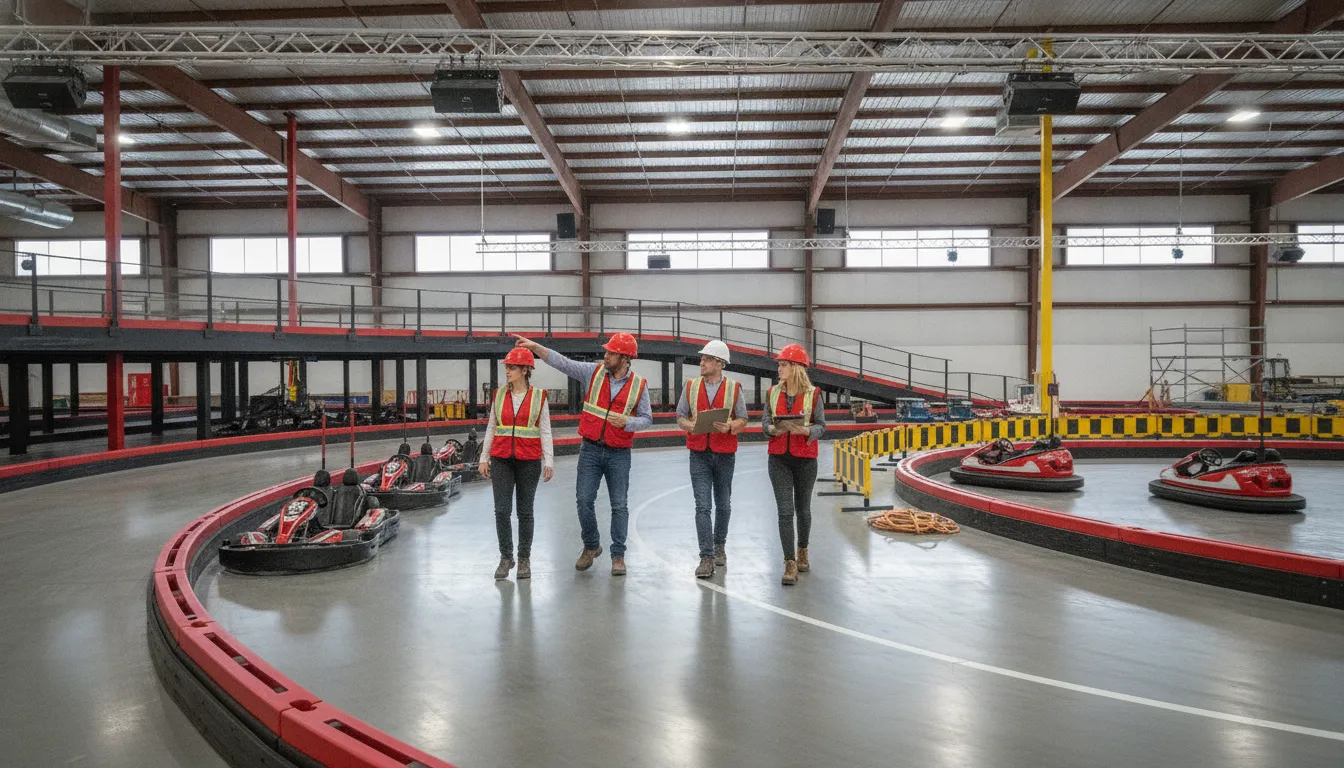
Start with the site and the customer experience. Explain the market area, access, visibility, surrounding competition, facility size, planned traffic flow, and the attractions that fit the available space. Show which equipment is essential to the opening concept and which additions could be phased later. Include layouts or planning drawings that make capacity, queue areas, safety zones, storage, service access, and staff positions easy to understand.
That scope should connect to documented feasibility work, not just enthusiasm for a concept. Amusement Products says its consultation process can include site evaluation, feasibility analysis, demographic and competition analysis, ROI projections, and financial modeling. A lender can use that work as context for reviewing your assumptions. For a broader planning framework, see this FEC attraction revenue modeling guide.
Pro forma, operations, and supporting documents
Your pro forma should explain the assumptions behind attendance, utilization, attraction revenue, ancillary sales, staffing, maintenance, insurance, utilities, marketing, and ramp-up. Tie those assumptions to capacity and operating schedules. Make clear which inputs are estimates, which are supported by market research, and which still require validation.
Include an equipment schedule, vendor or manufacturer information, construction scope, permits, insurance considerations, operating procedures, staffing plan, launch milestones, and a working-capital plan. The goal is to show that the project can be managed beyond opening day, including maintenance and replacement planning.
Match the request to the funding purpose
Use the funding purpose to frame the request.
If you are evaluating an SBA 7(a) structure, the SBA lists machinery and equipment purchase and installation, real estate acquisition or improvement, and short- and long-term working capital among potential uses. Eligibility is separately reviewed and can depend on factors such as business activity, credit history, operating location, size, and demonstrated repayment ability. Review the SBA 7(a) loan guidance and ask an eligible lender how those rules apply to your project. Present each requested use clearly, without assuming approval or a specific structure.
How Can FEC Equipment Financing Support Cash-Flow Planning?
Financing decisions should be evaluated alongside the operating plan, not treated as a separate paperwork step. For an FEC, the equipment mix affects opening readiness, staffing, maintenance planning, guest capacity, and the pace at which revenue assumptions can develop. A useful financing review therefore asks whether the proposed structure fits the project timeline and leaves the business prepared to operate through its ramp-up period.
Match ownership decisions to the equipment lifecycle
With equipment financing, the business purchases the equipment and maintains ownership during and after the payments are made. That may support a longer-term asset plan when the attraction is expected to remain part of the venue for years. Leasing creates a different relationship because the lender owns the equipment while the business pays for its use. Some lease structures are designed around taking ownership later, while others may fit an operator planning to replace equipment at the end of the term. Review the ownership, end-of-term, maintenance, and replacement provisions before comparing monthly obligations.
This distinction matters when building a cash-flow model. Ownership can make future replacement a separate planning responsibility, while a replacement-oriented lease may align more closely with a planned refresh cycle. Neither approach is automatically right for every FEC. The useful question is whether the structure matches the attraction’s expected operating life, service needs, and long-term site plan.
Protect working capital during the ramp-up period
New venues may need working capital for staffing, marketing, training, utilities, maintenance, and operating adjustments while attendance patterns become clearer. The payment assumptions in the model should be tested against conservative ramp-up scenarios rather than a best-case opening forecast. SBA guidance notes that some 7(a) loans can support short- and long-term working capital, but eligibility and repayment ability depend on the specific business and lender review. Read the SBA 7(a) guidance for general information, not personalized financial advice.
Finally, connect maintenance reserves and eventual replacement planning to the attractions being considered. Reviewing current FEC attraction investment priorities can help operators think through flexibility, guest flow, and how the equipment plan may need to evolve as the venue matures.
What Questions Should You Ask Before Choosing a Financing Route?
Before comparing financing routes, make sure you understand what each structure means for your FEC after the paperwork is signed. Lender criteria vary, and a route that fits one project may not fit another. Use these questions to keep the discussion tied to ownership, operations, and the actual scope of your venue.
- Who owns the equipment during the agreement and when does ownership transfer? Equipment financing generally means the business purchases and owns the equipment, while a lease typically leaves ownership with the lender. Ask whether there is a purchase option, transfer condition, or replacement expectation at the end of the term. The SBA notes that lease structures differ, so review the specific offer rather than relying on a label alone.
- What maintenance responsibilities are included? Clarify who handles preventive maintenance, repairs, parts, inspections, and service coordination. Ask whether support applies to the attraction itself, related systems, installation, or only defined components. Confirm how downtime is handled during the operating season.
- What eligibility and documentation standards apply? Ask which financial statements, projections, ownership documents, site details, permits, business history, and credit information the lender will review. If you are considering an SBA-related route, review the current 7(a) eligibility factors and permitted uses, then confirm requirements directly with the lender. Eligibility is not universal, especially for a new-build project.
- How will repayment assumptions be tested? Discuss how the lender evaluates ramp-up, seasonality, utilization, working capital, and cash flow before the FEC reaches steady operations. Ask which assumptions must be supported by a pro forma and what happens if opening or revenue timing changes. Avoid building a plan around an assumed approval or performance outcome.
- Does the route fit the complete project? Confirm whether the structure can address only equipment or also installation, facility improvements, and other eligible project needs. Separate equipment decisions from site and construction obligations so one financing choice does not leave a gap in the opening plan. A supplier-evaluation review can also help you evaluate FEC equipment suppliers for support and integration.
Bring the answers into one documented project plan. That makes gaps easier to identify before you commit to a structure.
Request a design and consultation conversation for your FEC project.
How Does Amusement Products Help With Financing-Ready Planning?
Financing-ready planning starts before an operator speaks with a lender. The project needs a clear scope, a defensible operating concept, and documentation that connects the facility, attractions, construction requirements, and expected business activity. Amusement Products supports that preparation as a manufacturer, distributor, and service provider for family entertainment centers.
Design and feasibility support
Amusement Products’ design and consultation process can help define the physical and operational plan for a new FEC. The design team develops custom layouts for individual attractions and complete facilities. While the consultation process may include site evaluation, feasibility analysis, demographic and competition analysis, ROI projections, and financial modeling. These steps help an owner test whether the proposed attraction mix fits the site, audience, traffic flow, staffing plan, and operating concept before equipment decisions are finalized.
That information can also make a lender discussion more productive. Instead of presenting an equipment list in isolation, the operator can explain why each major component belongs in the project. How it fits the facility, and which assumptions still require validation. The financial model and pro forma should remain the owner’s working documents and should be reviewed with qualified financial and lending professionals.
Education and financing connections
Through the FEC Success Institute, Amusement Products addresses financial planning, pro forma development, banking relationships, SBA programs, and ROI calculations. The education also covers construction planning, contractor selection, staffing, insurance, legal considerations, and cost control, all of which can affect a new-build plan.
Amusement Products can also help operators explore financing options through its financing-partner network. This is a connection point, not a promise of approval or a substitute for lender underwriting. Partner availability, eligibility, structure, documentation, and terms depend on the project and the financing source. The strongest use of this support is to arrive with a coherent plan, realistic assumptions, and clear questions about how equipment and broader project needs may be funded.
Frequently Asked Questions
What is an equipment financing loan?
An equipment financing loan is used to purchase business equipment while spreading repayment over time. With this structure, the business generally owns the equipment during and after the payments. Unlike a lease in which the lender owns the equipment and charges for its use. Review ownership, maintenance, security, and end-of-term provisions before choosing a structure. The SBA explains the distinction between financing and leasing.
How hard is it to get equipment financing for a new FEC?
Approval depends on the lender and the strength of the project information, so no universal answer applies. Prepare a clear equipment scope, site and construction plan, pro forma, operating assumptions, and repayment analysis. For SBA 7(a) financing, the SBA identifies factors including the business activity, credit history, operating location, creditworthiness, and reasonable repayment ability. Review the SBA’s eligibility guidance and confirm requirements directly with a qualified lender.
What are the main financing paths to compare?
Compare equipment financing, leasing, SBA-related funding, and a mixed project structure. Financing may fit equipment you intend to own, while leasing may fit a replacement cycle or a need to deploy equipment quickly. SBA 7(a) proceeds may be used for machinery and equipment, real estate, and working capital, subject to program requirements. The right route depends on the full build, ownership goals, cash-flow plan, and lender review.
What should I prepare before talking with a lender?
Bring an attraction and equipment list, facility details, construction assumptions, market and feasibility work. Operating model, pro forma, working-capital plan, and questions about ownership, maintenance, collateral, repayment, and documentation. A financing conversation is more productive when the equipment scope is connected to traffic flow. Revenue assumptions, staffing, and long-term operations rather than presented as a standalone shopping list.
Ready to Plan Your FEC New Build?
A financing conversation is more useful when it starts with a clear equipment scope, facility plan, and operating model. Amusement Products can help you discuss how your attraction mix and project goals fit into a practical design and consultation process.
Request a design and consultation conversation
Use the conversation to review your FEC new-build equipment needs and financing plan before final decisions are made.