Choosing equipment for a family entertainment center is an operating decision, not simply a product-selection exercise. The right supplier should help you match attractions to your site, audience, staffing model, throughput goals, maintenance plan, and future expansion.
A practical fec equipment manufacturers evaluation guide starts with safety documentation, model-specific training, installation ownership, warranty terms, parts access, service responsiveness, and evidence that the manufacturer understands FEC operations.
Evaluate each manufacturer against the same questions, then look beyond the equipment itself. A provider that can contribute to layout, capacity planning, construction documentation, training, and ongoing support may reduce handoff problems as your project moves from concept to daily operation. Before comparing broader capabilities, begin with the documentation and compliance questions that help establish whether a supplier is prepared to support a safe, maintainable installation.
Explore FEC design and consultation for your equipment plan
What Certifications Should an FEC Equipment Manufacturer Have?
There is no single certification that applies to every attraction, every installation, or every jurisdiction. A stronger question is whether the manufacturer can show how its equipment is designed, tested, documented, installed, and operated for your specific site. Your local authority, insurer, and permitting process may establish additional requirements, so evaluate the supplier’s evidence alongside the rules that govern your facility.
Start by asking for documentation tied to the exact model and configuration under consideration. Depending on the attraction, that may include applicable standards references, design or manufacturing compliance records, developmental and installation testing procedures, operational testing procedures, and nondestructive testing procedures. For example, California regulations identify manufacturer-originated documentation and testing records among the records facility owners or operators must maintain for permanent amusement rides. Massachusetts regulations address design, construction, inspection, and operation of amusement devices. Those examples illustrate why compliance is jurisdiction-specific, not a universal checklist. See the Massachusetts amusement-device regulations and California documentation requirements for the applicable language.
Look for model-specific operating information
Generic sales material is not enough for an attraction that will run repeatedly with guests and staff. Request a current manual for the model, installation, controls, safety devices, operating limits, inspection points, cleaning procedures, and maintenance intervals. Ask whether updates are issued when equipment or procedures change, and how the operator receives them. Documentation should help a supervisor train a new team member and help a technician identify a problem without guessing.
Confirm training and site-compliance support
Ask who trains operators, what training materials are included, and whether the supplier supports commissioning after installation. Clarify which responsibilities belong to the manufacturer, installer, facility owner, and local inspector. Questions about clearances, barriers, emergency stops, rider restrictions, traffic flow, electrical work, and daily inspections should be answered for the proposed layout, not copied from an unrelated attraction.
Use this concise review checklist before selecting a supplier:
- Can the manufacturer provide applicable testing and compliance documentation for the exact model?
- Are the operating manual, inspection schedule, maintenance requirements, and parts information current?
- Does the documentation identify installation assumptions, operating limits, and safety-system checks?
- What operator training, commissioning support, and refresher materials are included?
- Who answers questions from your authority having jurisdiction, insurer, and service team?
For a practical example of the operational questions that matter for one attraction category, review these commercial go-kart safety systems. The goal is not to collect certificates for their own sake. It is to verify that the manufacturer can support safe, repeatable operation from installation through daily maintenance.
US-Made vs Overseas FEC Equipment: Support, Safety, and Quality Differences
Geography can affect an FEC equipment purchase, but it is not an automatic verdict on quality or safety. An overseas supplier may produce well-engineered equipment, while a domestic manufacturer can still require careful review of design, testing, installation, and operating procedures. The practical question is whether the supplier can give your team dependable answers and support throughout the equipment’s working life.
As part of an fec equipment manufacturers evaluation guide, compare the operating consequences of each supplier’s location. Time zones, shipping routes, parts availability, service coverage, and responsibility for documentation can influence uptime and staff workload. Ask for those details in writing instead of treating a country-of-origin label as a substitute for due diligence.
| Evaluation area | US-based supplier considerations | Overseas supplier considerations |
|---|---|---|
| Communication | Confirm response channels, business-hour coverage, and who owns technical questions. | Confirm time-zone coverage, translation needs, and escalation contacts. |
| Logistics | Review domestic freight coordination, delivery milestones, and site scheduling. | Review import responsibilities, port or customs exposure, lead times, and delivery coordination. |
| Parts | Ask where replacement parts are stocked and how replenishment is handled. | Ask which parts are held regionally and how international fulfillment affects maintenance planning. |
| Service | Clarify technician coverage, remote troubleshooting, training, and on-site support. | Clarify local service partners, remote support capability, travel requirements, and training ownership. |
| Documentation | Request model-specific manuals, maintenance procedures, training materials, and testing records. | Request the same records, with confirmation that they fit your jurisdiction and installation. |
| Accountability | Identify the party responsible for design coordination, installation, commissioning, and follow-up. | Identify responsibility across the manufacturer, exporter, importer, installer, and local service provider. |
Amusement Products manufactures products in the USA at its facility in Chattanooga, Tennessee. The company also operates as a distributor and service provider, supporting a broader FEC portfolio that includes electric go-karts. Bumper cars, miniature golf, pitching machines, VR attractions, and control systems. That combination can simplify evaluation when an operator wants equipment and operational support considered together, but the same evidence-based questions still apply.
For example, review the specifications and operating fit of commercial electric go-kart equipment alongside the proposed layout, staffing plan, maintenance process, and support contact. The strongest supplier is not necessarily the closest one. It is the partner that documents safety responsibilities clearly, communicates reliably, supplies usable parts and training, and remains accountable after installation.
How to Evaluate Manufacturer Warranty and After-Sales Support
A warranty is useful only when you can understand it, invoke it, and get a clear answer when an attraction is not operating as planned. Before selecting an FEC equipment manufacturer, ask for the complete written warranty and review it with the people responsible for operations, maintenance, and finance. Do not rely on a sales summary.
Read the scope and exclusions closely
Confirm which equipment, components, and installation conditions are covered. Then identify exclusions involving normal wear, improper maintenance, operator error, site conditions, modifications, or third-party components. The goal is not to assume that every failure qualifies. It is to understand the boundary between manufacturer responsibility and facility responsibility before launch.
Ask how a claim is submitted, what information the support team needs, and who makes the coverage decision. A practical process should identify the correct contact, required photos or records, troubleshooting steps, and the next escalation point. Request the process in writing so a new operations manager can follow it without depending on one buyer’s memory.
Evaluate parts, troubleshooting, and training together
Ask whether replacement parts are available through an established channel, how parts are identified, and how the manufacturer handles equipment-specific questions after installation. Also ask what troubleshooting resources operators receive. Clear maintenance instructions, training materials, and launch education can reduce avoidable downtime and help staff recognize when a problem requires technical escalation.
Amusement Products supports customers through FECPartsMart.com and service programs intended to help keep equipment operating effectively. That is a support resource to evaluate directly. Ask what parts and service assistance apply to your attraction mix, who coordinates the response, and how an unresolved issue is escalated. Do not accept a general promise of support without understanding the handoff.
Plan the ownership handoff before opening
Support should continue beyond installation. Clarify who owns the relationship during commissioning, who trains supervisors and frontline operators, and who remains accountable after the project team departs. Document contacts, equipment records, maintenance responsibilities, inspection routines, and escalation steps in an operating handoff.
For a broader view of staffing and day-to-day responsibilities, review this go-kart attraction operations guide. If you are still defining the facility, an FEC design and consultation process can help connect equipment selection, capacity planning, training needs, and long-term support expectations before those decisions become difficult to change.
What Questions Should You Ask an FEC Equipment Manufacturer Before Buying?
A productive manufacturer conversation should test more than product fit. It should reveal whether the supplier understands your site, operating model, guests, and responsibilities after launch. Use the following questions to turn an introductory call into a practical evaluation.
- What site conditions will shape the equipment recommendation? Ask the manufacturer to review available square footage, ceiling height, floor surfaces, access points, utilities, climate, drainage, code considerations, and any site limitations. A credible recommendation should account for how equipment arrives, operates, and is serviced in the actual facility.
- Who are we serving, and how will the attraction fit our audience? Discuss age groups, rider or player abilities, local demographics, guest expectations, and the reasons people will visit. Ask how the supplier’s experience applies to your market rather than accepting a generic attraction package.
- How should the attraction mix work together? Ask whether the proposed equipment complements your existing attractions, supports different guest groups, and creates a balanced experience across the facility. The goal is not simply to fill available space. It is to build a mix that supports traffic flow, repeat visits, staffing, and operational variety.
- How are capacity and throughput being calculated? Request the assumptions behind capacity planning, cycle times, loading and unloading, queue space, staffing, and peak-period traffic. Ask how the layout will prevent bottlenecks between attractions and how changes in demand would affect the plan.
- Who owns the layout, installation, and construction coordination? Clarify who produces equipment specifications, drawings, permitting support, construction documentation, and the final installation plan. Also ask which tasks belong to your team, the manufacturer, contractors, or other vendors. Clear ownership prevents gaps at handoff.
- What training will our operators receive? Ask when training occurs, which roles are covered, what operating and safety materials are supplied, and how new employees can be trained later. Training should address daily procedures, guest control, inspections, and escalation, not only a demonstration on opening day.
- How will maintenance, parts, and troubleshooting work after launch? Ask about maintenance requirements, replacement-part access, diagnostic support, service contacts, and escalation ownership. A supplier should explain how it helps protect uptime when an issue affects a guest-facing attraction. Amusement Products supports customers through FECPartsMart.com and service programs intended to keep equipment operating effectively.
- How can the facility expand without rebuilding the plan? Ask what future attractions, capacity increases, infrastructure, or phased improvements were considered. Amusement Products describes custom layouts that include traffic-flow optimization, site optimization, capacity planning, permitting support, and future expansion planning.
- Who remains accountable when the project crosses disciplines? Ask who coordinates equipment, design, construction, training, parts, and service when several parties are involved. A consultation process may include site evaluation, feasibility analysis, demographics, competition analysis, market positioning, ROI projections, iterative design, 3D visualizations, and construction documentation. FEC design and consultation can help organize those decisions before commitments are made.
Compare each manufacturer’s answers in writing. The strongest fit is the supplier that can connect equipment choices to site realities, operating demands, and long-term accountability.
Why 60+ Years of Experience Matters in FEC Equipment Manufacturing
Operating history is not a substitute for technical documentation, safety practices, or a clear service plan. It is another part of your due diligence. A manufacturer with a long record in family entertainment can bring perspective shaped by the realities that affect an FEC after opening day: guest flow. Staffing, attraction upkeep, equipment fit, and the demands of running a varied venue.
Amusement Products has operated in the industry since 1960. The company evolved from operating 64 FEC locations, including 36 miniature golf courses and 28 go-kart tracks, into a business serving FEC owners, operators, and developers. That background gives buyers useful context when discussing an attraction plan. The company describes its manufacturing background and operating history in more detail on its About Us page.
Look for experience that applies to your operating decisions
For an FEC owner, the relevant question is not simply how many years a supplier has been in business. Ask how that experience informs the decisions your project requires. An operator heritage may help a provider discuss capacity, traffic flow, staffing, maintenance, and the guest experience in practical terms. It can also help you identify questions that may not appear in an equipment specification. Such as how an attraction fits with the rest of the venue or how future changes could affect the original layout.
This perspective matters because an FEC is usually an attraction mix rather than a single product. Amusement Products’ portfolio includes electric go-karts, bumper cars, miniature golf, pitching machines, VR attractions, and control systems. Reviewing categories together can help a buyer consider how equipment choices interact across the facility. For example, its bumper car equipment offering is one example of a product category that may need to be evaluated alongside available space, guest circulation, and operating requirements.
Consider project depth, not just product familiarity
Amusement Construction Co., Inc. was established in 2000 for specialized turnkey FEC construction and project management. That company context is relevant when your evaluation includes more than selecting equipment. Ask whether the provider can explain its role in layout, construction coordination, training, parts, and ongoing support, and which responsibilities remain with your team or other contractors. Clear ownership reduces uncertainty during installation and launch.
Use experience as one checkpoint in your evaluation, then verify it through specific questions, references, documentation, and a written support process. The strongest fit is the provider whose operating knowledge and project capabilities align with your attraction mix, facility, and long-term plan.
How This FEC Equipment Manufacturers Evaluation Guide Supports Long-Term Planning
The right manufacturer should support more than the opening-day equipment list. It should help you build an attraction mix that fits your site, audience, staffing model, and future growth plans. That means evaluating how a supplier thinks about the entire operating environment, not just whether an individual attraction appears suitable in a product catalog.
Start by identifying the role each attraction will play in the guest experience. A balanced FEC may combine electric go-karts, bumper cars, miniature golf, pitching machines, VR attractions, and control systems. The goal is not to select every available category. It is to create complementary activities that serve different age groups, visit occasions, and operating conditions while supporting practical traffic flow between them. Equipment decisions should connect to capacity planning, staffing, maintenance, safety, and repeat visits.
Plan the first phase around expansion
A phased plan can make a facility easier to operate and easier to improve. In the first phase, document the site constraints, utility requirements, queue areas, supervision points, storage needs, and guest circulation for the attractions you intend to open. Then reserve realistic locations for future additions. A layout that leaves no access, power capacity, or circulation options for expansion can limit your choices later. Even when demand creates a strong reason to add an attraction.
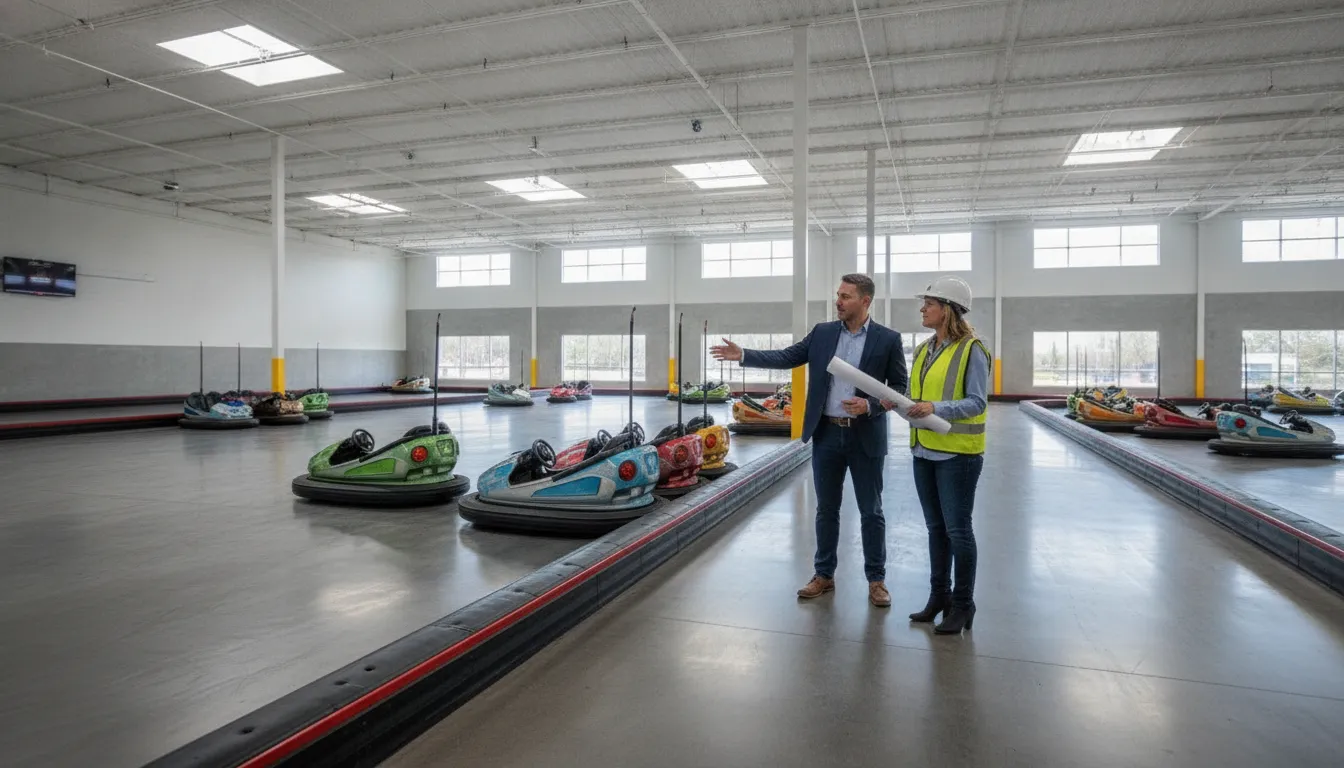
Ask the manufacturer to show how the proposed layout handles current capacity and possible future changes. Amusement Products describes custom layouts for individual attractions and complete FECs, including traffic-flow optimization, site optimization, capacity planning, permitting support, and future expansion planning. That type of planning helps turn expansion from an improvised construction project into a defined operating decision.
Measure integration and ownership fit
Integration should be evaluated in practical terms. Can the supplier coordinate equipment specifications with the building plan? Are installation responsibilities clear? Will the attraction’s controls, safety procedures, training materials, and maintenance routines fit your staffing model? Does the partner remain available after launch for parts, troubleshooting, and operational questions?
These questions create a measurable ownership-fit test. Compare manufacturers on documented training, service response processes, parts access, maintenance requirements, installation coordination, and the clarity of each handoff. Also ask how success will be reviewed after launch. Useful measures may include attraction availability, operator readiness, queue performance, maintenance frequency, and the ability to add capacity without disrupting guests.
An integrated provider can contribute across several of these decisions. Amusement Products presents itself as a manufacturer, distributor, and service provider serving FEC owners, operators, and developers with equipment, design and consultation, construction, education, parts, and ongoing support. Its consultation process includes site evaluation, feasibility analysis, demographic studies, competition analysis, market positioning, iterative design, visualizations, and construction documentation. Review the details through its FEC design and consultation services, then use the same questions to evaluate any manufacturer you are considering.
The strongest long-term relationship is one where the equipment, facility plan, training program, and support model reinforce one another. Choose the partner that can explain those connections clearly and accept ownership of the work it has agreed to deliver.
Request an FEC equipment planning consultation
Frequently Asked Questions
What safety documentation should an FEC equipment manufacturer provide?
Request model-specific operating instructions, maintenance requirements, training materials, testing records, and any documentation needed for local review. Ask the manufacturer to identify which standards and permits apply to your attraction and facility rather than assuming one certification covers every equipment category.
Is equipment made in the United States always the better choice?
No. Manufacturing location is one evaluation factor, not an automatic quality verdict. Compare communication, shipping coordination, parts access, service coverage, documentation, and accountability. The right supplier should demonstrate how its location and support model will affect uptime and your launch schedule.
What should I look for in an equipment warranty?
Review the written warranty’s coverage, exclusions, claim process, response expectations, and responsibilities for installation and maintenance. Also confirm how replacement parts, troubleshooting, operator training, and escalation are handled after the warranty claim is opened. A warranty is more useful when the support process is clear and owned by a specific team.
How can I tell whether a supplier offers meaningful after-sales support?
Ask where you will obtain parts, who troubleshoots equipment, what training is included, and how service requests are escalated. Amusement Products supports customers through FECPartsMart.com and service programs intended to help keep equipment operating effectively. Verify that the proposed support matches your attraction mix, staffing model, and operating hours.
What is the difference between a manufacturer and a reseller?
A manufacturer may bring direct product knowledge and engineering accountability, while a reseller may focus primarily on sourcing and sales. Ask who designs the layout, specifies the equipment, manages installation, trains operators, and supports the project after launch. Some providers combine manufacturing, distribution, design, construction, parts, and service, which can reduce coordination between disconnected vendors.
Ready to Plan Your FEC Equipment Evaluation?
A focused consultation can help connect your attraction mix, site requirements, operational goals, and long-term support needs before you select a manufacturer. Schedule a design and consultation conversation about your FEC equipment plan with Amusement Products to discuss the next steps for your project.