
How much revenue can a commercial mini golf course generate? The honest answer depends on throughput, the admission rate you set for your market, operating hours, utilization, and the revenue each visit creates beyond the round itself. This guide gives FEC owners a practical way to model mini golf course ROI revenue before committing to a site plan, using the performance logic behind championship miniature golf construction.
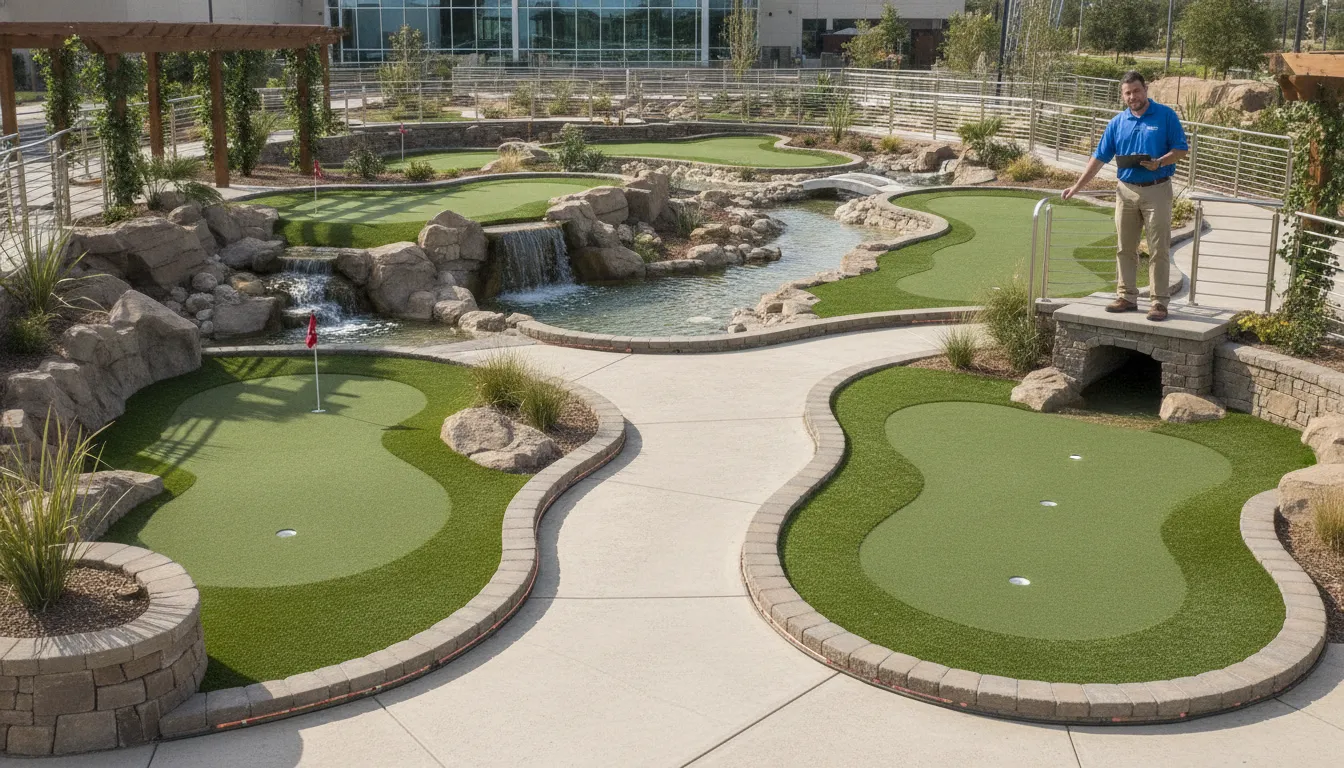
Schedule a free design and consultation for your mini golf project
What Revenue Can a Commercial Mini Golf Course Generate Per Year?
A commercial mini golf course generates annual revenue by converting available playing capacity into completed rounds, then adding event, food and beverage, membership, and cross-attraction sales. The most useful forecast starts with capacity and realistic utilization, not a headline annual number detached from the course layout and operating plan.
Amusement Products’ published championship construction guidance identifies a planning benchmark of approximately 90 to 100 players per hour for an 18-hole course. That is a capacity reference, not a promise of constant demand. A responsible revenue model applies a utilization factor that reflects weekdays, weather, seasonality, staffing, queue management, and local market demand.
| Planning input | What it measures | Revenue-model question |
|---|---|---|
| Player throughput | How many guests can move through the course per hour | Does the layout support demand without creating bottlenecks? |
| Admission rate | The amount charged per completed round in the operator’s market | What will the target audience accept for this experience? |
| Utilization | The percentage of theoretical capacity filled over time | What happens during ordinary weekdays, not just peak Saturdays? |
| Operating calendar | Open hours and operating days by season | How much bookable capacity is actually available? |
| Revenue per visit | Admission plus optional event and ancillary spend | How can one visit support more than a single round? |
The core formula is simple: annual admission revenue equals completed players per hour multiplied by the admission rate, paid operating hours per day, operating days per year, and the average utilization rate. Model the result by month or season so the forecast shows when demand is strongest and where marketing, events, or bundled attractions need to fill the gaps.
How Do Throughput, Capacity, and Location Affect Revenue?
Throughput is not simply the number of holes. It is the number of guests who can enter, play, finish, and exit without slowing the next group. Course width, starting areas, walking paths, hole transitions, queue space, party operations, and visibility all influence whether theoretical capacity becomes actual revenue.
- Course flow: Staggered starts and clear transitions help prevent groups from stacking at a single hole.
- Site access: Visibility, parking, nearby retail, and complementary attractions can affect both first visits and repeat demand.
- Session duration: A longer experience can increase perceived value, but only if the queue and circulation plan can support it.
- Accessibility: Accessible paths and thoughtful hole design expand the addressable audience and make group visits easier to plan.
- Operating discipline: Opening routines, course recovery, reservations, and staffing determine how much of the available calendar can be sold.
Use a capacity ceiling and a utilization forecast together. For example, an 18-hole course planned around 90 to 100 players per hour may have substantial theoretical capacity across a full operating day, but the annual plan should reduce that ceiling for school-day mornings, bad weather, shoulder seasons, maintenance windows, and unfilled reservation slots. The resulting model is less exciting than a full-capacity projection, but it is much more useful for an investment decision.
What Revenue Streams Should a Mini Golf ROI Model Include?
Admission revenue is the foundation, but a strong commercial mini golf operation earns more by designing the visit around groups, celebrations, and repeat use. Each additional revenue stream should be modeled separately so the operator can see which assumptions are proven, which need testing, and which depend on the broader FEC plan.
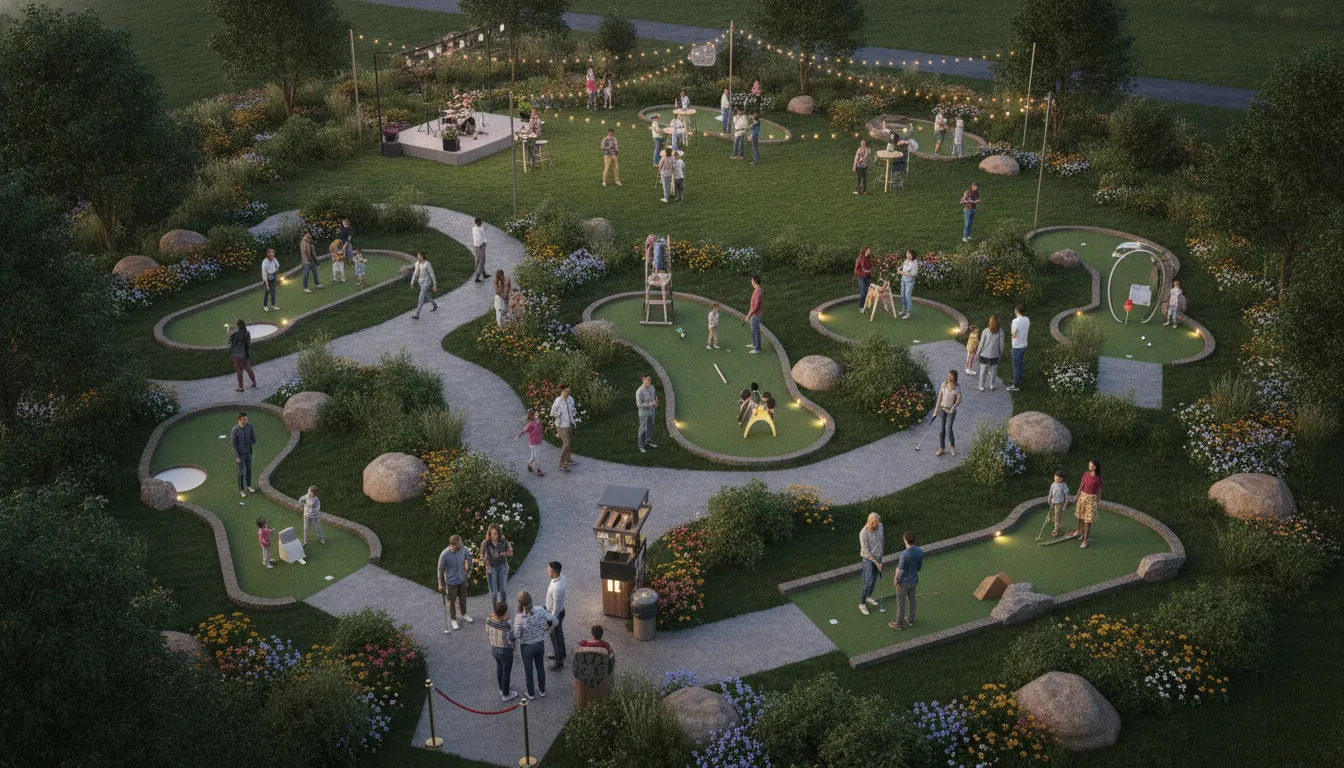
- Open-play rounds: Forecast ordinary admissions by daypart, season, and expected utilization.
- Birthday and group bookings: Packages can combine reserved play, a party area, food, and a defined schedule for easier staffing.
- Corporate and team events: Dedicated booking windows can create predictable demand during periods that are weaker for walk-in play.
- Memberships and repeat-visit programs: These can improve visit frequency when the offer fits the local audience and operating calendar.
- Food, beverage, and retail: If included in the facility plan, ancillary sales can increase revenue per guest without requiring another course round.
- Cross-attraction packages: Mini golf can be bundled with other FEC attractions to lengthen visits and make the overall venue more valuable to groups.
Do not hide all of these assumptions in one blended revenue-per-visitor figure. Build a base case from admissions, then add conservative event and ancillary scenarios. That makes it easier to identify the operational lever that matters most, whether it is booking capacity, group sales, course design, or the attraction mix around the course.
Request a custom mini golf layout and revenue-planning consultation
How Do You Calculate Break-Even on a Mini Golf Course Investment?
Break-even is reached when the cumulative contribution from the course covers the project investment and ongoing fixed obligations. Because purchase-price figures vary by site, scope, construction conditions, and supporting amenities, the best model uses the operator’s own proposal and separates admission revenue from the expenses required to deliver each visit.
Use this sequence:
- Define the investment base: Include the approved course scope and the site-specific items required to open the attraction. Do not use a generic online estimate.
- Forecast completed visits: Start with the course throughput ceiling, then apply utilization by month and daypart.
- Calculate contribution per visit: Subtract the variable expense of serving a guest from the admission and attributable ancillary revenue.
- Account for fixed obligations: Include staffing structure, occupancy, insurance, maintenance planning, marketing, utilities, and other recurring commitments in the operating model.
- Run conservative and upside cases: Test lower utilization, delayed ramp-up, weather disruption, stronger group bookings, and cross-attraction demand.
- Track actuals after opening: Compare completed rounds, utilization, event conversion, average revenue per visit, and repeat visits against the forecast every month.
The break-even month is the point at which cumulative contribution exceeds the investment base. This approach avoids pretending that a single industry average can predict every project. It also shows which design decisions can improve payback, such as reducing circulation friction, increasing reservable event capacity, or creating a course experience that supports repeat visits.
Does Indoor or Outdoor Mini Golf Generate More Revenue?
Neither format wins in every market. Indoor and outdoor courses generate revenue through different utilization patterns, and the stronger choice is the one that fits the site’s climate, real estate, seasonality, operating calendar, and customer demand. Compare the formats by annual sellable hours and visit quality, not by construction label alone.
| Revenue factor | Indoor planning emphasis | Outdoor planning emphasis |
|---|---|---|
| Utilization | Year-round schedule and weather-independent bookings | Season length, weather resilience, and peak-season throughput |
| Visit design | Integration with food, arcade, parties, and other indoor attractions | Landscaping, shade, lighting, paths, and destination appeal |
| Group sales | Predictable party and corporate booking windows | Seasonal celebrations, local events, and destination packages |
| Forecast risk | Occupancy and facility operating requirements | Weather, maintenance, drainage, and shoulder-season demand |
For a deeper format comparison, review the indoor versus outdoor miniature golf profitability guide. The key ROI question is how many high-quality visits the selected format can support over the entire year, not which format has the most impressive peak-day capacity.
How Does Championship-Grade Design Improve Revenue Per Visitor?
Design affects revenue before a guest ever reaches the payment point. A championship-grade course can create a stronger reason to visit, make the experience easier to share, support group bookings, and encourage repeat play. It also gives the operator more control over circulation, accessibility, sightlines, maintenance access, and the usable value of the site.
Revenue per visitor improves when the course delivers a coherent experience rather than a collection of disconnected holes. Varied elevation, durable materials, themed scenery, clear wayfinding, accessible routes, and memorable finishing moments can help the attraction feel worth repeating. Event-ready spaces and a layout that keeps groups moving can also increase the number of bookable sessions without making the course feel rushed.
These design choices should be evaluated against the operator’s business model. A family-focused facility may prioritize all-ages play and repeat visits. A destination venue may need a distinctive theme and photo-worthy moments. A mixed FEC may use mini golf as an anchor that helps sell a longer visit across several attractions. Amusement Products’ championship miniature golf construction resource explains the broader design and construction considerations; this ROI guide applies those decisions to revenue planning.
Schedule design and consultation to map your course, capacity, and revenue assumptions
Frequently Asked Questions About Commercial Mini Golf Revenue
How much profit do mini golf courses make?
Profit varies with utilization, admission rates, labor, occupancy, maintenance, weather, and ancillary revenue. Use a monthly operating model rather than applying a generic margin to theoretical full capacity.
Can a commercial mini golf course generate revenue year-round?
Yes, if the format, climate, facility, and operating plan support demand throughout the year. Indoor courses may reduce weather disruption, while outdoor courses can create strong seasonal destination appeal. The forecast should reflect the actual local calendar.
What is the most important input in a mini golf ROI model?
Utilized throughput is usually the most important starting point. It connects course capacity to completed visits, but it must be adjusted for daypart, seasonality, weather, staffing, and demand rather than treated as constant.
How can an FEC increase revenue per mini golf visitor?
Operators can test group packages, birthday bookings, corporate events, memberships, food and beverage, retail, and cross-attraction bundles. The right mix depends on the site’s audience and the attractions already available.
Should I choose an indoor or outdoor mini golf course?
Choose the format that produces the strongest annual utilization for the site. Compare weather exposure, seasonality, occupancy, event demand, circulation, accessibility, and the role mini golf will play in the larger FEC before selecting a format.
Request a custom consultation for a commercial mini golf course