
When FEC operators compare indoor vs outdoor miniature golf profitability fec options, the right question is not which format wins everywhere. The better question is which format can convert the site, market, operating calendar, and attraction mix into dependable utilization.
Indoor miniature golf may support steadier scheduling and weather protection. Outdoor miniature golf may offer visual impact, land flexibility, and seasonal energy. Profitability depends on usable operating time, guest throughput, repeat visits, maintenance, facility requirements, and the quality of the financial model.
Amusement Products brings practical experience to that decision. The company evolved from operating 64 FEC locations, including 36 miniature golf courses, and has more than 60 years of miniature golf design experience. Its miniature golf construction for family entertainment centers work connects the business case to the physical plan.
Schedule a design consultation to evaluate the right miniature golf format for your FEC.
Indoor Mini Golf and Profitability: Revenue Stability, Weather Independence, and Build Tradeoffs
Indoor miniature golf removes much of the direct exposure to rain, extreme heat, cold, wind, and seasonal closures. That can make the operating calendar easier to plan. It does not guarantee full sessions or eliminate demand swings. School calendars, holidays, local events, weekday patterns, and the strength of the broader attraction mix still determine how much available time becomes revenue.
Weather protection supports a steadier operating plan
An indoor course can make it easier to schedule birthday parties, school groups, league play, corporate events, and family visits when outdoor conditions are unreliable. It also gives staff more control when a forecast changes shortly before a reservation. The benefit is operational consistency, not automatic profitability.
Use the financial model to test ordinary weekdays, not only peak Saturdays. Estimate course capacity, session duration, queue time, realistic utilization, and weekly throughput. A venue that can open more often still needs a plan for filling those hours. Memberships, group bookings, food and beverage, and complementary attractions may create different visit occasions. Each should be modeled against the local market rather than treated as guaranteed demand.
Indoor space creates facility tradeoffs
An indoor course becomes part of a larger building decision. The layout must share space with entry, queueing, restrooms, food and beverage, party rooms, storage, circulation, and other attractions. A course can look strong in isolation and still underperform if guests face bottlenecks at check-in, crowded waiting areas, or unclear movement between activities.
Indoor development requires early review of ceiling height, utilities, HVAC, lighting, fire and life-safety requirements, maintenance access, and future expansion. The usable footprint should support safe movement and efficient throughput. A master plan that considers traffic flow and adjacent attractions before construction is more useful than a course layout chosen only for appearance.
Indoor miniature golf can serve as an all-weather anchor for a broader destination. Guests may combine a round with an arcade, food service, parties, or another attraction. That combination can support repeat visitation, but the operator should test the customer journey and capacity limits before assuming that every attraction will strengthen the others.
What Makes Outdoor Mini Golf Profitable in a Seasonal Market?
Outdoor miniature golf can be a strong fit when the site, climate, land, and operating calendar work together. Its profitability depends on how effectively the course converts favorable weather and an engaging setting into completed rounds. A warm or tourism-driven market may support a long outdoor season. A colder or storm-prone market may need a shorter reliable season or a complementary indoor attraction mix.
Model the season before selecting the format
Seasonality belongs in the financial model from the first draft. Identify the months when heat, rain, cold, wind, lightning, or snow may interrupt play. Then model school breaks, holidays, tourism, local events, and shoulder-season demand. Forecasting the first year month by month can expose staffing, scheduling, cash-flow, and capacity issues that a yearly average would hide.
Weather exposure affects more than walk-in traffic. Rain can interrupt a round. High heat can reduce comfort. Lightning can close the course and disrupt parties. The operating plan should define how staff handle closures, rescheduling, customer communication, and unused capacity. A nearby indoor attraction, food service area, arcade, or other activity can give guests a reason to remain on site when outdoor play is unavailable.
Use land flexibility without overlooking upkeep
Outdoor space can support water features, elevation changes, landscaping, themed obstacles, gathering areas, shade, seating, and a visible course identity. Those elements can make the attraction memorable for children, adults, and multigenerational groups. They should still support clear circulation, comfortable play, drainage, lighting, and future changes.
Outdoor flexibility brings a maintenance commitment. Surfaces, landscaping, water features, lighting, drainage, and decorative elements are exposed to the local environment. Build inspection, cleaning, seasonal preparation, repairs, and preventive maintenance into the operating plan. Attraction downtime can damage a venue’s reputation, so the team should know who owns each task and how quickly issues are addressed.
An outdoor course should be judged by its full operating season, not just its busiest summer weeks. If the site has strong seasonal demand and enough complementary activity to balance weather risk, outdoor miniature golf may be compelling. If the business depends on consistent year-round programming, the model may favor indoor or hybrid planning.
Which Format Attracts More Repeat Visitors?
Repeat visitation depends less on the indoor or outdoor label and more on whether the course gives guests a reason to return. The experience should be visually memorable, playable across age groups, easy to combine with other activities, and aligned with the occasions the market can support.
Indoor miniature golf can support reliable family visits, leagues, parties, and seasonal programming across more of the year. It may also work as part of a destination where guests combine play with food, beverages, arcade activity, or another attraction. Outdoor miniature golf can create a stronger sense of occasion when the setting includes distinctive landscaping, water, elevation, themed obstacles, or gathering space.
| Planning factor | Indoor miniature golf | Outdoor miniature golf |
|---|---|---|
| Operating pattern | More control over weather-sensitive sessions and scheduled events. | Strong seasonal energy, tied more closely to local weather and daylight. |
| Repeat-play levers | Memberships, leagues, parties, and programming can create year-round occasions. | Events, course refreshes, themed programming, and a distinctive setting can encourage return visits during the active season. |
| Attraction mix | Pairs naturally with indoor food, arcade, party, and other FEC activities. | Can anchor an outdoor mix and complement indoor attractions in a hybrid plan. |
| Design priorities | Lighting, theming, circulation, building systems, and queue management. | Landscaping, drainage, shade, weather protection, lighting, and exposed-surface upkeep. |
Session length matters as well. A strong FEC does not make every attraction depend on the same peak period. Miniature golf can serve as a longer anchor experience while quick-turn attractions serve shorter visits. Parties, memberships, leagues, and seasonal events can create different reasons to return, provided the course and staff can handle the resulting traffic.
Course design should balance skill and fun. A first-time player should understand how to begin, while a returning guest should notice details worth exploring again. Visual appeal, comfortable gathering areas, clear routes, and multigenerational play all influence whether the course becomes a memorable part of the venue.
How Indoor vs Outdoor Miniature Golf Profitability FEC Decisions Affect Operating Costs
Profitability is shaped by the operating burden behind each round. Indoor and outdoor courses have different facility requirements, staffing patterns, maintenance exposure, and utilization risks. Compare those categories before comparing formats.
Weather, uptime, and maintenance
Outdoor conditions can shorten operating windows, interrupt reservations, accelerate wear, and increase inspections, surface care, drainage work, landscaping, lighting checks, and repairs. Water elements and elevation changes may improve the guest experience while adding maintenance responsibilities. A weather closure can affect staff scheduling, group events, reservations, and guest satisfaction at the same time.
Indoor courses reduce direct weather exposure, but upkeep remains essential. Operators need a plan for surfaces, obstacles, lighting, HVAC, restrooms, common areas, and building systems. Inspections, parts availability, staff training, and response procedures protect uptime in either setting. Neglected course conditions can harm the reputation of an FEC regardless of where the course is located.
Staffing, facility overhead, and throughput
Staffing depends on operating hours, guest flow, party volume, supervision, and the relationship between miniature golf and adjacent attractions. Indoor venues may support more weather-independent operating periods, which can improve access to usable hours while expanding scheduling needs. Outdoor venues may concentrate labor around seasonal demand while requiring plans for weather calls, site preparation, and off-season coverage.
Indoor facility planning includes building footprint, utilities, HVAC, lighting, life-safety systems, cleaning, and the opportunity cost of space that could support another attraction. Outdoor planning shifts more attention to land use, drainage, walkways, landscaping, lighting, security, and weather protection. Both formats require efficient queue design and guest circulation.
Capacity planning should examine session duration, hourly guest capacity, weekday and weekend utilization, parties, group bookings, and traffic flow. Leave room for future attractions or a hybrid mix when possible. Amusement Products’ commercial course design standards provide a framework for connecting guest experience, durability, accessibility, and practical operation.
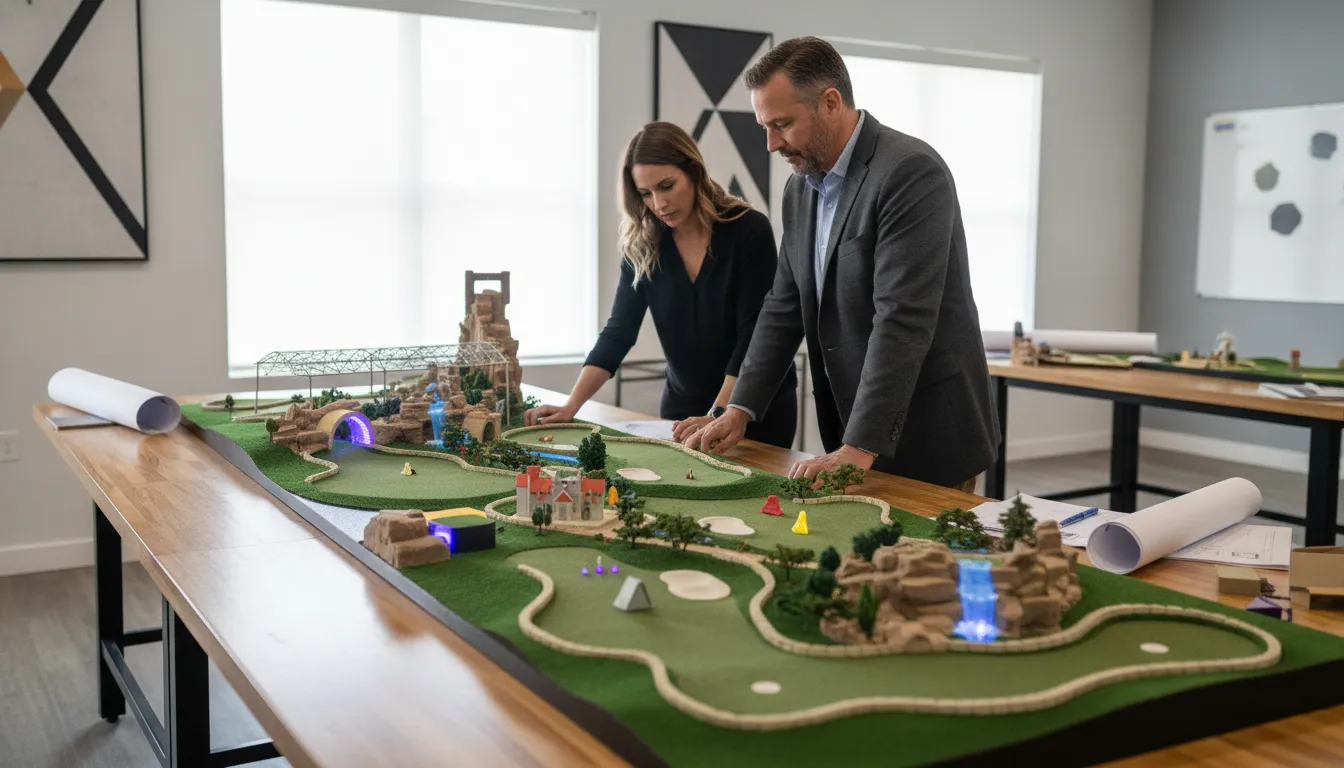
How Should an FEC Choose Between Indoor and Outdoor Mini Golf?
There is no universal winner. The stronger format matches the market, site, operating calendar, attraction mix, and financial model. Use this decision framework before committing to a building, parcel, or course layout.
- Define the trade area. Identify the population that can reasonably reach the FEC. Urban venues may draw from a tighter area, while suburban and rural concepts may depend on a wider drive-time market. Map roads, schools, residential growth, tourism, and nearby attractions.
- Study demographics and customer occasions. Review families with children, adult evening demand, corporate events, birthday parties, school groups, and multigenerational use. The course should serve audiences the market can support.
- Model climate and seasonality. List conditions that can interrupt outdoor play. Compare usable operating time, staffing, school calendars, holidays, and low-demand weekdays. Test conservative utilization rather than assuming every session is full.
- Match the site and capacity plan. Confirm room for the course, queues, restrooms, parking, food service, access, drainage, lighting, and complementary attractions. Review miniature golf course planning early.
- Compare the attraction mix. Study nearby competitors, booking patterns, busy periods, and guest expectations. A hybrid model may combine miniature golf, go-karts, bumper cars, or an arcade to support different visit occasions.
- Build the financial model. Include capacity, session duration, utilization, staffing, maintenance, facility requirements, seasonality, group demand, ancillary sales, and expansion options. Amusement Products’ design consultation process can support site evaluation, feasibility, demographic review, competition analysis, ROI projections, and financial modeling.
Frequently Asked Questions
Is indoor or outdoor miniature golf more profitable for an FEC?
Neither format is automatically more profitable. Compare weather exposure, seasonality, usable operating time, capacity, staffing, maintenance, real estate, guest demand, and the attraction mix. The best choice is supported by a site-specific model.
Does indoor miniature golf eliminate seasonality?
Indoor miniature golf reduces direct weather disruptions but does not eliminate demand changes. School calendars, holidays, local events, and weekday patterns still affect attendance. Model the first year month by month.
What makes outdoor miniature golf a strong FEC attraction?
Outdoor miniature golf can create visual appeal and a distinctive destination when climate, land, landscaping, drainage, and the operating season support it. Plan water features, elevation, shade, seating, and themed elements alongside maintenance.
When should an FEC consider a hybrid format?
Consider a hybrid format when the property supports indoor and outdoor demand patterns, complementary attractions, shared guest services, and phased expansion. Validate climate, permitting, circulation, staffing, maintenance, and capacity.
What belongs in an indoor versus outdoor profitability model?
Include usable operating days, hours, course capacity, session duration, utilization by day and season, staffing, maintenance, facility overhead, group demand, ancillary revenue, weather risk, and future expansion.
Schedule a Design Consultation for Your FEC
Schedule a design consultation with Amusement Products to compare indoor, outdoor, and hybrid options before you commit. The right miniature golf format depends on your site, local demand, capacity, climate, construction goals, and long-term attraction plan.