Choosing attractions for an FEC is not simply a matter of collecting popular activities. Each element has to earn its place in the guest experience, fit the site and operating model, and work alongside the rest of the portfolio. A lineup that looks strong on paper can still create awkward traffic patterns, uneven demand, or operational strain if those relationships are not considered early.
Schedule a design consultation for your FEC attraction mix.
A practical family entertainment center attraction mix connects audience needs and visit occasions with attraction roles, guest flow, staffing, maintenance, available footprint, and future expansion. There is no universal winning lineup; the right balance depends on the venue, market, and way the facility will operate.
That makes attraction planning a portfolio decision rather than a product-by-product comparison. Start by defining what the mix must accomplish for guests and operators, then use those goals to evaluate each proposed attraction.
What Does a Family Entertainment Center Attraction Mix Need to Accomplish?
A family entertainment center attraction mix is not simply a list of rides and activities. It is a coordinated portfolio in which each attraction has a job within the guest experience and the operating model. One element may draw a particular age group, another may encourage repeat visits, and another may help the venue serve groups with different interests during the same visit.
Think in roles, not a catalog of attractions
The right mix starts with the occasions you want to serve. A venue may be planned around family outings, youth group events, birthday parties, competitive play, or a combination of those uses. Each occasion creates different expectations for participation, supervision, guest flow, and time spent on site. The goal is not to appeal equally to every possible customer. It is to identify a primary audience, a secondary audience, and the attraction roles that support both.
Before comparing individual products, define what the portfolio must accomplish:
- Audience fit: Which guests are you intentionally prioritizing, and what interests or abilities should the venue accommodate?
- Visit variety: Can the lineup support more than one reason to visit without becoming a disconnected collection of activities?
- Operational fit: Do the attractions align with the venue, staffing approach, maintenance plan, and expected guest movement?
- Future flexibility: Can the portfolio be adjusted or expanded as the market, audience, or operating model changes?
These questions make the planning discussion more useful than a generic attractions list. Audience fit, throughput, footprint, staffing, maintenance, and expansion are planning dimensions, not universal rankings. Their importance depends on the venue and operating model. For a broader explanation of the format and its common uses, see this overview of family entertainment center attractions.
Then use the portfolio-architecture lens to decide how those elements should work together in your specific facility.
How Do You Match Attractions to FEC Visit Occasions?
A useful attraction mix starts with the guest’s reason for visiting, not with a list of equipment categories. A parent planning a younger child’s birthday party has a different job to accomplish than a group of teenagers looking for an active challenge or an adult team arranging a social outing. Mapping those occasions helps operators build a portfolio that serves distinct needs without trying to make every attraction equally relevant to every guest.
Define a primary audience and a secondary audience
Begin by identifying the audience your venue is best positioned to serve. Consider local preferences, age ranges, interests, and the types of experiences guests actively seek. Research-based attraction planning guidance recommends choosing a primary and secondary audience rather than attempting to appeal equally to everyone. That focus can make decisions about experience level, programming, layout, and future additions more coherent.
The primary audience should guide the venue’s central promise. The secondary audience should broaden the occasions you can serve without pulling the concept in an unrelated direction. For example, a family-focused venue may need attractions that work for mixed-age groups while also offering a clear reason for older children or adults to return. The right balance depends on the community and operating model, so treat audience research as a planning input rather than a universal formula.
Map the guest job behind each visit.
List the occasions you want to support, then describe what the guest needs the venue to accomplish:
- Family day out: provide shared activities with accessible entry points for different ages.
- Birthday or group event: support a memorable, easy-to-organize experience with opportunities for participation and social time.
- Teen or young-adult outing: offer challenge, competition, or a stronger sense of progression.
- Repeat local visit: create enough variety that returning guests can choose a different experience.
Next, look for gaps and overlap. A portfolio may have several attractions that serve the same occasion while leaving another important guest job unaddressed. Use the commercial rides for FECs resource for broader category context, but make the final mix decision around your audiences, visit occasions, and facility plan.
How Should Operators Score an Attraction Portfolio?
A useful scorecard keeps an attraction decision tied to the way the venue will actually operate. Score each candidate against the same questions, then discuss tradeoffs rather than searching for a universal winner. A strong family entertainment center attraction mix is one that fits the intended guests, site, team, and next stage of development.
Use evidence, not enthusiasm
Begin with a simple qualitative rating such as strong fit, workable with conditions, or poor fit. Support each rating with evidence from the site plan, customer research, operating plan, maintenance approach, and expansion goals. The venue and operating model should determine how much weight each dimension receives. For example, a compact indoor venue may place more emphasis on footprint and staffing, while a destination-oriented facility may weigh visit occasions and future expansion more heavily.
| Planning dimension | Questions to ask | Evidence to collect |
|---|---|---|
| Audience fit | Which primary and secondary audiences does this serve? Does it support the visit occasions the venue wants to attract? | Audience profiles, local research, guest feedback, and planned programming. |
| Throughput | How will guests enter, participate, exit, and rejoin the wider venue? Where could queues or uneven demand develop? | Operating assumptions, flow diagrams, session rules, and observation of comparable venues. |
| Footprint | Does the attraction fit without sacrificing circulation, sightlines, queue space, or useful support areas? | Measured plans, equipment layouts, access routes, and utility requirements. |
| Staffing | What supervision, training, dispatch, guest assistance, and opening or closing routines will it require? | Role descriptions, training plan, operating schedule, and peak-period coverage assumptions. |
| Maintenance | Can the team inspect, clean, service, and reset the attraction without disrupting adjacent activities? | Maintenance schedule, access clearances, parts and support plan, and downtime procedures. |
| Expansion | Can the venue add complementary attractions or improve the experience later without reworking the whole site? | Reserved infrastructure, adaptable layouts, phased-development plan, and defined review triggers. |
Record the reason behind every rating and identify any condition that must be resolved before approval. For a broader planning checklist, review these FEC equipment planning considerations. Amusement Products frames consultation around balancing guest appeal with operational realities, including facility layout, attraction mix, and guest flow, rather than promising identical outcomes for every venue.
What Does Attraction-Mix Planning Require From the Site?
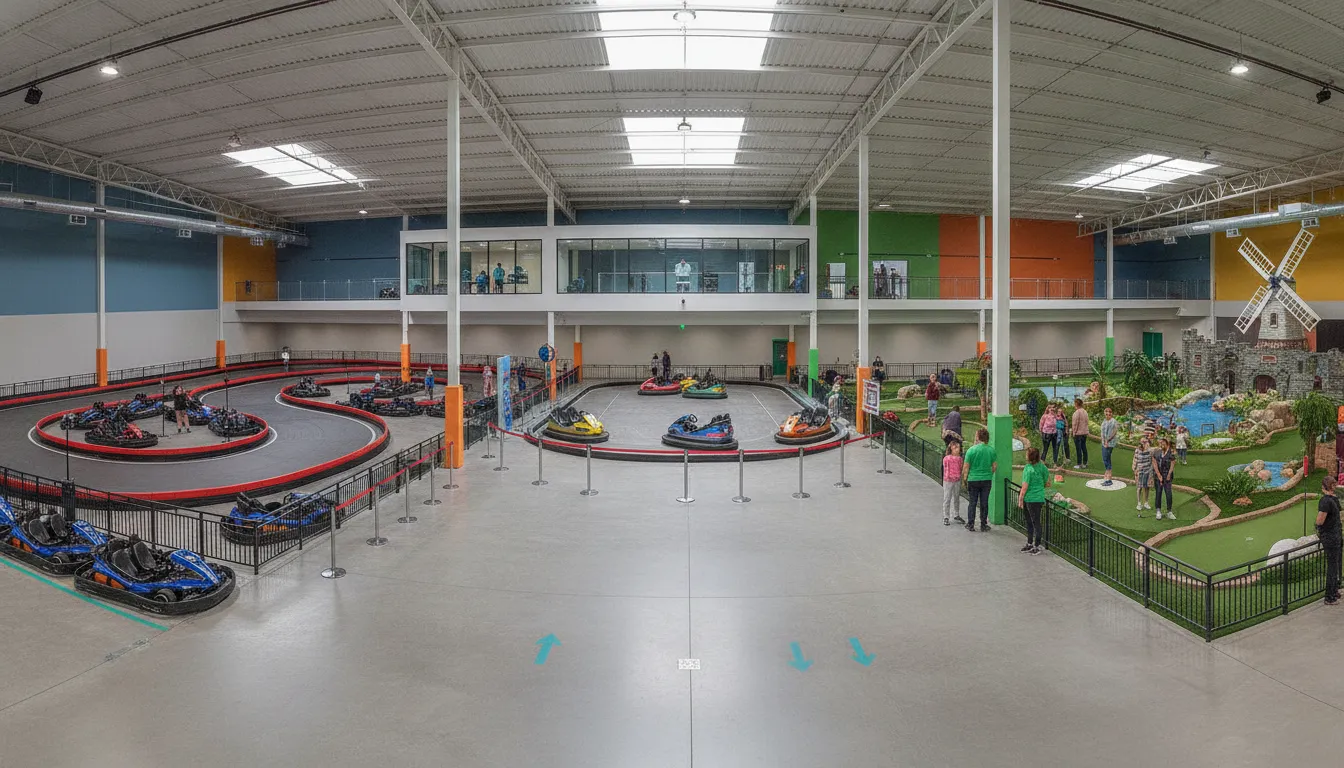
A strong attraction mix has to work within the building, not just look compelling on a concept list. Start with a usable footprint that accounts for the attraction itself, guest circulation, queues, loading or staging areas, staff positions, storage, and clear access for inspection and service. Requirements depend on the venue and operating model, so a layout that works for one FEC may be a poor fit for another.
Plan the movement between activities
Map how guests enter, orient themselves, choose an activity, wait, participate, and leave. Avoid forcing traffic through active play zones or placing queues where they block food service, restrooms, exits, or sightlines. Staff should be able to observe important operating areas without relying on a maze of blind corners. Loading zones and dispatch points also need enough separation from general guest movement to support orderly operations.
Build accessibility and safety into the layout
The 2010 ADA Standards establish minimum accessibility requirements for newly designed, constructed, or altered public accommodations and commercial facilities. Apply that planning lens to routes, access points, participation areas, and the way guests reach supporting amenities. Confirm the final design with the appropriate professionals for the project.
For play-oriented areas, the CPSC discusses risks and planning considerations involving falls, impact, protective surfacing, entrapment, age-appropriate design, layout, installation, and maintenance. Its public playground equipment guidance is a useful reference for those specific concerns, but it does not replace project-specific code review or manufacturer instructions.
Reserve the infrastructure operators need
Before finalizing the mix, identify electrical, ventilation, drainage, network, lighting, and other utility needs for each attraction. Leave practical access for cleaning, inspection, parts replacement, and repairs. A plan that uses every open area may appear efficient at first, yet create avoidable downtime when technicians cannot reach equipment or staff cannot reset an activity safely.
How Can an FEC Phase Its Attraction Mix Over Time?
A phased plan lets an operator open with a coherent guest experience while preserving room to respond to actual demand. The sequence should reflect the venue, operating model, site constraints, and team capacity rather than a universal attraction ranking.
A practical sequence for portfolio decisions
- Define the opening lineup. Start with the primary guest occasion and choose a balanced group of attractions that supports it. Check that the initial mix gives guests meaningful reasons to move through the venue while avoiding a collection of activities that compete for the same space, staffing attention, or audience.
- Reserve the infrastructure. During initial planning, identify areas that could support future attractions and protect the access, circulation, utilities, sightlines, and service routes they may require. Document what is intentionally reserved, what can be changed later, and which decisions would be difficult to reverse. The FEC equipment planning considerations guide can help organize this review.
- Set expansion triggers. Agree in advance on the signals that justify a closer look at expansion. These might include recurring guest requests, underused zones, operational bottlenecks, changing audience patterns, or a shift in the occasions the venue wants to serve. Treat these as investigation prompts, not automatic reasons to add equipment.
- Use operating feedback. Review observations from operators, guest comments, queue behavior, maintenance records, and event patterns. Compare those findings with the original portfolio assumptions. A new attraction should solve a documented planning need and fit the existing traffic flow, not simply follow a trend.
- Govern the mix as a portfolio. Assign ownership for reviewing the attraction plan, recording decisions, and checking how proposed additions affect safety, staffing, maintenance, guest experience, and future flexibility. For a live venue, adding bumper cars to an FEC illustrates why integration deserves its own planning process.
Revisit the mix at defined operating intervals and after major changes to the facility or audience. That discipline keeps expansion connected to evidence while allowing the attraction portfolio to develop with the venue.
What Should an FEC Attraction-Mix Partner Provide?
A credible partner should help you connect attraction selection to the realities of the venue, not simply present a catalog. That means understanding whether you are developing a new facility, refreshing an existing lineup, or planning an expansion. Then evaluate audience fit, guest flow, operational requirements, maintenance, and future flexibility together.
Look for support beyond equipment selection
Start with feasibility and site planning. A qualified partner should be able to discuss the site, facility layout, attraction mix, and guest flow before equipment decisions are finalized. The goal is a workable plan for the specific venue, not a universal ranking of attractions. Amusement Products provides FEC design and consultation, with consultation services that range from feasibility studies through grand-opening support. Its design team develops layouts for individual attractions and complete FECs, with attention to traffic flow and the facility plan.
The relationship should also extend into implementation and daily operation. Ask who will coordinate construction, explain equipment use, provide education, help source parts, and remain available for maintenance and ongoing support. Amusement Products describes itself as a manufacturer, distributor, and service provider. Its broader offering includes equipment, design, construction, education, parts, and ongoing support. You can review its FEC education and operator learning resources and learn more about Amusement Products experience, including its stated history operating FEC locations.
This integrated approach can make attraction decisions easier to evaluate across the full lifecycle. Whether the mix includes electric go-karts, bumper cars, miniature golf, pitching machines, VR attractions, or control systems, the right partner should explain each choice. It should also show how the portfolio fits the audience, site, operating model, and next phase of development.
Schedule an FEC design consultation with Amusement Products at +1 423 892 7264.
Frequently Asked Questions
What is considered a family entertainment center?
A family entertainment center is a venue that combines multiple activities or attractions for family groups and other guest segments. The strongest operating plans define the role each attraction plays, then coordinate audience fit, guest flow, staffing, maintenance, and future expansion rather than treating the lineup as a simple list of equipment.
What are some creative ideas for entertainment centers?
Start with combinations that serve different visit occasions and guest preferences. An operator might balance active attractions with skill-based activities, social experiences, and options that work for different age groups. The creative decision is not simply choosing unusual equipment; it is building a complementary portfolio that uses the site well and gives guests reasons to return.
What is the most profitable family entertainment business?
There is no universal winner. Evaluate each attraction or concept against local audience fit, expected demand, throughput, footprint, staffing, maintenance requirements, and expansion flexibility. Compare those dimensions with your operating data and facility constraints before deciding which role is most valuable in your portfolio.
How do you evaluate a family entertainment center attraction mix?
Score the proposed mix against the guest experience and the work required to operate it. Check whether attractions serve distinct audiences, whether queues and traffic can function safely, whether staff can supervise them consistently, and whether utilities, service access, and future phases are accounted for. Revisit the scorecard after opening as guest behavior and operating feedback become clearer.
Ready to Plan Your FEC Attraction Mix?
A coordinated attraction mix can help you connect guest needs with your available space, operating goals, and plans for future expansion. If you are evaluating a new venue, refreshing an existing lineup, or planning the next phase, a structured design conversation can clarify the decisions ahead.
Schedule a design consultation with Amusement Products to review your FEC attraction mix, site, and operating goals.
Next.