An operator-focused plan turns a go-kart attraction from a promising concept into a workable part of an FEC. It connects the guest experience to site readiness, attraction mix, staffing, safety controls, maintenance ownership, and the decisions managers must make every day after opening.
Request FEC design and consultation services to evaluate your attraction concept and operating requirements before site commitments are finalized.
A go kart track business plan for FEC operators should define how the attraction fits the venue. It should show how guests and staff move through it, how equipment will be controlled and maintained, and who owns each operating decision. It should also identify site requirements, local authority reviews, launch checks, and the information needed to improve the operation after opening.
This is different from a lender-focused plan built around financing, projections, and investor questions. The operator version is a practical implementation guide, beginning with the elements that shape the attraction’s daily performance and guest experience.
What Belongs in a Go Kart Track Business Plan for FEC Operators?
An operator-facing go kart track business plan should explain how the attraction will work inside a real family entertainment center. It is not only a document for lenders or investors. It is a decision tool for confirming attraction fit, preparing the site, assigning operating ownership, controlling safety risks, and opening with a manageable process. The U.S. Small Business Administration’s business-plan guide provides a useful general planning framework, but FEC operators need to translate that framework into practical venue decisions.
Start with attraction fit. Define who the experience is for, how it complements the existing mix, and what guest problem it solves. Consider rider experience levels, the role of electric equipment, and how the attraction will interact with food, arcade, party, or other activities. Review appropriate electric go-kart attraction options against the intended experience, facility, and operating model. The plan should document decisions and open questions rather than promise a particular result.
Next, make site readiness specific. Identify the proposed track area, access points, utilities, pit and staging needs, spectator areas, queue flow, staff visibility, and emergency access. Requirements depend on the selected equipment, building, property, and local authorities, so permitted use, inspections, and emergency procedures must be verified for the actual project. A go-kart track design guide can support early planning, while a qualified project team can help connect layout choices to construction and guest flow.
The operating section should map the complete guest journey: booking or walk-up arrival, check-in, waiver handling, briefing, dispatch, ride control, queue recovery, and closeout. Assign an owner for each handoff and define what happens when weather, equipment, staffing, or guest issues disrupt the normal sequence. Include the systems that must connect, such as booking, point of sale, waivers, customer records, and reporting, without selecting software solely because it appears in another venue’s plan.
Finally, document safety and lifecycle ownership. State who reviews procedures, records incidents, completes equipment checks, manages charging, orders parts, tracks maintenance issues, and escalates technical concerns. Amusement Products brings manufacturer, distributor, service, and operator experience to planning support from design through maintenance and technical assistance. A strong plan ends with launch gates, responsible owners, a soft-opening review, and an issue log that turns early operating observations into controlled improvements.
How Do You Confirm Attraction Fit Before Site Commitments?
Before committing a site or ordering equipment, test the attraction against the people you expect to serve and the way your venue operates. An FEC owner may be adding a track to an established mix, while a developer may be planning the first attraction in a new venue. Both need a clear answer to one question: will this experience make sense for the audience, space, team, and service model?
Start With the Audience and Attraction Mix
Define who the attraction is intended to serve, including families, children, teens, adults, groups, and repeat local guests. Then compare the proposed experience with the attractions already available. A go-kart track may complement a mix that needs an active, repeatable experience, or it may compete with another attraction for the same guest time. Review the full visit, including how guests discover the attraction, wait, participate, and move to the next activity.
Electric go-karts are intended for FEC use and offer selectable experience levels, including Rookie, Novice, Family, and Competition. Those options can help an operator plan for different rider experiences, but the right configuration depends on the selected equipment, site, procedures, and audience. Review electric go-kart attraction options alongside the rest of the venue plan.
Map the Operating Model Before You Choose the Equipment
Write down who owns each part of the guest journey: booking or check-in, waivers, briefing, dispatch, track control, queue communication, incident response, closing, and daily readiness. Include the maintenance owner and the escalation path when a kart, charging system, control feature, or facility area needs attention. The plan should also account for seasonality, weather exposure when relevant, school and holiday demand, group events, and the staffing and service capacity available during busier periods.
Use Decision Gates, Not Assumptions
Set gates before signing a site agreement or placing an order. Confirm permitted use, inspections, emergency procedures, utilities, access, guest flow, and applicable local authority requirements for the actual site and equipment. Check that the attraction can operate within the venue’s desired experience and support model. Amusement Products is a manufacturer, distributor, and service provider, and its design work can address traffic flow and project support. Request FEC attraction design and consultation to review the concept before the commitment point. Also compare the proposed layout with this go-kart track design guide. Move forward only when audience fit, attraction mix, operating ownership, seasonal plan, and lifecycle support have been reviewed together.
What Site and Track Readiness Checks Should Come First?
Before equipment is ordered or a layout is finalized, confirm that the proposed site can support the attraction as an operating environment. Start with permitted use and the approvals that may apply to the property, then document the assumptions behind the plan. Requirements depend on the selected equipment, building, site conditions, and local authorities, so early coordination is more useful than relying on a generic checklist.
Next, map the usable footprint rather than the total floor area. Identify the proposed track area, pit and staging space, queue, spectator zones, circulation routes, storage, charging or service areas, and staff work points. Check how guests and equipment enter the property, building, or outdoor site. Confirm that deliveries, maintenance access, and emergency access can remain practical after barriers, fencing, seating, and other attraction elements are placed.
Walk the plan for columns, low clearances, doors, grade changes, drainage, landscaping, and other obstructions. Note utilities and their locations, including the electrical service needed for the selected system and any requirements for lighting, communications, drainage, or climate control. Have qualified project professionals confirm site-specific utility capacity and construction conditions instead of assuming an existing service is adequate.
A useful readiness review turns open questions into assigned decisions:
| Unresolved site decision. | Documented ready decision. |
|---|---|
| Permitted use and authority review are assumed. | Applicable contacts, questions, approvals, and open items are recorded. |
| Track and queue are placed around existing obstacles. | Usable footprint, access routes, obstructions, and circulation are shown on the plan. |
| Pit, staging, and service needs are left for later. | Equipment movement, charging or service, storage, and staff access have owners. |
| Spectators and emergency responders share an informal route. | Guest flow, viewing areas, exits, and emergency access are reviewed together. |
Give equal attention to the guest experience. Trace the path from arrival and check-in through the queue, briefing, dispatch, ride, exit, and return to the broader FEC. Spectators should have an intentional place to watch without creating conflicts with riders or staff. Queueing should not block entrances, other attractions, service doors, or emergency routes. Consider weather exposure for outdoor areas and how the plan works during busy periods without promising a particular capacity.
Finally, coordinate the documented concept with the equipment supplier, design and construction partners, facility team, and local authorities. Amusement Products supports FEC projects with manufacturing, distribution, design, construction, and ongoing service resources, but site-specific approvals remain a project responsibility. Use the go-kart track design guide as a planning reference, then request the reviews needed for the actual property and selected system.
How Should Guest Flow and Daily Operations Work?
A strong go kart track business plan should show how a guest moves from reservation to finish, and who owns each handoff. Guest flow is not only a front-desk concern. It connects booking data, waiver status, attraction readiness, race control, and maintenance communication. Define the workflow before opening so the team can test it with the selected equipment.
Use a booking, point-of-sale, waiver, and reporting system that can exchange the information your operation actually needs. Avoid choosing software because it is popular or because it promises automation. Instead, document which system is the source of truth for reservations, payments, waiver completion, session assignment, and incident notes. Your team should also know what happens if one system is unavailable.
- Opening: The opening lead confirms facility access, attraction condition, communication devices, queue areas, and the day’s reservations. Any unresolved issue is assigned before guests enter the operating area.
- Booking and check-in: The front-of-house team confirms the reservation, party details, session time, and any venue rules. Staff should explain the next step clearly instead of sending guests between stations.
- Digital waiver completion: The team verifies that each required participant has completed the appropriate waiver process. Unfinished records are resolved through the designated check-in owner, with a clear escalation path for questions.
- Briefing: A trained team member delivers the approved orientation consistently and confirms that guests understand the instructions required for the experience. Procedures should reflect the selected equipment, site, and applicable local requirements.
- Dispatch: The dispatch lead matches the ready group to the assigned session, confirms the track is ready, and communicates with race control. The handoff should be visible in the operating system.
- Race control: The race control operator monitors the session, communicates with dispatch, and records operational issues according to the venue’s procedures. Clear radio language prevents front-of-house staff from guessing about track status.
- Queue recovery: If a session is delayed, the guest-experience lead explains the next action, updates affected reservations, and keeps the queue moving where possible. Recovery ownership should be assigned before the first busy day.
- Incident handoff: Staff follow the venue’s documented response process, notify the designated manager, and record relevant facts without improvising medical, legal, or regulatory conclusions. Equipment concerns are routed to the appropriate technical owner.
- Closing: The closing lead reconciles open sessions, guest follow-ups, system notes, equipment status, charging or storage procedures, and maintenance requests. The next shift should receive a concise handoff rather than relying on memory.
Assign an owner and backup for each step, then test the flow during a controlled practice session. Amusement Products’ go-kart staffing and operations guide can support staffing discussions, while the electric go-kart attraction options page helps connect the workflow to the attraction being evaluated. Site procedures, permitted uses, inspections, and emergency processes still need review for the specific equipment and local authority requirements.
What Safety and Maintenance Controls Keep the Attraction Ready?
A go-kart attraction stays ready when safety and maintenance are treated as shared operating responsibilities, not as tasks assigned to one person at the end of the day. The business plan should identify who owns pre-opening checks, who can pause dispatch, who documents incidents, and who escalates equipment concerns. This layered approach gives the team clear decisions to make before guests enter the track and during active operation.
Start each operating day with a documented pre-opening review. The checklist can cover the track surface and barriers, kart condition, controls, restraints or other guest-contact points, charging status, communication equipment, signage, and the pit area. The exact checks should reflect the selected equipment, site procedures, and advice from the manufacturer or service provider. A supervisor should know what constitutes a ready condition and what requires a hold for further review.
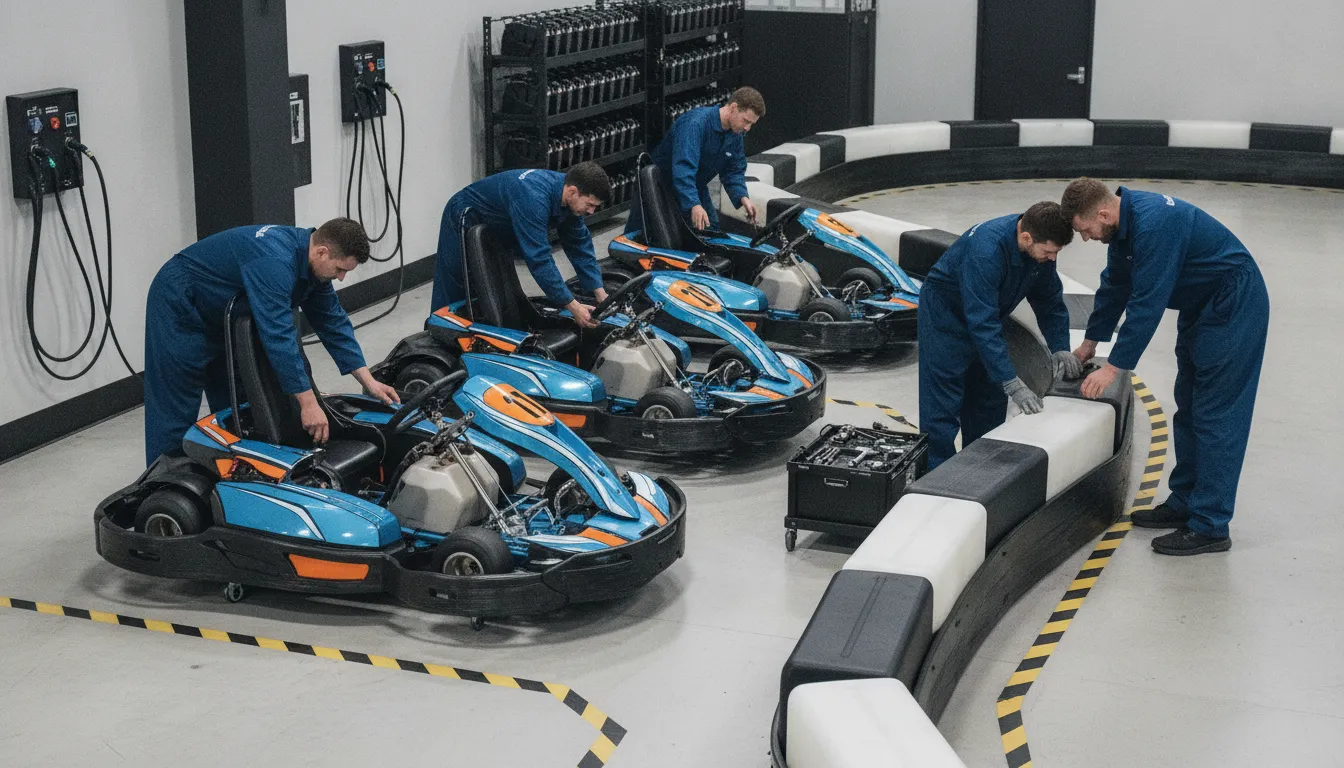
Incident documentation is another control layer. Record what happened, when and where it occurred, the equipment involved, the immediate response, and any follow-up assigned. Avoid treating an incident log as paperwork only. Review it for recurring conditions, unclear procedures, guest-flow problems, or equipment issues that need correction. The related electric go-kart safety systems guide can help operators think through the controls that belong in this section of the plan.
Fleet readiness should include charging ownership and a clear process for identifying karts that are unavailable, partially charged, or awaiting inspection. Plan how the team will stage charged equipment, rotate or assign units according to the operating workflow, and confirm that charging practices match the equipment instructions. Do not rely on memory when a maintenance log can show the current condition of each unit and the action still pending.
The plan should also define parts and technical escalation. Staff can identify symptoms and remove a questionable kart from service, while designated technical contacts determine the next step. Keep commonly needed parts, approved service information, and contact details organized so a minor issue does not become a long interruption. Amusement Products supports attractions through design, maintenance, parts, and technical assistance, giving operators a potential lifecycle support resource.
Use maintenance logs to connect daily observations with planned service, repairs, parts used, and return-to-service approval. Finally, review the attraction with the applicable local authority and confirm permitted use, inspection expectations, emergency procedures, and other site-specific requirements before opening. Requirements depend on the jurisdiction, facility, and equipment. Build those review steps into the launch plan rather than assuming a generic checklist proves compliance. For broader planning support, consider the electric fleet maintenance guide.
Which Go-Kart Systems and Support Roles Should Be Defined?
A go-kart track business plan should identify the systems and ownership model that keep the attraction consistent from opening through close. Start with the fleet. Document the intended rider mix, vehicle count, dispatch approach, and how operators will manage different experience levels. Amusement Products offers four selectable speed levels, Rookie, Novice, Family, and Competition. Treat those settings as operating choices to be configured around your venue, rider policies, and local requirements, not as a substitute for training or supervision. Review the electric go-kart attraction options alongside the planned track experience.
Charging should have a defined place in the daily workflow. Assign responsibility for charging status, vehicle rotation, connector handling, and recording issues. The plan should also explain how charging fits into opening checks, peak-period dispatch, and closing procedures. For system-level details, use the ThunderVolt operating system guide as a planning reference, then confirm the actual requirements for the selected equipment and facility.
Next, map the guest-facing technology. Decide how timing, race control, booking, point-of-sale, and waiver systems exchange information, if they are integrated. A generic booking or POS platform may need configuration or an interface to support availability, check-in, session assignment, and operational reporting. Document who owns data accuracy, who can change session settings, and what happens when a system is unavailable. Include a manual check-in and dispatch fallback so staff can protect the guest flow while technical support investigates the issue. The goal is a clear fallback process, not an assumption that every platform works together automatically.
Parts and technical escalation also belong in the plan. List routine inspection responsibilities, the person who logs faults, the person who decides whether a kart returns to service, and the contact path for technical questions. Keep a practical parts process for identifying the correct component, recording usage, and tracking unresolved issues. The electric fleet maintenance guide can support maintenance ownership and recordkeeping decisions.
Finally, document the handoffs between the manufacturer, distributor, service team, and operator. Amusement Products supports the attraction lifecycle through design, maintenance, parts, and technical assistance. But the plan should state which party supplies each decision, approval, training input, and escalation response. The operator still owns day-to-day procedures, local authority coordination, and staff execution. A written responsibility matrix reduces ambiguity when equipment, software, charging, or guest operations require attention.
How Do You Govern the Launch and Improve After Opening?
A go-kart track business plan should define how the attraction moves from planned concept to controlled operation. Launch governance is the operator’s working system for making decisions, assigning ownership, and learning from real guest use. It is different from a lender review because the focus is execution, reliability, and the guest experience.
Set Readiness Gates and Accountable Owners
Before opening, organize the work into readiness gates. Confirm that the site, track, equipment, guest flow, operating procedures, maintenance process, and local authority requirements have been reviewed for the actual facility and selected equipment. Each gate should have a named owner, an evidence standard, and a decision to proceed, correct, or hold. Assign responsibilities across the operator, attraction lead, maintenance lead, training lead, and project partners. Do not assign a task to a group without naming the person responsible for closing it.
A soft opening gives the team a controlled setting to test the full experience before normal operations. Run the real sequence from booking or check-in through waiver handling, briefing, dispatch, race control, queue recovery, and closing. Watch where guests hesitate, where staff need clarification, and where equipment or facility conditions interrupt the flow. Keep an issue log with the observation, owner, priority, action, and disposition. The log turns scattered comments into decisions that can be reviewed.
Review Feedback and Escalate Deliberately
After opening, schedule regular qualitative reviews rather than relying on one launch-day impression. Combine staff feedback with guest questions, comments, complaints, and observed behavior. Look for repeated friction in wayfinding, instructions, queue transitions, dispatch, or recovery after an interruption. Pair those observations with operator-defined indicators such as whether sessions start as intended, staff explain the process consistently, and maintenance concerns are closed and documented. Do not invent universal benchmarks. Compare results with the standards your team set for this venue.
Maintenance issues should follow a defined escalation path. Staff need to know what they can resolve, what must be recorded for the maintenance owner, and what requires technical assistance or manufacturer review. Keep safety concerns separate from preference changes, and pause an activity when the responsible authority determines that operation is not appropriate.
Iterate Without Losing Control
Use the issue log and feedback review to choose a small number of controlled changes. Assign each change an owner, document the reason, communicate it to staff, and check whether the guest experience improved. Preserve working procedures until the replacement is understood. For broader layout, attraction mix, traffic flow, or lifecycle questions, an FEC design and consultation review can help connect operational observations to practical planning. A complementary FEC operating and marketing plan can keep guest-facing decisions aligned with how the venue actually runs.
Request FEC design and consultation services to review your operating plan before launch.
Frequently Asked Questions
What makes a go-kart track business plan useful to operators?
It connects attraction fit, site readiness, guest flow, equipment, safety, maintenance, and launch ownership, giving teams a shared reference for decisions.
What are the biggest challenges in running a go-kart business?
Challenges include coordinating reservations and walk-ins, consistent dispatch, equipment readiness, and incident or queue recovery. Assign each workflow an owner and escalation path.
What software systems might a go-kart venue need?
A venue may need booking, POS, waiver, customer-record, reporting, and communication systems. Choose tools that support the actual check-in and dispatch workflow.
Should a venue evaluate buying or building go-kart equipment first?
Evaluate site conditions, rider experience, maintenance, support, and safety before choosing. Compare ownership and service workflows, not only the equipment itself.
Plan Your Go-Kart Attraction With Experienced Support
A strong go kart track business plan connects attraction fit, site readiness, guest flow, safety, maintenance, and launch responsibilities. Amusement Products can help FEC operators evaluate these decisions through practical design and consultation support.