
Every minute a commercial go-kart sits idle, your FEC loses revenue. A structured electric go kart fleet maintenance commercial program keeps your track operating at full capacity while managing wear, battery performance, and safety inspections on a predictable schedule.
Get a custom quote for your commercial electric go-kart fleet and speak with Amusement Products about the equipment and support approach that fits your operation.
The goal is a repeatable process that catches small issues before they interrupt operating hours or compromise the guest experience. For broader planning guidance, review our complete guide to commercial electric go-kart fleets, then apply the daily inspection process below to your own track operation.
Daily Kart Inspection Checklist for Commercial Operators
Effective electric go kart fleet maintenance for commercial operators combines daily inspections with scheduled cleaning, battery state-of-health monitoring, replaceable-part checks, and timely software and control-system service. Because electric vehicles have fewer moving parts than conventional vehicles, maintenance can be more focused, but high utilization still accelerates wear on components that affect uptime.
A disciplined opening inspection protects track availability and catches small issues before they become guest-safety or revenue problems. High-frequency fleet operation accelerates wear on replaceable parts, so commercial operators should document findings by kart and remove any unit that does not meet the site’s operating standard.
- Clean and disinfect guest-contact surfaces. Wipe the steering wheel, seat, restraints, controls, and other frequently touched surfaces. Check beneath the seat and around the footwell for debris that could interfere with pedals or controls. Regular cleaning is especially important for large fleets shared by many guests, as noted in fleet-maintenance research from the National Library of Medicine.
- Inspect visible wear and replaceable parts. Examine tires for uneven wear, cuts, exposed material, or low pressure. Check wheel hardware, bumpers, restraints, seat mounts, pedal surfaces, and steering components for looseness, cracking, or damage. Record the kart number and escalate any part that needs replacement rather than returning the unit to service.
- Check the motor and drivetrain area. Look for loose hardware, damaged covers, unusual residue, and anything that could obstruct cooling or movement. Commercial electric go-karts commonly use 3-phase AC induction motors, so verify the motor area and connections according to the manufacturer’s service procedure. Do not open energized components during a routine floor check.
- Test controls and safety functions. Confirm the accelerator returns smoothly, steering moves without binding, braking responds consistently, and the emergency-stop or shutoff function works as designed. Use the facility’s documented test sequence, then review the broader electric go-kart safety protocols before opening the track.
- Log the result before dispatch. Mark each kart as cleared, monitored, or held for service. A consistent record helps managers identify recurring wear patterns and supports the uptime planning described in our guide to commercial electric go-kart fleets.
Schedule a fleet consultation to discuss your inspection workflow with our technical team.
Battery Charging Schedules and Longevity Best Practices
Battery management is central to reliable electric go-kart fleet maintenance commercial operators can depend on. In a high-throughput FEC, charging should be treated as a scheduled operating process, not an end-of-day improvisation. Assign responsibility for charging, record each kart’s status, and make battery condition visible to the team before the first race session.
Build charging into the operating rhythm
Use a written rotation that identifies which karts are available, charging, cooling, or awaiting inspection. After a busy operating period, connect eligible karts according to the manufacturer’s approved charging procedure rather than repeatedly topping off whichever kart is nearest the charger. Keep charging equipment and connectors clean, dry, and free of visible damage. Separate any kart that shows unusual heat, swelling, odor, damaged cabling, or inconsistent performance, and route it for qualified inspection before returning it to service.
Charging records should include the kart identifier, date, operating symptoms, and any abnormal charge behavior. This simple history helps managers spot repeat issues before they become a track-availability problem. It also supports more consistent fleet rotation, so the same vehicles are not exposed to every peak-demand session.
Monitor state of health, not just charge level
A charge indicator tells the team how much energy is available now. Battery state of health (SoH) provides a longer-term view of capacity and performance. Routine SoH monitoring is essential for protecting lap consistency and track availability. While estimating remaining useful life (RUL) can help reduce maintenance costs, safety hazards, and operational downtime, according to research indexed by PubMed.
Review SoH and RUL trends alongside runtime, charging behavior, and driver reports. A gradual decline can be planned into a maintenance window, while a sudden change deserves immediate investigation. For additional guidance, review our electric go-kart battery maintenance resources.
Electric vehicles generally require less maintenance and repair than conventional vehicles because they have fewer moving parts, but that advantage does not eliminate battery controls. A documented charging schedule and condition-based replacement plan turn lower routine maintenance requirements into dependable fleet uptime.
When to Replace Go-Kart Tires on a Commercial Track
Tires are replaceable wear components, and high-frequency fleet operation accelerates their service needs. Research on electric vehicle fleets links increased vehicle use with greater wear on replaceable parts, making scheduled inspection essential. On a commercial track, tire replacement should be based on observed condition and operating history, not a calendar date alone.
Inspect for uneven wear and damage
Check each tire during the daily fleet inspection, with particular attention to the shoulders, center tread, sidewalls, and bead area. Look for visibly reduced tread, flat spots from hard braking, cupping, cracks, exposed cord, punctures, and wear concentrated on one side. Electric karts can place additional stress on the driven tires because instant motor torque delivers acceleration immediately. If one kart develops a repeatable wear pattern, inspect alignment, steering, wheel condition, and driving behavior before returning it to high-volume service.
Use condition and track data together
There is no universal replacement interval for every commercial operation. Surface type, kart specification, compound, rider volume, corner layout, and setup all change tire life. Establish a track-specific baseline by recording tread measurements, hours or sessions in service, and the location of each tire. Follow the tire and kart manufacturer’s minimum tread-depth and damage limits. Replace a tire when it reaches that limit or shows structural damage, even if its scheduled interval has not arrived. When the limit is not documented, ask the manufacturer rather than guessing.
Worn tires can reduce grip, lengthen braking consistency, and alter lap times from kart to kart. That creates a less predictable guest experience and can increase the risk of avoidable incidents. Planned replacement protects revenue by reducing unplanned downtime, keeping fleet performance consistent, and helping operators identify related mechanical issues before they affect more karts.
Common Electric Kart Issues and How to Diagnose Them
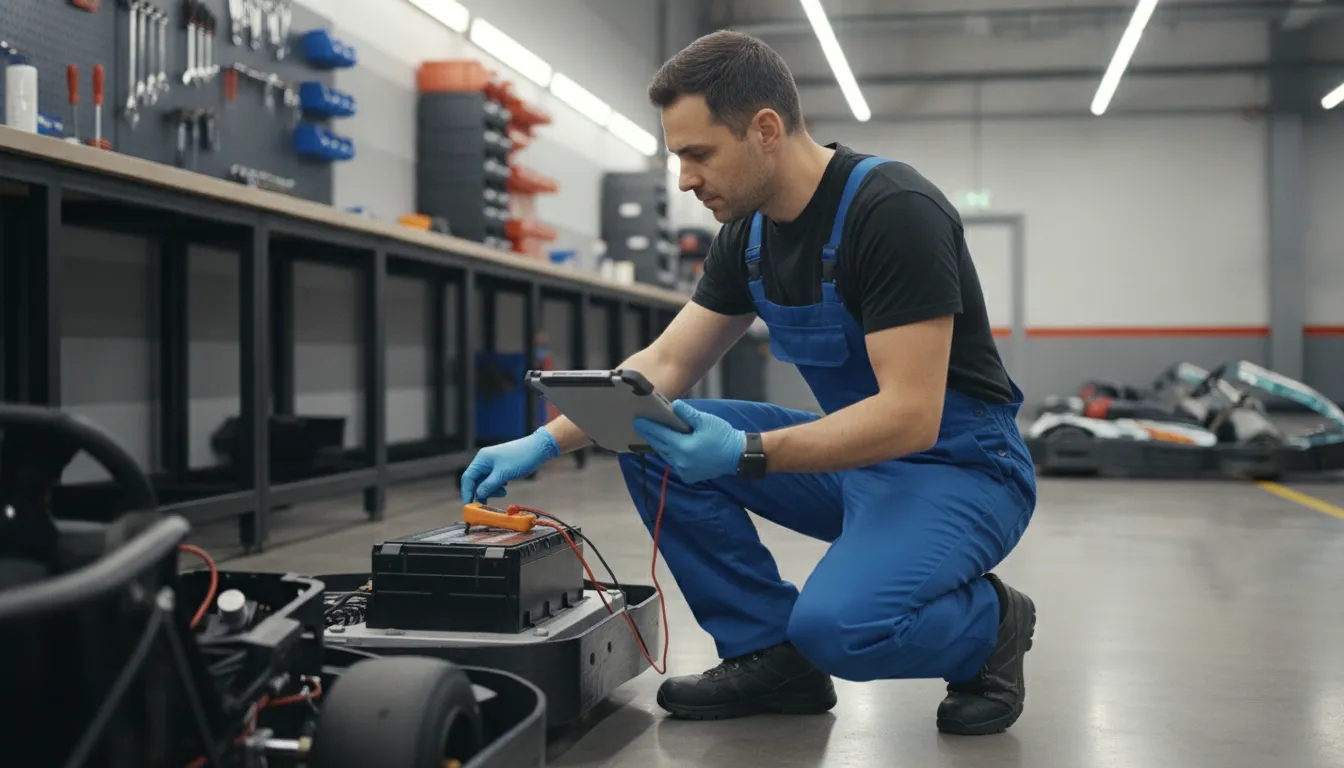
Commercial electric kart fleets are designed to reduce routine mechanical complexity, but they still require structured diagnosis. High-frequency operation increases wear on replaceable components, while modern fleets add software and control systems that can affect availability. Treat troubleshooting as part of revenue protection: identify the symptom, isolate the subsystem, and document the repair before returning a kart to service.
Battery and motor controller faults
Battery degradation often appears as reduced runtime, inconsistent acceleration, or a kart that drops into a protective power mode sooner than expected. Compare the affected kart’s state of charge, state of health, voltage behavior, and runtime with fleet baselines. A battery diagnostic tool or the kart’s service interface can help distinguish a capacity problem from a charging fault. Estimating battery remaining useful life can reduce maintenance cost, safety hazards, and operational downtime, according to research indexed by PubMed.
Motor controller faults may produce intermittent power loss, error codes, uneven acceleration, or no response from the throttle. Record the code and operating conditions first. Then inspect controller connections, confirm the battery supply is within the manufacturer’s specified range, and test the kart under controlled conditions. Do not bypass a protective shutdown to keep a kart in rotation.
Wiring, software, and brake checks
Loose, contaminated, or heat-damaged connectors can mimic a failed battery or controller. With power isolated, inspect terminals, harness routing, grounds, and connector locks. Look for corrosion, chafing, discoloration, and signs of water or debris intrusion. Repair the root cause, secure the harness, and retest before releasing the kart.
Software maintenance now belongs alongside hardware upkeep in electric commercial fleets. Review fleet-management logs for communication failures, stale kart status, incorrect speed settings, or incomplete updates. The ThunderVolt operating system should be checked using the applicable service procedures, with configuration changes recorded for the maintenance team.
Regenerative braking can reduce wear on traditional brake components, but it does not eliminate brake inspections. If stopping distance, pedal feel, or braking balance changes, check adjustment, friction surfaces, cables or hydraulic components, and sensor feedback according to the manufacturer’s procedures. Remove any kart with a safety-related brake concern from service until the issue is verified and corrected.
How Electric Go Kart Fleet Maintenance Protects Commercial FEC ROI
Maintenance should be managed as a revenue-protection program, not an unexpected line item. Electric karts have fewer moving parts than conventional gas-powered vehicles, which generally means fewer maintenance and repair requirements overall. That advantage is realized only when operators turn it into a disciplined operating routine. Research has also linked higher fleet use with increased wear on replaceable parts, making scheduled inspections essential.
| Factor | Electric Go-Kart Fleet | Gas-Powered Fleet |
|---|---|---|
| Moving parts requiring service | Fewer (motor, controller, battery) | More (engine, carburetor, fuel system, exhaust) |
| Annual maintenance cost per kart | Lower (fewer consumables, no engine servicing) | Higher (fuel, oil, filters, carburetor, exhaust) |
| Indoor ventilation cost | None (zero emissions) | Required (expensive HVAC) |
| Brake component life | Extended via regenerative braking | Standard wear rate |
| Inspections needed | Daily visual + scheduled SoH checks | Daily visual + engine/emissions checks |
Request a cost analysis for your fleet transition to compare electric versus gas operating expenses for your specific track volume and facility.
Set the calendar by operating frequency
Build one maintenance calendar around the pace of your track, then assign ownership for every check. A practical schedule can include:
- Daily: Inspect tires, steering, restraints, bodywork, charging connections, and visible wiring. Clean high-touch surfaces and record any kart removed from service.
- Weekly: Review tire and brake wear, examine fasteners and safety systems, clean equipment thoroughly, and compare each kart’s performance with the fleet baseline.
- Monthly: Review battery state-of-health trends, charging behavior, fault codes, and downtime. Confirm that software and operating-system updates are documented before returning karts to service.
- Annually: Complete a deeper inspection of batteries, motors, electrical connections, chassis components, and safety controls. Use the findings to plan parts, labor, and replacement timing before peak season.
Track cost, uptime, and early warning signals
Record labor, parts, charging issues, downtime, and completed work by kart identification number. Cost per kart is more useful than a single fleet-wide total because it reveals which units are becoming expensive to operate. Pair those records with telematics and remote diagnostics. ThunderVolt remote diagnostics can give operators a practical way to identify fault patterns and prioritize service before a minor issue becomes a missed session or an avoidable outage.
Electric propulsion also supports indoor, year-round operation without the exhaust ventilation required by gas-powered karts. That makes uptime especially valuable: each well-maintained unit can remain available for more scheduled sessions in a controlled environment. Review the maintenance data during fleet planning, and use it alongside our complete guide to commercial electric go-kart fleets when evaluating capacity, service requirements, and long-term ROI. Operators comparing equipment can also review these commercial-grade electric go-karts.
Frequently Asked Questions
What are the main maintenance requirements for commercial electric go-karts?
Use a scheduled inspection routine that covers tires, steering, restraints, bodywork, charging connections, battery condition, braking performance, and safety controls. High-frequency fleet use increases wear on replaceable parts, so inspections should be tied to operating volume rather than handled only when a kart fails. Cleaning is also essential in shared fleets, both for presentation and for maintaining equipment between guest sessions. Document each inspection, defect, repair, and return-to-service decision so your team can identify repeat issues and protect track availability. Research on shared electric fleets also emphasizes scheduled inspections and adequate cleaning services as core maintenance needs (National Institutes of Health).
How often should an FEC check electric go-kart batteries?
Check battery state of charge before operation and monitor state of health as part of a recurring maintenance program. Review charging behavior, unusual heat, reduced session performance, and changes in usable runtime. A battery that still accepts a charge may nevertheless be losing capacity, so maintenance records should track performance over time rather than relying on a single reading. Battery remaining-useful-life estimation can help reduce maintenance costs, safety hazards, and operational downtime in demanding electric vehicle applications (PubMed).
Do electric go-karts need brake maintenance?
Yes. Inspect the complete braking system, including pads or other friction components, linkages, controls, and stopping consistency. Regenerative braking can reduce wear on traditional braking components, but it does not eliminate the need for functional checks or replacement of worn parts. Any kart with inconsistent braking, unusual noise, delayed response, or damage should be removed from service until a qualified technician evaluates it. Electric vehicle maintenance research identifies regenerative braking as one factor that can reduce conventional brake wear (National Institutes of Health).
How can operators reduce downtime across a go-kart fleet?
Use preventive maintenance records, standard inspection checklists, clear defect codes, and defined return-to-service criteria. Keep common replacement parts available, separate minor corrective work from safety-critical repairs, and review downtime by kart and failure type each month. Include software and control-system checks alongside physical maintenance, because electric fleets depend on both hardware and software for reliable operation. This approach helps maintenance teams address developing problems before they remove multiple karts from revenue-generating service.
Ready to Strengthen Your Electric Go-Kart Fleet Maintenance Plan?
A consistent maintenance approach helps commercial FEC operators protect uptime, manage wear, and keep fleet performance aligned with daily operating demands. If you are reviewing your current process or planning a fleet upgrade, our team can discuss practical next steps for your facility.
Request a consultation for your commercial electric go-kart fleet maintenance needs and speak with Amusement Products about the equipment and support approach that fits your operation.