A go-kart track can become a central attraction in a family entertainment center, but the track itself is only one part of the business decision. Before selecting equipment or drawing a layout, operators need to test demand, evaluate the site, understand local requirements, and define how guests, staff, and vehicles will move through the experience.
Request FEC design and consultation for your go-kart track project.
Starting a go kart track business requires a feasibility process that connects market research, site selection, track and fleet planning, permitting, safety, staffing, and ongoing support. The right sequence helps you identify constraints early and build a practical operating plan instead of relying on a universal startup formula.
The U.S. Small Business Administration recommends using market research to assess customers and existing businesses, then developing a business plan to guide structure, operations, growth, and funding needs. With that foundation in place, the next step is to examine what the project must accommodate before committing to a site or attraction plan.
What Does Starting a Go Kart Track Business Require?
Starting a go-kart track business is a feasibility-to-opening process, not simply an equipment purchase. You need to confirm that the attraction fits its market, site, facility, operating model, and local requirements before committing to construction or a fleet. The sequence below gives an FEC owner a practical starting framework.
- Define the attraction and customer. Decide whether the track will serve families, competitive riders, parties, tourists, or a broader mix. Clarify how it fits with other attractions, food service, events, and the overall guest experience. An FEC equipment planning guide can help you evaluate the attraction mix and facility requirements together.
- Test the opportunity. Research the customer base, nearby alternatives, access patterns, and the reasons guests would choose your venue. The U.S. Small Business Administration recommends market research to identify potential customers and businesses already operating in the area. See the SBA business-startup steps for the broader research process.
- Evaluate the site. Review the available building or land, traffic flow, utilities, access, neighboring uses, and room for safe loading, unloading, queuing, and future changes. Zoning, permits, insurance, and safety duties must be verified for the specific jurisdiction with the appropriate local authorities and qualified professionals.
- Build the operating plan. Document the track concept, fleet requirements, control systems, staffing, training, maintenance, guest rules, emergency procedures, and opening-day workflow. These decisions should be made together because layout and equipment affect how the attraction is supervised and operated.
- Prepare the business plan. The SBA describes a business plan as a roadmap for structuring, running, and growing a business. It should connect your market assumptions, site, design, operating model, funding needs, and launch schedule. The plan also helps estimate the funding required to start, without treating projections as guarantees.
Before selecting a supplier or finalizing drawings, have the concept reviewed by the relevant design, engineering, legal, insurance, and regulatory professionals. A well-sequenced plan exposes site or operating constraints early, when they are easier to address.
How Do You Test Demand and Choose a Site?
A strong concept can still struggle if the site does not match its audience, access needs, or operating requirements. Treat site selection as a feasibility exercise, not simply a search for available land or an empty building. The U.S. Small Business Administration notes that market research combines consumer behavior with economic trends, while location decisions can affect legal requirements and revenue. Use that framework before committing to a layout or equipment plan.
- Define the customer area. Map where likely guests live, work, and spend leisure time. Review population age, family composition, household wealth, interests, and other demographic indicators that fit your attraction mix. Then estimate a realistic customer radius based on travel patterns, road access, nearby destinations, and whether the track will serve local repeat guests, destination visitors, or both. The SBA recommends examining demand, market size, economic indicators, and customer location as part of market assessment. Review the SBA market research guidance for the questions to document.
- Test demand and competition. Identify existing go-kart tracks and other attractions competing for the same family, teen, group, and corporate outings. Compare their location, experience, hours, capacity, customer feedback, and attraction mix rather than copying their positioning. Competitive analysis should help you define a clear edge, such as a better fit for your market or a stronger connection to a broader FEC. Do not treat online interest alone as proof of demand.
- Inspect the property and access. Evaluate building or land dimensions, visibility, traffic patterns, parking, pedestrian movement, emergency access, loading areas, noise considerations, and room for expansion. Check whether the proposed track can support safe circulation without creating conflicts between guests, staff, and vehicles. Confirm electrical service, drainage, ventilation, lighting, communications, and other utilities with qualified professionals. A site that looks adequate on a map may not support the required guest flow or operating systems.
- Verify local feasibility before design is final. Licensing and permit requirements depend on the business activity, state, county, city, and other government rules, so confirm them with local authorities. Engage zoning, engineering, legal, insurance, and financial professionals early. The SBA startup guide emphasizes researching the requirements that apply to your own location. A qualified attraction-planning partner can then translate the findings into a site evaluation, traffic-flow plan, capacity assumptions, and a practical next-step sequence.
How Should You Plan Track Layout, Fleet, and Guest Flow?
Track planning should connect the physical ride experience to the way guests enter, wait, drive, exit, and move to the next attraction. Treat the layout, kart fleet, controls, and queue as one operating system rather than separate purchases. Indoor and outdoor sites can both work, but the right choice depends on the building or land, site conditions, guest mix, and the operating model you can support.
| Planning area | Indoor | Outdoor |
|---|---|---|
| Layout and site fit | Work around columns, clear height, sightlines, ventilation, pedestrian separation, and the locations of loading and unloading areas. | Evaluate grade, drainage, weather exposure, access routes, fencing, lighting, and how the track connects to the rest of the property. |
| Guest movement | Keep queues, spectators, drivers, and nearby attractions from competing for narrow interior paths. Make the route from check-in to staging easy to understand. | Plan for longer walks, changing conditions, shade or shelter, and clear pedestrian routes between parking, registration, the pit, and the track. |
| Operations and expansion | Coordinate controls, signals, charging or service areas, storage, and future attraction phases within a fixed envelope. | Reserve space for service access, utility extensions, traffic changes, and future phases without forcing guests through active operating areas. |
At the drawing stage, check grade or flatness, turn radii, sightlines, signals, control systems, kart performance specifications, and the exact points where drivers load and unload. These details affect how easily attendants can brief guests, respond to a stopped kart, and keep each session moving. A well-planned queue should not block the exit from the previous race or create a pedestrian shortcut across the operating area. Review the go-kart track design planning resource before fixing the footprint.
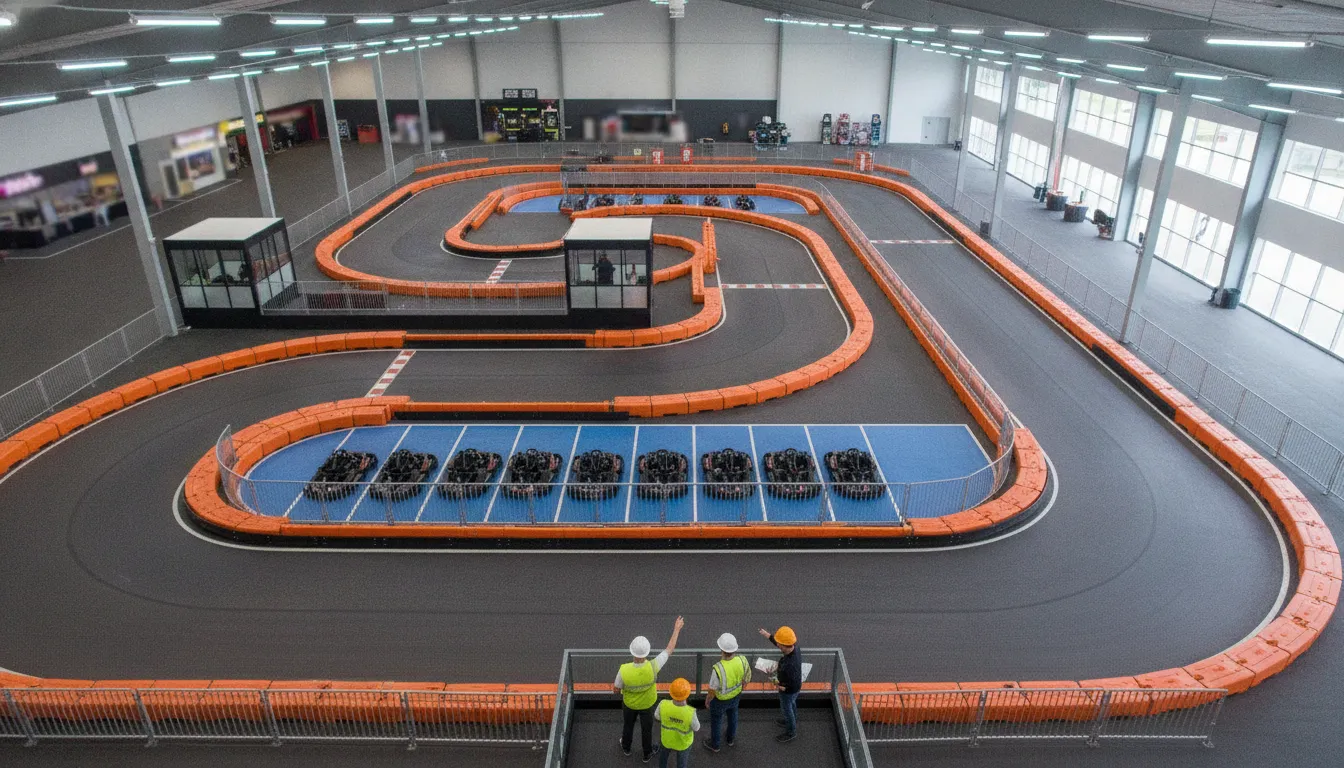
Fleet planning is more than selecting a number of vehicles. Match the fleet to the intended driver groups, track geometry, dispatch process, charging or maintenance workflow, and any operating modes supported by the selected equipment. Review commercial electric go-karts against your requirements, and confirm model-specific capabilities before making a final specification.
Capacity should be modeled as a guest-flow question, not just a kart-count question. Account for briefing time, loading, unloading, dispatch intervals, recovery from interruptions, queue space, and attendant visibility. Leave a practical path for expansion, such as additional fleet, revised staging, or a future track phase. The customer’s commercial go-kart safety systems information can also help frame control and safety-system discussions. For a complete plan, connect layout, capacity, traffic flow, and expansion decisions through professional FEC design and consultation.
What Permits, Safety, and Insurance Work Comes Before Opening?
Permits and operating obligations should be part of the track plan from the beginning, not a final inspection checklist. The U.S. Small Business Administration notes that licenses and permits vary by industry, state, location, business activity, and government rules. Start by asking the city, county, and state authorities which approvals apply to the property and attraction. Review zoning, building, fire, electrical, accessibility, environmental, signage, and business requirements with the appropriate local offices. SBA licensing guidance is a useful starting point, but it is not a substitute for local confirmation.
Safety design also requires qualified review. Have the track, structures, electrical systems, controls, and emergency access evaluated by the appropriate engineers and authorities having jurisdiction. Ask an insurance professional to review general liability, property, workers’ compensation, vehicle or equipment exposures, incident reporting, and any coverage conditions before committing to an operating model. Legal counsel can help interpret waivers, supervision duties, accessibility obligations, and local regulations. Requirements and coverage expectations differ, so do not treat another facility’s documents as a universal template.
Turn safety concepts into documented operating procedures
Your procedures should explain how guests enter and exit karts, how operators control dispatch and speed, how staff respond when a ride stops or a collision occurs, and how inspections are recorded. Plan physical separation between karts, staff, and pedestrians. Define loading and unloading zones, queue boundaries, crossing points, emergency routes, and access for maintenance. Barriers should be selected and reviewed for the layout and operating conditions, rather than added as generic decoration.
As a clearly labeled state-specific example, Maryland’s go-kart regulation addresses noncrossing track paths, designated loading areas, barriers, pedestrian access, wheel guarding, rollover protection in applicable designs, and lap and shoulder restraints. These are examples from Maryland COMAR 09.12.64.08, not universal requirements for every track. Use them to prompt questions, then have local authorities, engineers, legal counsel, and your insurer identify the rules that apply where you operate.
How Do You Build the Operating Plan for Staffing and Maintenance?
A track can be well designed and still underperform if the operating plan is unclear. Build the plan around who owns each decision, how the attraction is checked before guests arrive, and how issues are documented and resolved. The FEC Success Institute curriculum treats staffing, scheduling, insurance, legal and regulatory considerations, and cost control as connected operating disciplines, not isolated tasks.
Assign roles and train for the full guest journey
Define responsibility for opening the track, welcoming and briefing drivers, controlling dispatch, monitoring the course, responding to a stopped kart, and closing the attraction. Supervisors should know when to pause operations and who must be notified. New team members need more than a script. Train them on rider instructions, control systems, emergency communication, accessibility procedures, incident documentation, and escalation to a manager. Use the go-kart track staffing and operations guide to develop the role descriptions and training checklist around your venue.
Make inspections and maintenance repeatable
Create opening and closing checklists for the track surface, barriers, loading area, gates, signals, controls, restraints, karts, charging equipment, and guest-facing areas. Record the date, person responsible, condition found, corrective action, and approval to return equipment to service. A maintenance log should also track recurring faults, parts replaced, technician notes, and outstanding work. This record helps managers identify patterns before a minor issue becomes an operating interruption.
Document an incident response sequence for collisions, injuries, equipment faults, guest complaints, and weather or facility interruptions. Include immediate scene control, first-aid or emergency calls as appropriate, manager notification, evidence preservation, and follow-up reporting. Review incidents with the team without assigning blame, then update training or procedures when the review identifies a gap.
Schedule against demand and measure what matters
Schedule coverage for expected arrival patterns, group events, breaks, cleaning, inspections, and maintenance windows. Track practical operating measures such as dispatch delays, session cancellations, repeat equipment faults, inspection completion, incident frequency, training completion, and guest feedback. Pair these measures with observations from supervisors. The commercial go-kart safety systems page can help operators evaluate control and safety features that support consistent procedures.
How Can Starting a Go Kart Track Business Stay Ready for Opening Day?
The final handoff should turn a feasible concept into an attraction the team can operate consistently. Before announcing an opening date, confirm that the site plan, equipment, training, approvals, and guest experience all work together. This is also the point to identify unresolved decisions rather than treating a construction milestone as proof of readiness.
- Recheck the approved project assumptions. Compare the installed layout with the feasibility work, site constraints, planned attraction mix, traffic flow, loading areas, and future expansion concept. If the design changed, update the operating and financial models before relying on the original plan.
- Confirm equipment and documentation. Verify that the selected fleet, controls, signals, barriers, charging or service procedures, spare parts, and operating documents match the final track. When assessing a supplier, use this commercial go-kart manufacturer guide to review questions about integration, commissioning, training, and ongoing support.
- Complete the local approval and insurance handoff. Have the owner, contractor, engineer, insurer, and relevant authorities confirm their responsibilities. Permits, zoning, inspections, insurance requirements, and safety duties vary by jurisdiction, so do not treat another facility’s approval process as a universal checklist.
- Train the team against written procedures. Run practical sessions for guest briefing, loading, dispatch, shutdowns, incidents, weather or facility interruptions, inspections, cleaning, charging, and maintenance escalation. The opening team should know who makes each decision and where every record is kept.
- Test the guest journey before opening. Walk the route from arrival and waiver completion through briefing, loading, riding, unloading, payment, and exit. Use staff and invited reviewers to identify confusing signs, bottlenecks, accessibility concerns, or communication gaps. Resolve safety-critical findings before scheduling public sessions.
Choose a partner that can stay involved beyond equipment delivery. Amusement Products’ operating history includes equipment, design, construction, education, and ongoing support for FEC owners and operators. Ask who will support commissioning, staff education, troubleshooting, parts, and later expansion, and make those expectations clear in writing.
Request FEC design and consultation for your track launch plan.
A structured review can connect site evaluation, feasibility, traffic flow, capacity, permitting support, and expansion planning before the opening date is fixed. It should complement, not replace, advice from local legal, insurance, engineering, and financial professionals.
Talk with Amusement Products about your go-kart track plan before you finalize the next step.
Frequently Asked Questions
How do you start a go-kart track business?
Start with market research, site and demographic analysis, a clear operating model, and a written business plan. Then evaluate track layout, fleet, guest flow, staffing, maintenance, insurance, permits, and financing before committing to construction. The U.S. Small Business Administration describes a business plan as a roadmap for structuring, running, and growing a business.
Is go-kart racing profitable?
It can be a viable FEC attraction, but profitability is not automatic. Results depend on demand, site fit, competitive positioning, operating hours, throughput, staffing, maintenance, financing, and how well the track works with the rest of the facility. Test those assumptions with local research and a financial model rather than relying on a universal revenue or payback claim.
How much does it cost to make a karting track?
There is no responsible one-size-fits-all figure. The project scope changes with indoor or outdoor conditions, available site work, track design, controls, barriers, fleet, utilities, construction, local approvals, insurance, and the surrounding FEC plan. Build a site-specific plan and budget from verified quotes, engineering input, and your operating requirements.
What permits are needed for a go-kart track?
Requirements vary by the activity, property, and state, county, or city. Review zoning, building, fire, electrical, business, accessibility, environmental, and amusement-related requirements with the relevant authorities and qualified local professionals. The SBA notes that licenses and permits depend on business activities and location, so do not treat another jurisdiction’s checklist as universal.
Ready to Plan Your Go-Kart Track Project?
A go-kart track benefits from coordinated decisions about site fit, guest flow, safety, equipment, and day-to-day operations before construction begins. Amusement Products can help you evaluate those connected requirements and shape a practical direction for your FEC.
Request design and consultation for your go-kart track.
Use that conversation to clarify your goals, identify planning questions, and determine the next steps for your location.