
How long does it take to build a miniature golf course? For a commercial FEC project, the on-site construction phase can take 2 to 4 weeks after the site is ready and the design is approved. The full calendar is longer because site evaluation, design, permitting, procurement, site preparation, inspections, and opening preparation happen before and after that construction window. For a project-specific sequence, start with championship miniature golf construction guidance, then confirm the schedule with the builder.
Schedule a miniature golf design and consultation
What Is the Typical Timeline for a Commercial Mini Golf Course Build?
There is no single timeline that applies to every commercial miniature golf course. A purpose-built FEC attraction may move quickly once the site, scope, drawings, approvals, materials, and construction crew are aligned. A project with complex grading, drainage, utilities, water features, extensive theming, or unresolved approvals needs more calendar time.
The most useful way to think about the schedule is as a sequence of gates:
- Feasibility and site evaluation: Confirm that the property, access, circulation, utilities, drainage, and operating concept can support the course.
- Concept and design: Develop the hole layout, theme, play flow, accessible routes, features, and relationship to the rest of the FEC.
- Approvals and pre-construction: Complete the drawings, specifications, permits, site agreements, procurement, and construction planning required for the project.
- Site preparation: Establish the grades, foundations, utilities, drainage, walkways, and other site conditions needed for the course.
- Course construction: Build the playing surfaces, retaining elements, themed features, paths, lighting, landscaping, and related components.
- Commissioning and opening: Inspect the experience, correct punch-list items, train the operating team, and prepare the attraction for guests.
Q: How long does it take to build a miniature golf course?
A: The construction phase for an Amusement Products miniature golf course is typically 2 to 4 weeks, while the complete project timeline depends on design, approvals, site readiness, scope, weather, and opening requirements.
Design Phase: How Long Does Planning and Permitting Take?
Planning time is driven less by the number of holes than by how many decisions must be coordinated before work begins. The design team needs to understand the property, the intended audience, the operating model, the available footprint, the desired theme, and how guests will move through the attraction. A course that looks attractive in isolation still needs to function within the larger FEC.
Early site evaluation should address:
- Property boundaries, setbacks, access, parking, and the relationship to nearby attractions.
- Topography, drainage, soil conditions, existing structures, and areas requiring site work.
- Utility routes, lighting requirements, service access, and maintenance circulation.
- Guest entry and exit points, queue space, accessible paths, and emergency access.
- Local approvals, zoning questions, permit requirements, and any environmental or site restrictions.
After the site information is understood, the design can progress through a concept layout, client feedback, detailed drawings, construction documentation, and specifications. The approval path varies by jurisdiction and property. Local authorities may require additional drawings, engineering, drainage information, or inspections, so permitting should be treated as a schedule gate rather than a box to check at the end.
Amusement Products has designed, built, and operated miniature golf courses since the early 1960s. That operator experience matters during planning because the layout must account for throughput, supervision, maintenance, guest flow, and the practical realities of running the attraction after opening. Its miniature golf course design themes and layouts resource provides additional context for the design decisions that shape the project.
Construction Phase: Typical Timelines by Course Size
Course size affects the amount of work, but it does not determine the schedule by itself. A compact course on a prepared site may move differently from a larger course with significant elevation changes, water features, extensive theming, or complicated utility work. The construction sequence also depends on whether site preparation is complete before the course crew arrives.
For Amusement Products projects, the typical miniature golf construction phase is 2 to 4 weeks from groundbreaking to completion. That window should be understood as the active construction period, not as a promise that every project will open four weeks after the first conversation. The earlier design and approval work, and the later inspection and opening work, still need to be scheduled.
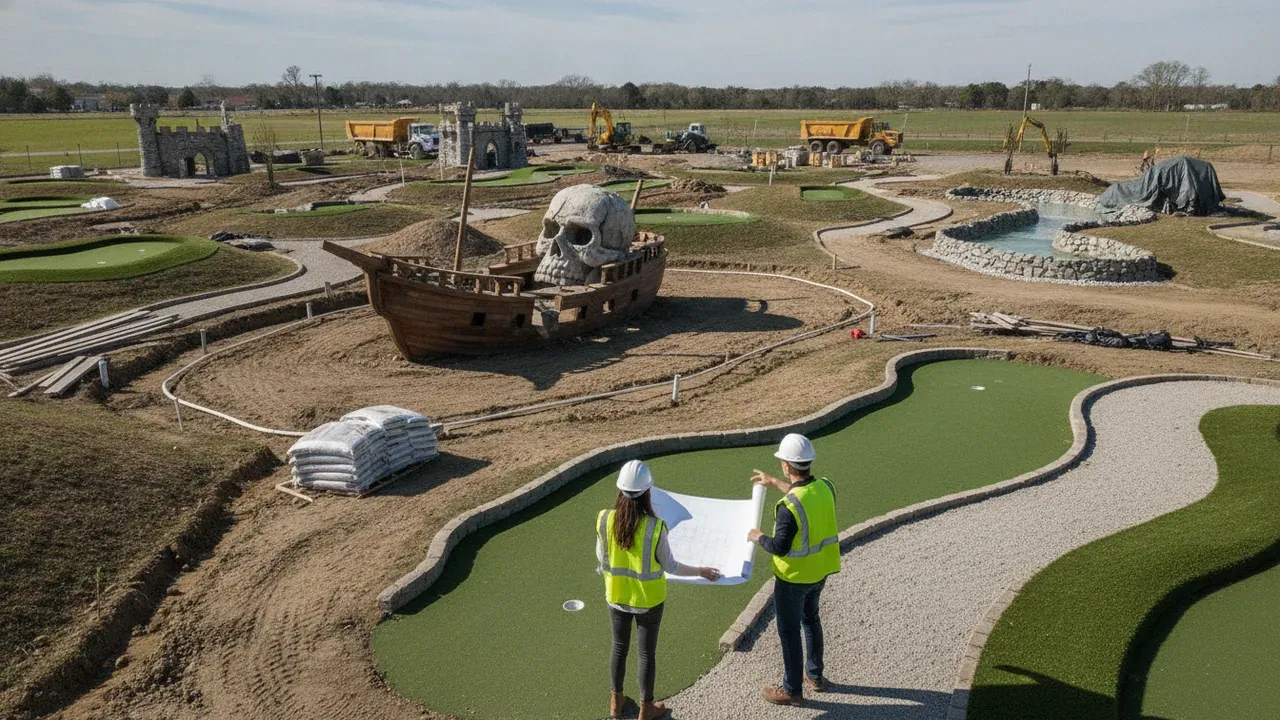
A practical construction schedule may include:
- Mobilization and layout: Confirm the approved plan on the site and establish work areas, access, and reference points.
- Earthwork and base preparation: Shape grades, prepare foundations, coordinate drainage, and establish the base for playing surfaces and paths.
- Course features and surfaces: Install the hole structures, obstacles, retaining elements, greens, walkways, and themed components.
- Utilities and finish work: Complete lighting, water or electrical connections where applicable, landscaping, railings, and guest-facing details.
- Inspection and corrections: Walk the course, test the experience, address punch-list items, and confirm that the completed attraction matches the approved plan.
Progress updates during construction help the owner make timely decisions when field conditions require clarification. If the scope changes, documented change orders keep the schedule and responsibilities visible to everyone involved.
What Delays Commercial Mini Golf Builds and How Can You Avoid Them?
Most schedule problems begin before the first construction activity. A site that is not ready, a permit that is still unresolved, a late decision on the theme, or a utility conflict can interrupt the planned sequence. Weather can also affect earthwork, concrete, landscaping, and other outdoor activities.
Common delay risks include:
- Unclear scope: Confirm the hole count, theme, features, paths, lighting, landscaping, and operating requirements before final documentation.
- Late site information: Provide accurate surveys, utility details, grades, setbacks, and property constraints early.
- Permit changes: Ask the local authority what documentation and inspections apply before the construction schedule is fixed.
- Uncoordinated vendors: Assign responsibility for site work, utilities, landscaping, theming, and course construction so handoffs are explicit.
- Material or equipment lead times: Confirm what must be selected, ordered, or delivered before the crew can maintain its sequence.
- Opening tasks left too late: Plan staffing, operating procedures, safety checks, signage, reservations, and training alongside construction.
The best schedule is not the shortest estimate on paper. It is the schedule that identifies dependencies, assigns owners, leaves room for required inspections, and gives the operator a clear decision point before each major phase.
Request a project-specific FEC design and consultation
How Should You Plan Your Opening Date Around Construction?
Work backward from the date guests are expected to play, then add time for every activity that must be complete before opening. The public opening is not the same as the day the last construction task is finished. The operator still needs time to inspect the course, resolve punch-list items, train staff, test guest flow, prepare the point-of-sale process, and coordinate marketing and reservations.
Build the opening plan around these checkpoints:
- Design freeze: Confirm that the approved layout and specifications are the version being built.
- Site-ready date: Verify that grading, access, utilities, drainage, and staging conditions are ready for construction.
- Construction completion: Reserve time for the final walk-through, corrections, cleaning, landscaping, and installation checks.
- Operational readiness: Train the team on opening and closing routines, guest supervision, maintenance, accessibility, and incident response.
- Soft opening: Use a controlled trial period to observe queues, pace, wayfinding, staffing, and guest questions before the public launch.
Leave a buffer between substantial completion and the advertised opening date. That buffer protects the customer experience if an inspection, weather event, correction, or supplier handoff takes longer than expected. It also gives the operating team a chance to learn the course before it is busy.
Indoor and outdoor projects have different scheduling risks. An outdoor course may need more attention to weather, drainage, landscaping, and seasonal conditions. An indoor project may depend more heavily on the building shell, floor conditions, occupancy requirements, and coordination with other trades. The indoor versus outdoor miniature golf guide can help operators compare those planning considerations.
Frequently Asked Questions About Miniature Golf Construction Timelines
What is the fastest a commercial miniature golf course can be built?
The active construction phase can be as short as 2 to 4 weeks for an Amusement Products course when the site is prepared, the design is approved, materials and responsibilities are coordinated, and required approvals are in place. The full project should still include planning, inspections, commissioning, and opening preparation.
Does an 18-hole course always take longer than a smaller course?
Not always. Size matters, but the schedule also depends on site conditions, theming, elevation, drainage, utilities, access, and the amount of preparation required. A smaller course with a difficult site can take more coordination than a larger course on a ready property.
When should permitting begin?
Permitting should begin as soon as the site and concept provide enough information for the local authority to review the project. The exact process varies by jurisdiction, so the owner and design team should identify the required drawings, approvals, and inspections before setting a firm opening date.
What should an operator ask a miniature golf builder?
Ask how the builder handles site evaluation, design revisions, construction documentation, site preparation, progress updates, change orders, inspections, commissioning, and opening support. Also ask which tasks belong to the builder, the owner, local contractors, and other vendors.
How can I get a more accurate construction schedule?
Provide the builder with the site location, survey information, property constraints, intended course scope, desired opening date, utility details, and any existing plans. A design and consultation process can then turn those inputs into a sequence with clearer dependencies and decision dates.
Schedule a consultation for your commercial miniature golf project