Mobile bumper cars can mean more than one thing to an FEC operator. You may want cars that can be moved within one facility, an attraction that can be set up at temporary venues, or a seasonal installation with a changing footprint. Those use cases raise different equipment, site, and operating questions. Define the intended use before comparing options, and verify each requirement with the manufacturer and the venue. This guide gives you a practical way to prepare.
Discuss your bumper car project
Prefer to speak directly? Call Amusement Products at (423) 892-7264 to start a conversation about your plans.
What does mobile need to mean for your project?
Start with the outcome you need, not a broad product label. In a permanent FEC, “mobile” might mean that equipment can be moved during maintenance or when the facility is reconfigured. That does not automatically mean the ride is designed to travel to events. For an event operator, mobile may mean repeated transportation, installation, operation, and removal at more than one site. A seasonal attraction can sit between those cases: it may remain in one venue for a defined period but need to be stored or relocated later.
Write a one-sentence use case. For example: “We need a bumper car attraction for one fixed indoor venue, with equipment movement limited to planned service.” Or: “We are evaluating whether a traveling attraction can work at a list of temporary venues.” The sentence forces you to state what changes and what stays fixed. It also helps suppliers respond to the same question instead of assuming that “mobile” has one standard meaning.
- Move within one venue: Identify which components may need to move, why, how often, and who will authorize and perform the task.
- Operate at multiple venues: List venue types, event frequency, travel and loading arrangements, setup responsibilities, and local approvals to investigate.
- Use seasonally: Define the operating period, storage location, environmental conditions, and any planned changes between seasons.
Amusement Products manufactures FEC attractions, including bumper cars. Its Spin Zone Bumper Cars information and the broader FEC equipment catalog can help you frame questions. Neither a product name nor a photo proves that a specific configuration can be moved or used at a particular venue. Ask for confirmation tied to the exact equipment and use case.
Which operating model are you actually evaluating?
Before discussing a layout, separate the operating model from the physical attraction. A fixed FEC installation has one principal site and an established operating routine. Internal repositioning is a specific maintenance or facility-planning question, not evidence of suitability for repeated event travel. A temporary model involves coordination at each site. Seasonal use may use one venue, but still calls for a plan for storage, recommissioning, and the start and end of each operating period.
Use this comparison to identify the unknowns, not to assume that any option is available for every bumper car system. Ask the supplier to confirm whether your requested use is supported by the proposed equipment and what conditions apply.
| Planning factor | Fixed FEC | Seasonal or reconfigurable | Traveling between venues |
|---|---|---|---|
| Site information | One facility plan, access route, and utility review | Operating and storage areas, plus transition conditions | Requirements and access information for each venue type |
| Movement to plan | Installation and any approved service movement | Movement between use and storage, as specified by the supplier | Repeated receiving, transport, setup, and removal sequence |
| Operating routine | Opening checks, guest flow, supervision, and close | Routine operations plus seasonal start-up and shutdown planning | Venue coordination and readiness checks at every site |
| Key decision | Does this configuration fit the permanent site and operation? | What requirements apply during use, storage, and transition? | Can the equipment and operating plan meet each venue’s conditions? |
| Approvals to verify | Facility and jurisdiction requirements | Facility, storage, and applicable seasonal requirements | Venue, event, and jurisdiction requirements at each location |
The table is a planning aid, not a technical specification or a declaration that a ride is transportable. Put important answers in writing. If an intended use is not explicitly confirmed for the proposed model, treat it as unresolved.
What should you check at each site?
Build a site profile before selecting equipment or setting an event schedule. For a fixed location, document the usable operating area, nearby guest paths, entrances and exits, ceiling constraints, columns, floor transitions, queue area, electrical access, and adjacent attractions. For multiple venues, create a separate profile for each one. A convention hall, outdoor event space, and community venue can differ in access, floor condition, weather exposure, available utilities, and permitted activity.
Measure the route as well as the activity area. Record the path from receiving or storage to the proposed operating area, including door widths, corridors, turns, ramps, and thresholds. Note when loading is allowed and whether other event activity shares the route. A component that appears to fit on a floor plan may still create a delivery or handling problem on the way in. Have the responsible project team review actual dimensions and site conditions rather than relying on a rough area estimate.
Mark queue boundaries, guest entry and exit, staff positions, and circulation around the attraction. Identify who controls each site decision. A venue may set rules for floor protection, load-in, utilities, crowd flow, and event approval, while the operator manages staff procedures and guest communication. Write down assumptions and unresolved items, then assign an owner and a date for confirming each one.
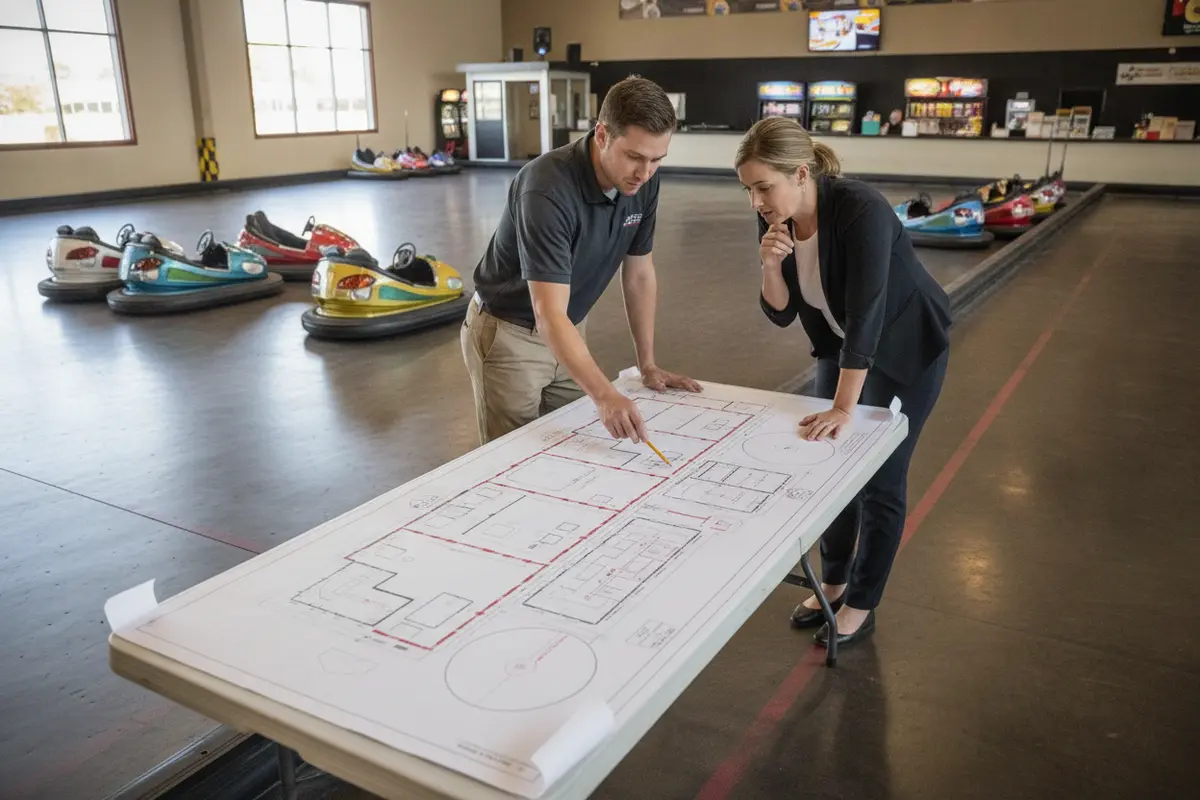
Bring a dimensioned plan, current photos, access notes, and the questions you cannot answer. Amusement Products offers FEC attraction design and consultation to discuss project planning. A conversation can help organize the information needed for a design review; it is not a substitute for an on-site assessment where one is necessary.
What equipment questions should a buyer ask?
Ask about the complete attraction rather than only the cars. Find out which components are included in the proposed configuration, which are separate, and what site conditions each part requires. Confirm the intended operating environment and the manufacturer’s instructions for installation, handling, movement, storage, inspection, and service. Request relevant documentation early enough for the people responsible for the venue and operation to review it.
- What exact model and configuration are proposed, and what is included?
- Which components, if any, are intended to be moved? What approved handling method and qualified personnel are required?
- What surface, clearances, utilities, and environmental conditions must the site provide?
- What inspection, opening, shutdown, and storage procedures apply?
- What training or operating instructions should be provided to staff?
- What service access and maintenance tasks should be considered in the site plan?
- Which statements about mobility or use at a venue can be confirmed in writing for this configuration?
Do not infer transportability, setup duration, crew size, capacity, or operating suitability from photographs or from another attraction. These details depend on the specific equipment and context. If a detail affects your operating plan, ask for the documented requirement and confirm it applies to your model. For company background, see Amusement Products’ company information. For examples of attractions, the product gallery is useful for discussion, but examples are not a substitute for project-specific review.
How will guest flow and staff duties work?
Map the full guest journey: arrival, queueing, instructions, entry, participation, exit, and the next destination. The queue should not block other attractions, facility circulation, or routes that must remain clear. Decide where staff can observe the activity and communicate with guests. For a temporary venue, repeat this exercise for each location rather than assuming one layout will work everywhere.
Write an operating sequence that covers opening, guest instruction, supervision, pauses, incident communication, and closing. Identify who can pause or stop the attraction, who contacts the venue, and how concerns are recorded and escalated. Assign duties by role, not by assumption. A plan that says “staff will watch” is less useful than one that specifies the position, task, communication method, and person responsible.
Consider how guests with different needs will understand instructions and move through the experience. Ask the manufacturer and venue about relevant access conditions and support requirements. Make guest directions clear and plan how staff will answer common questions. Avoid promising a particular accessibility feature until it has been confirmed for the attraction and the site. Test the guest route with the queue and nearby activity shown on the plan, including what happens during a busy period.
For a fixed FEC, consider how the attraction fits with other operating areas and staff routines. The bumper car portfolio can offer context for a discussion about attraction examples. Keep the focus on the requirements of your own facility, rather than assuming another venue’s operating arrangement transfers to yours.
How should safety and local requirements be handled?
Safety responsibilities depend on the equipment, location, and operating arrangement. Ask the manufacturer for applicable instructions and required checks. Ask the venue and relevant local authorities which inspections, approvals, event rules, and other obligations apply. Confirm who is responsible for each task, and document the answer before committing to an opening date. Requirements may differ between sites, so do not assume that a prior review applies automatically to a new venue.
For general U.S. consumer safety information, consult the U.S. Consumer Product Safety Commission. A general federal resource does not determine the requirements for a particular amusement ride or location. Confirm the applicable rules with the relevant authority and qualified professionals, and follow the manufacturer’s documentation.
Prepare a written process for staff training, pre-opening checks, reporting a concern, and pausing operation when a condition needs review. Keep records in line with applicable requirements and the manufacturer’s guidance. For each temporary venue, revisit the site conditions, utilities, crowd flow, and event-specific rules. If responsibility or a technical requirement is unclear, stop and get direction from the appropriate qualified person instead of improvising.
How do transport, setup, and storage affect the plan?
If the intended use involves moving equipment between sites, create a logistics plan before accepting an event. Identify loading access, delivery windows, the person responsible for receiving equipment, the path to the operating area, and the available storage. Confirm vehicle, lifting, securing, and handling requirements with the manufacturer. Do not choose a transport method based on a visual estimate or assume that standard event equipment is appropriate.
Build a setup sequence around the supplier’s instructions. List which steps must happen before opening, who performs and verifies them, and what happens if a check is incomplete. Plan the reverse sequence for closing and breakdown, including protection and storage. Coordinate the schedule with venue access and any other event work. Do not promise a setup duration or crew requirement until it is confirmed for the exact configuration and site.
For a permanent installation, movement still deserves attention. Keep installation and service access in mind, and decide where relevant equipment or components are stored when not in use. Coordinate service work with facility operations. Amusement Products provides maintenance training information that can help operators explore equipment upkeep and training questions.
What should you bring to a design consultation?
A useful consultation starts with facts and clearly labeled unknowns. Bring the intended operating model, a dimensioned site plan, current photos, access and ceiling details, utility information, venue restrictions, and any known approval requirements. If you are considering different types of sites, bring a representative plan for each rather than presenting one location as a stand-in for all of them.
Also describe your audience, guest journey, nearby attractions, staff roles, storage plan, expected operating schedule, and how often the attraction may need to move. Identify decisions that are already fixed and those still open. A simple question log can keep the discussion focused:
- Use: Is the plan fixed, seasonal, internally reconfigurable, or traveling? Which parts of that plan need confirmation?
- Site: Which measurements, conditions, or venue permissions remain unverified?
- Equipment: What documentation is needed to evaluate the exact model and configuration?
- Operation: Who will own setup, checks, guest supervision, and communication?
- Next steps: Which decisions require a site review, an authority’s answer, or further technical information?
Ask the design team to distinguish confirmed facts from assumptions and identify what information is still needed. Amusement Products’ design and consultation page is the starting point for discussing a project. You can also use the Amusement Products site to explore its broader FEC equipment offering.
Request a design and consultation discussion
How can you pressure-test your operating plan?
Use a short scenario review to expose gaps before they become commitments. For a fixed facility, walk through an ordinary opening: staff arrive, complete the documented checks, prepare the guest area, open the queue, supervise participation, and close the attraction. Ask what information or equipment each step depends on. If the answer relies on an assumption, add it to the question log and identify who can verify it.
For a temporary venue, walk through the same sequence from the venue’s perspective. Who approves the load-in? Where does receiving happen? Who confirms the route is clear? Who reviews the operating area and utilities? Who is responsible for the pre-opening verification, and who can pause operations? Then consider what changes if a site detail differs from the information provided in advance. The goal is not to invent a workaround; it is to determine who must make a decision and what must be confirmed before operation.
Use a simple decision record with four columns: question, current evidence, owner, and next action. For example, a question about whether a component can be moved should point to the applicable manufacturer documentation or a written answer for the model. A question about event permission should point to the venue or authority responsible for that decision. This keeps technical questions separate from site approvals and makes unresolved items visible.
Set a clear decision gate before making an operational commitment. Proceed to the next planning step only after the intended use, site conditions, equipment requirements, and responsibilities have been reviewed by the appropriate people. The exact gate will depend on your project, but recording it helps prevent a tentative idea from being treated as an approved operating plan.
Frequently asked questions
Are mobile bumper cars suitable for any event venue?
No general label can establish that. Suitability depends on the exact equipment, site, access, utilities, operating plan, and applicable venue and jurisdiction requirements. Confirm the proposed use with the manufacturer and responsible venue or authority.
Does mobile mean the cars can be moved around inside an FEC?
Not necessarily. Ask which components may be moved, for what purpose, and according to which handling instructions. Do not assume that a fixed installation is designed for routine movement or travel between sites.
What should I measure before requesting a layout?
Record the usable operating area, ceiling conditions, columns, doors and corridors, loading route, queue area, utilities, and nearby guest paths. Include current photos and note any venue restrictions so the review can focus on actual conditions.
Who determines whether a temporary installation is allowed?
That depends on the venue, event, location, and applicable requirements. Check with the venue and relevant local authorities, and confirm the manufacturer’s conditions. Assign responsibility for obtaining approvals and completing checks before the event date.
What is the first step in planning mobile bumper cars?
Write down whether you need in-venue flexibility, seasonal use, or repeated travel between locations. Then gather site information and ask the manufacturer which equipment and operating requirements apply to that specific use.
Plan your project with an Amusement Products consultation
Mobile bumper cars are a use-case question before they are a product decision. Define how and where you expect to operate, verify the equipment and site requirements, and resolve open responsibilities before committing to a plan.