A laser tag attraction for FEC operators is more than a themed room and equipment package. It is an operating system that must fit your building, staffing model, guest mix, and other attractions. Before choosing a concept, define how guests enter, play, exit, and return to the rest of the center. This guide offers a practical planning framework without assuming one format fits every venue.
Call to discuss your attraction plans
What does the attraction need to accomplish?
Start with the job the attraction should do in your facility. It may serve as a destination, a group activity, or one part of a broader visit. Each role changes the planning priorities. A destination needs a clear arrival and briefing process. A group activity needs predictable turnover and room for participants to gather. An attraction within a larger center needs to connect smoothly with nearby activities, party areas, and food service.
Write down the guest groups and occasions you expect before selecting equipment or a theme. Consider families, birthday parties, school groups, corporate events, and walk-in visitors. Ask whether guests arrive together or join scheduled sessions. List any age, mobility, or comfort considerations your operation must address. These are operating questions, not assumptions about a particular product.
Agree on what a successful visit looks like. Guests should understand where to go, what happens next, and how a session ends. Staff should be able to manage entry, give instructions, start play, and reset the attraction consistently. Put the sequence on paper so that design choices can be checked against real operating needs.
How should you plan the guest journey?
Map the experience from arrival through departure. A simple journey can include check-in, waiting, equipment issue, briefing, play, equipment return, and transition to the next activity. Each step needs a location and an owner. If a queue crosses a main circulation path or returning guests meet incoming players at a narrow doorway, revise the plan.
- Arrival: Decide how guests find the attraction and where they wait without blocking traffic.
- Preparation: Set aside room for instructions and equipment handling outside the play area.
- Play: Define boundaries and make rules easy for staff to explain.
- Exit: Let guests return equipment and leave without reversing through the incoming queue.
- Next step: Direct guests toward another activity, a party area, or a clear exit route.
Draw this journey on a floor plan, then walk it as a first-time visitor and an employee. Check sightlines, door swings, accessible paths, and places where guests may stop to ask questions. Include staff routes for supervision and reset tasks. Test peak-time scenarios, including two groups arriving close together. A route that works for one party may fail when arrivals overlap.
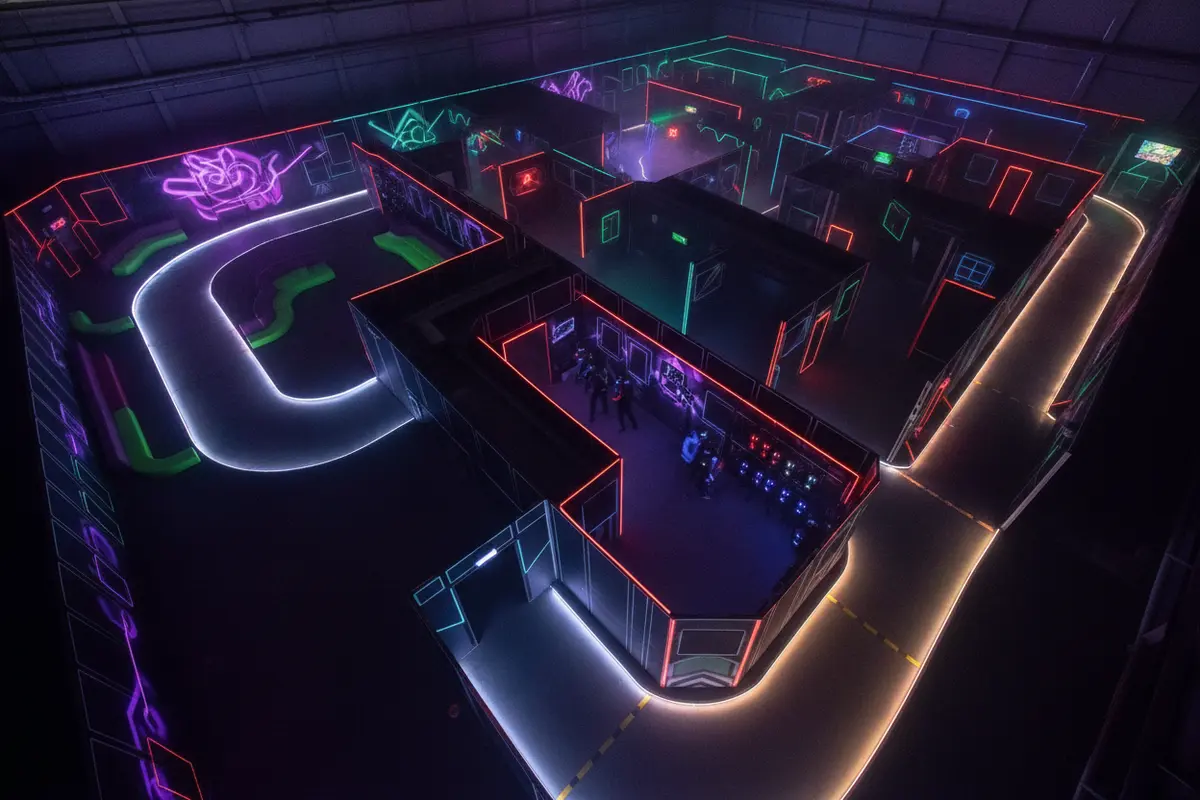
Use a simple arrival test before approving the arrangement. On the drawing, mark where a group first sees the attraction, where they ask questions, and where they wait if play has not started. Then trace the route of a group that has finished. If the two paths cross, see whether a separate doorway, a changed waiting point, or clearer staff direction could reduce the conflict. Also mark where personal belongings are kept and where a late guest can join the briefing without interrupting the group.
How do capacity and session timing fit together?
Capacity is not simply the number of players who can enter the arena. It is also the number your team can check in, brief, equip, supervise, and turn around. Estimate each part separately. If play ends quickly but equipment return and preparation take longer, the support area may determine the pace.
Use a planning worksheet to compare assumptions. Treat them as inputs to validate with the chosen system and site design, not universal standards.
| Planning factor | What to record | Why it matters |
|---|---|---|
| Session duration | Play time, briefing, and turnover | Shows how often a new group might begin |
| Group size | Expected range by event type | Helps size waiting and preparation areas |
| Peak arrivals | Likely overlap between groups | Reveals queue and staffing pressure |
| Reset tasks | Equipment checks, cleaning, and readiness steps | Clarifies what must happen between sessions |
| Staff coverage | Roles required during each phase | Exposes conflicting duties |
Build a conservative case and a busy case. In both, account for late arrivals, guests who need extra explanation, and a group that takes longer to clear the area. For example, if a briefing begins while the previous group is still returning equipment, identify whether the same employee is expected to supervise both tasks. If so, change the schedule, staffing assignment, or physical flow before opening.
Make a timed rehearsal with a written sequence. Start the clock when a sample group arrives, and record check-in, equipment distribution, briefing, play, return, and reset separately. The purpose is not to claim a universal cycle time; it is to find the slow or unclear step in your own process. Repeat the exercise with a family group and a scheduled party, since their questions and arrival patterns may differ.
Do not promise throughput before reviewing the attraction specifications and operating process. Record the assumptions behind each estimate: session length, actual reset tasks, group arrival pattern, and staff availability. That makes it possible to test and adjust the model during design instead of treating a rough estimate as a commitment.
What should the site plan include?
Confirm physical constraints before committing to a layout. Record usable floor area, ceiling conditions, structural elements, utilities, entrances, exits, and nearby uses. Mark spaces that cannot be blocked, including required circulation and service access. Building and life-safety questions are site- and jurisdiction-specific, so coordinate them with qualified local professionals and the relevant authorities.
Separate the arena from support functions on the plan. These may include a queue, briefing point, equipment storage, staff position, and a place for guests waiting outside the session. Ensure employees can reach equipment and observe the areas they are assigned to supervise. Plan for cleaning and service access rather than treating them as afterthoughts.
Amusement Products offers design and consultation for FEC projects. Bring a current floor plan, rough measurements, photos, and fixed building conditions to a design discussion. Review the attraction catalog in the context of the overall venue rather than choosing each component in isolation.
Separate fixed conditions from decisions that remain open. A column, low ceiling, or existing exit route is a constraint; the placement of a briefing area may be flexible. Label both on the drawing. This prevents a discussion from treating a potential arrangement as a building fact, and helps the design team focus on the choices that can still change.
Which operating choices should you compare?
Compare options by how they affect daily operation, not only by appearance. Ask suppliers what is included, what the operator must provide, and which assumptions affect installation and use. Answers depend on the selected system and site; record them for the specific proposal.
| Choice to evaluate | Questions to ask | Evidence to request |
|---|---|---|
| Game format | Does it suit intended guest groups and session patterns? | Demonstration and clear operating description |
| Control and scoring | How do staff start, monitor, and conclude play? | Workflow walk-through |
| Equipment workflow | How is gear issued, returned, checked, and prepared? | Reset procedure and operator responsibilities |
| Facility fit | What does the building need to provide? | Site requirements and scope list |
| Support | How are training, troubleshooting, parts, and maintenance handled? | Documentation and support process |
Amusement Products describes its consultation process as a way to consider attraction layouts and complete centers. Operators may also review the company background and product gallery as starting points. Verify specific capabilities and included components directly before deciding.
When comparing proposals, use the same questions for each option. Ask the supplier to identify the equipment and site assumptions behind its description, and request a demonstration of staff tasks rather than only a player view. Note any steps that depend on a separate system, a particular room arrangement, or operator-provided resources. A side-by-side record makes differences visible without treating one general description as proof that every venue will operate the same way.
How should staffing and training be planned?
List each task that must happen before, during, and after a session. Assign each task to a role and flag periods when duties overlap. One person may manage several steps in a quiet period, but a busy arrival window may need another arrangement. Avoid building the process around an untested assumption that one employee can handle every function at once.
Training should cover guest instructions, equipment handling, normal session flow, cleaning and readiness checks, and how staff respond when something does not work as expected. Include an escalation route and a clear way to pause activity when the team cannot follow the planned process. Keep instructions concise and accessible to seasonal and newly hired employees.
Amusement Products lists maintenance training among its educational resources. Ask what training applies to the proposed attraction and what documentation your team will receive. Requirements vary by equipment and operation, so confirm details with the provider.
Turn the procedure into a short role card for each shift position. One card might cover welcoming and organizing the next group; another might cover checking readiness and reporting a problem. Include the order of actions, the person to contact when a task cannot be completed, and where the written operating instructions are kept. A new employee should be able to follow the sequence without relying on informal memory alone.
Before opening, run a tabletop rehearsal: describe a late group, an equipment issue, a guest who needs more time to understand instructions, and a delayed reset. Ask staff who owns each response and what the waiting guests should be told. This exercise can expose unclear handoffs before they become a live operational problem.
What should the maintenance plan cover?
Set expectations for daily readiness and longer-term maintenance before opening. Identify who performs checks, where findings are recorded, how faults are reported, and who decides whether the attraction can continue operating. Follow the selected equipment manufacturer’s documentation rather than substituting a generic checklist.
- Assign a role for opening and closing checks.
- Keep operating and service documents where authorized staff can access them.
- Record issues, corrective actions, and follow-up needs.
- Set a process for taking equipment or an area out of service when needed.
- Review the process after equipment, staffing, or layout changes.
Keep maintenance access in the design conversation. Poorly placed storage or blocked service routes can complicate routine tasks. Consider how the attraction shares staff, storage, and circulation with other activities. The FEC equipment and solutions overview can frame a wider discussion, while equipment-specific instructions should come from the relevant documentation.
Separate routine checks from corrective work. A routine check is a repeatable readiness task assigned to an authorized employee. A reported fault may require a different person, documentation, or a decision to pause operation. Make the distinction clear in the written procedure, and do not ask staff to improvise repairs outside their training or the manufacturer’s instructions.
How can you make the experience accessible and comfortable?
Consider how different guests receive instructions, move through the space, and participate. Review signage, verbal briefings, room in waiting areas, and straightforward ways to ask for help. Trace the route from the entrance to the briefing area and onward to the exit. Consult qualified accessibility professionals and local requirements for site-specific questions.
Do not assume one format works for every guest. Ask the supplier which participation options and operating adjustments the proposed system supports. Train employees to explain available choices accurately and respectfully. Include these questions early, when circulation and support areas can still be adjusted.
Test the experience from a guest’s point of view, not only from the operator’s station. Can someone find the check-in point? Is there a place to wait without standing in a crowded route? Can a guest hear and understand the briefing? Are directions consistent when a staff member explains them aloud? These prompts do not replace formal accessibility review; they help identify practical questions to take to qualified professionals.
What should you bring to a design consultation?
A productive consultation starts with specific information. Gather a building plan, approximate dimensions, intended guest groups, likely event patterns, target opening timeline, and a list of attractions already planned or installed. Note fixed columns, restricted areas, utility limitations, loading constraints, and operating preferences. Mark uncertainties clearly so the team can identify what needs investigation.
Prepare questions about layout, guest flow, capacity assumptions, training, support, and work outside the attraction scope. If the project includes construction or multiple attractions, explain how the pieces relate. Amusement Products provides design and consultation for attraction and FEC planning. A clear brief keeps the discussion grounded in the actual site.
Bring a one-page operating brief with answers, even if some are preliminary:
- Which guest groups and occasions matter most?
- Will sessions be scheduled, walk-in, or a mix?
- Where can guests queue, receive instructions, and return equipment?
- Which other attractions or party areas share the same circulation routes?
- What building details or approval questions still need confirmation?
- Which staff tasks must happen simultaneously at peak times?
Attach photos that show the approach to the planned area, adjacent spaces, overhead conditions, and likely equipment route from delivery to installation. A photo without a location note can be difficult to interpret, so label each image and point it to the floor plan. Keep a short decision log with open questions, who will confirm each item, and the evidence needed to close it.
How do regulations and site approvals fit in?
Do not treat a general planning guide as a substitute for approvals. Identify which local building, fire, accessibility, and operational requirements apply to the specific property. Ask the design team and local authorities which plans, inspections, or permits are needed, and who is responsible for each step. Keep a record of questions, decisions, and outstanding items.
For U.S. projects, the Department of Justice provides information about the Americans with Disabilities Act. Use official guidance as a starting point for accessibility questions, then confirm how requirements apply to the facility and attraction with qualified professionals. Do not assume that a generic layout or a supplier conversation resolves site-specific compliance.
Frequently asked questions
What is the first step in planning a laser tag attraction for FEC use?
Define the attraction’s role, intended guest groups, and operating sequence. Then assess the building and map the guest journey before comparing systems.
How do I estimate capacity?
Estimate the full cycle, including arrival, briefing, play, equipment return, and reset. Validate group size and timing with the selected system and site plan rather than treating a generic figure as guaranteed throughput.
What should an operator ask a supplier?
Ask about facility requirements, workflow, training, maintenance documentation, support, and what is included. Request answers tied to the proposed equipment and your project conditions.
Should laser tag be planned with the rest of the FEC?
Yes. Queues, staffing, storage, and guest routes interact with other activities. Planning the attraction as part of the whole venue can reveal conflicts before installation.
Plan the operation before opening
A strong laser tag plan connects the building, guest journey, staffing, and maintenance process. Define assumptions early, test the busy-day scenario, and resolve site questions with qualified professionals and the attraction provider. To discuss a layout and the wider FEC plan, connect with Amusement Products about design and consultation.