For an FEC, a fast kart is only useful when it also fits the riders, track, schedule, and staff who operate it. High performance electric go karts should be evaluated as part of a commercial system, not as isolated speed machines.
Schedule a design and consultation conversation
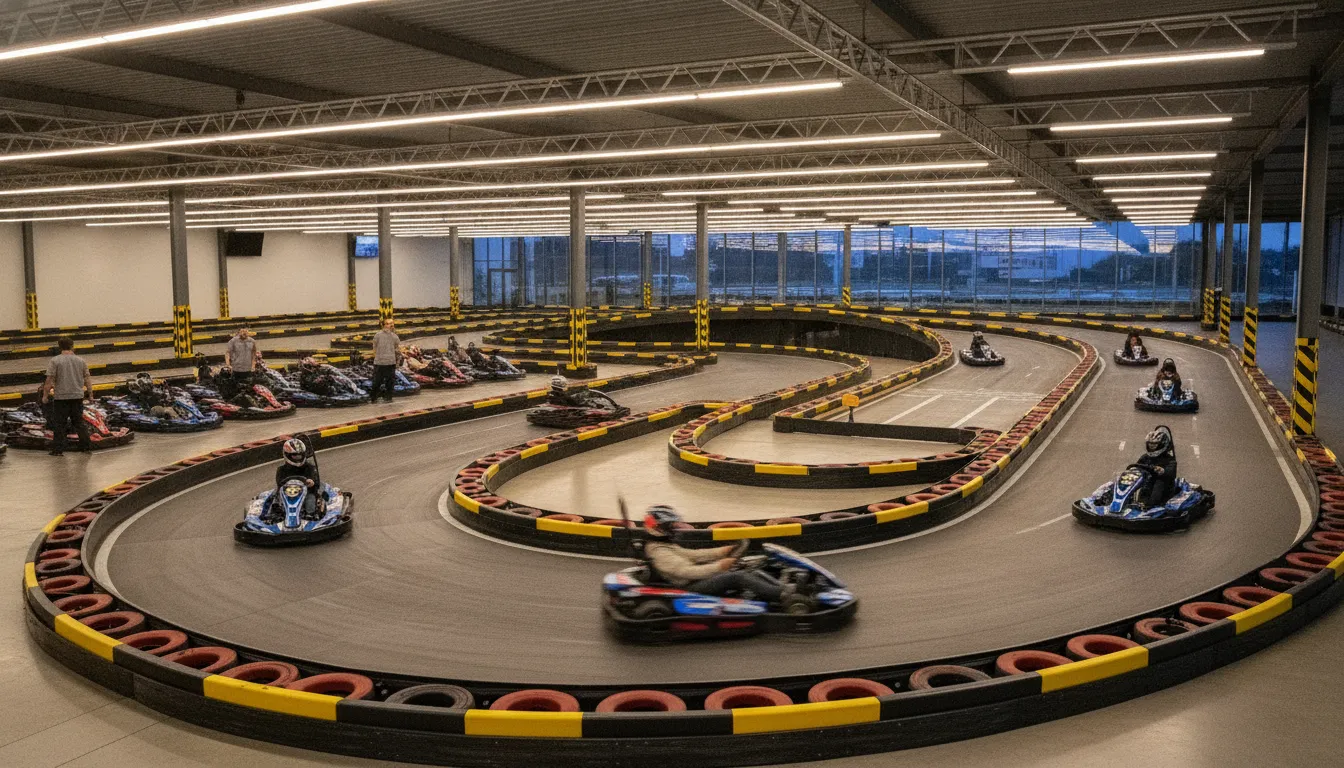
The right high performance electric go karts balance acceleration and control with rider fit, throughput, safety, durability, operating requirements, and long-term supplier support. That may mean a racing-focused fleet for experienced adults, selectable speeds for mixed-age sessions, or a durable configuration built for high-volume daily use.
Start by defining what performance needs to accomplish at your facility. The strongest selection process connects the kart’s characteristics to your rider mix and business objective, then checks whether the track and operating systems can use those capabilities effectively.
What Makes High Performance Electric Go Karts Commercially Useful?
For an FEC, performance is not a single speed figure. The most useful high performance electric go karts deliver an engaging ride while remaining manageable for staff, appropriate for the facility, and productive across a full operating day. That means evaluating acceleration, control, rider fit, throughput, durability, safety, operating costs, and long-term support together rather than choosing equipment on speed alone.
Acceleration and control should serve the track
Acceleration affects how quickly a kart reaches its useful pace, but the result must match the track layout and the riders using it. Strong response can make a race feel more engaging, while predictable control helps first-time drivers learn without overwhelming them. Operators should consider how the kart behaves through turns, under changing speed settings, and in the hands of riders with different experience levels. A performance package that is exciting on an open circuit may not be the right fit for a compact family track or a venue with a broad mix of guests.
Rider fit and throughput shape the guest experience
Commercial performance also includes putting more appropriate riders on the track and moving them through loading efficiently. A fleet should support the venue’s actual audience, whether that means single-rider racing, passenger access, family sessions, or more competitive experiences. When kart characteristics and operating controls match the rider profile, staff can spend less time correcting poor fit and more time maintaining an orderly attraction flow. Loading efficiency, track capacity, and control procedures all influence how many guests receive a consistent experience during busy periods.
Durability and operational consistency matter every day
High-use equipment has to withstand repeated sessions, routine contact, and the demands of commercial operation. The ThunderVolt lineup is described for indoor and outdoor use, with high-tech plastic bumpers and high-impact plastic or fiberglass bodies. Electric karts also have fewer moving parts and no fuel requirement, factors that can simplify day-to-day operations when supported by appropriate inspection and service routines. Quieter operation than gas alternatives can be another practical consideration for indoor venues and facilities where the guest environment matters.
The right evaluation is therefore a system decision, not a contest for the highest headline number. Review the electric go-kart lineup by matching each kart’s intended role to rider mix, track design, operating volume, and support requirements. That approach makes performance useful to the business as well as exciting for the guest.
How Should FECs Match Kart Performance to Rider Profiles?
Rider mix should shape the fleet decision before an operator chooses a performance label. A family entertainment center may serve first-time drivers, adults seeking competitive racing, parents sharing a kart with a passenger, and repeat guests who want a more demanding experience. The right setup gives staff a practical way to match operating mode and kart format to each group.
The ThunderVolt lineup uses four selectable racing speeds: Rookie, Novice, Family, and Competition. That range allows one fleet to serve first-time drivers through serious racers without treating every guest as though they have the same experience or comfort level. Operators should still validate the settings against track layout, loading procedures, staffing, and the facility’s operating plan.
| Rider profile or operating objective | Useful mode or format | Relevant model positioning |
|---|---|---|
| First-time drivers or guests | Rookie or Novice | Begin with a controlled experience and adjust the mode as appropriate. |
| Mixed-age family groups | Family mode | Eco-Racer Deluxe is positioned as a versatile, value-driven option for family-focused tracks. |
| Adult riders and competitive repeat guests | Competition mode | Lightning is positioned for fast, agile competitive racing excitement. Megavolt GT is described as the latest and most advanced model in the lineup. |
| A parent or companion riding with another guest | Two-seat configuration | Model E is a single-rider racing kart, while Model E + One provides a two-seat passenger option. |
| High-volume daily operation | Mode selection aligned with throughput and rider mix | Stockart is positioned as a durable, dependable commercial kart for high-volume daily operation. |
Single-seat and two-seat choices should be evaluated separately from speed selection. A two-seat option can support a different guest experience and may be useful where passenger participation is part of the attraction plan. A single-rider kart keeps the focus on individual racing. Neither format is universally better. The decision depends on the audience, staffing model, track capacity, and the type of experience the FEC wants to deliver.
Model positioning also helps an operator build a balanced fleet rather than selecting every kart for maximum intensity. Lightning may suit a track built around competitive excitement, Stockart may better fit heavy daily utilization, and Eco-Racer Deluxe may align with a family-focused operation. The electric go-kart lineup includes additional configurations, including Megavolt GT, Model E, Model E + One, Stockart + One, and Eco-Racer Deluxe + One. Compare those options against rider profiles, operating modes, and the facility’s broader business objective.
Which Safety and Control Features Matter on a Fast Electric Kart Track?
Performance is only useful when the track team can manage it consistently. For a commercial attraction, safety planning should connect kart behavior, rider expectations, track layout, staff procedures, and the control systems used during each session. The goal is not simply to limit speed. It is to provide the right level of control for the rider group while preserving orderly traffic flow and a good guest experience.
Use speed zoning to match the operating situation
A single speed setting may not suit every session. First-time drivers, younger riders, experienced adults, and competitive groups can require different operating parameters. Speed zoning gives the operator a practical way to align the kart’s available performance with the rider profile, track conditions, and current activity. The specific zones and operating rules should be established during attraction planning rather than improvised after opening.
Operators should also consider where a change in speed is appropriate. A controlled entry area, a tight technical section, a loading zone, and a more open racing section may each have different requirements. These decisions should account for slope, turn radius, and traffic flow. They should also be documented clearly enough that every trained team member can apply them consistently.
Plan signals and control-system integration together
Traffic signals are part of the operating system, not an isolated track accessory. Signals and other controls can help staff communicate conditions to riders and coordinate activity across the track. During design, confirm how the kart system, traffic signals, operator controls, and emergency procedures are expected to work together. Control-system integration is specifically identified as a track-planning consideration, alongside traffic signals and kart performance specifications.
Remote shutdown may be relevant to a commercial safety plan, but its availability and operation should be verified for the specific system being evaluated. It should not be assumed from a general performance description. See the guide to commercial electric go-kart safety systems for a focused discussion of remote shutdown, speed zoning, and related operating considerations.
Build staff procedures around the controls
Hardware does not replace trained supervision. Staff should know how to select the appropriate operating mode, monitor rider behavior, respond to stopped or slow karts, manage loading and unloading, and communicate a controlled stop. Procedures should be practiced before opening and reinforced whenever the rider mix or track conditions change.
The strongest safety plan matches controls to the people using them. A fast kart track should feel exciting, but its performance, signals, staff routines, and rider rules must function as one system.
What Do Operators Need to Know About Uptime and Maintenance?
For a commercial fleet, performance is only useful when the karts are ready for the next session. Uptime planning starts with matching battery range and charging capacity to the track schedule, rider volume, session length, and daily operating pattern. Operators should map when vehicles can charge, how the fleet will be rotated, and what operating margin is needed during busy periods. The electric go-kart battery range guide provides a starting point for evaluating range and charge planning without treating one battery result as universal for every facility.
Plan charging as part of the attraction workflow
Charging should be considered alongside loading, dispatch, inspections, and staff handoffs. A practical plan identifies which karts are in service, which are charging, and which are held back for inspection or recovery. It should also account for the track environment and the way operators adjust speed or session settings for different rider groups. This is a fleet-management decision, not simply a battery specification decision. Final requirements depend on the selected equipment, facility layout, operating hours, and expected throughput.
Use simpler service routines to protect availability
Electric karts have fewer moving parts and no fuel requirement, which can simplify routine fleet care. That does not eliminate maintenance. Staff should inspect the body, bumpers, wheels, steering, controls, charging connections, and visible wear before operation. Then record issues so they can be addressed before they affect a session. A consistent inspection schedule also helps managers identify recurring damage, separate normal wear from a developing fault, and keep parts planning tied to actual fleet use. The electric go-kart fleet maintenance guide covers inspection routines, battery care, and related practices for commercial operators.
Durability matters because daily attraction use creates repeated contact and handling demands. The lineup is described as using high-tech plastic bumpers and high-impact plastic or fiberglass bodies, and the karts are suitable for indoor and outdoor operation. Those materials should still be checked regularly, especially after high-volume sessions or contact on the track. Electric operation is also quieter than gas alternatives, which can improve the facility environment while reducing one source of operational noise.
Finally, maintenance planning should include labor, training, parts, and response procedures. Any operational savings depend on fleet size, utilization, staffing, service practices, and site conditions. The right uptime plan combines battery scheduling, inspections, durable equipment, and clear support processes.
How Does Track Design Change Electric Go-Kart Performance?
A kart’s performance is experienced through the entire attraction, not in isolation. A powerful fleet can still underperform operationally when the track creates bottlenecks, limits visibility, or makes loading slow. Plan the site first, then match the fleet and control approach to the layout.
- Start with the grade and available running surface. Review where the course is flat, where it changes elevation, and how those conditions affect the intended riding experience. Slope and flatness belong in the planning conversation because they influence how the track uses space and how kart performance fits the site. Do not assume a higher-performance kart automatically solves a layout constraint.
- Design entry and exit points for efficient loading. The attraction’s practical throughput begins before a rider reaches the track. Entry and exit loading efficiency affects how quickly guests can be seated, briefed, dispatched, and cleared after a session. A layout that looks impressive on paper may still lose operating efficiency if the pit, queue, and unloading areas do not support a clean flow.
- Match turn radius to the kart and rider experience. Turn radius is one of the track factors that should be evaluated alongside kart performance specifications. Tight corners may emphasize technical handling, while broader turns can support a different rhythm and traffic pattern. The right decision depends on the rider mix, desired experience, and the fleet being considered, rather than on speed alone.
- Map traffic flow before selecting the fleet. Consider how many karts can move through each section, where riders may bunch up, and how staff will observe the course. Traffic signals and control-system integration should be planned as part of the attraction, not added after the equipment is chosen. These decisions help connect rider management, operational consistency, and the performance characteristics of the karts.
- Account for the indoor or outdoor setting. Electric go-karts are designed for indoor and outdoor operation, but the facility still shapes the best layout. Available footprint, sightlines, circulation, noise expectations, and access for daily operations should all inform the design. Electric operation can be quieter than gas alternatives, which may support more flexible facility planning, but it does not remove the need for a site-specific review.
- Use a planning partner before finalizing specifications. A complete review should connect slope, loading, turn radius, signals, controls, track capacity, and fleet requirements. The FEC go-kart track design guide provides a useful starting point. For a new attraction or major expansion, site planning should precede the final fleet decision. The equipment should serve the operation instead of forcing the operation around it.
How Do You Choose a High Performance Electric Go-Kart Supplier?
Choosing a supplier for an FEC kart fleet is a long-term operating decision, not simply a search for the most powerful vehicle. Start by asking whether the company understands the demands of commercial attractions, including rider diversity, daily utilization, track fit, staff training, parts availability, and future expansion. A supplier should be able to explain how its equipment and services support the complete attraction.
Look for manufacturer and operator experience
Supplier identity matters. Amusement Products is a manufacturer, distributor, and service provider for FEC equipment. The company has operated in the industry since 1960, manufactures electric go-karts at its Chattanooga, Tennessee facility, and previously operated 64 FEC locations. That combination gives an operator more than a product catalog to evaluate. It provides a basis for discussing how kart choices affect the guest experience and the practical work of running a facility. You can learn more about the company’s background on the Amusement Products About Us page.
Evaluate the complete product range
A strong supplier should help you match equipment to the attraction’s purpose rather than push one universal model. The ThunderVolt lineup includes the Megavolt GT, Model E, Model E + One, Lightning, Stockart, Stockart + One, Eco-Racer Deluxe, and Eco-Racer Deluxe + One. This range gives operators options for different rider profiles, operating volumes, and track concepts. Four selectable speeds, Rookie, Novice, Family, and Competition, can also help one fleet serve guests with different levels of driving experience.
Confirm project support before committing
Ask what happens after the order. A capable supplier should be prepared to discuss track layout, loading efficiency, turn radius, traffic flow, control-system integration, kart specifications, education, parts, and ongoing support. Those details can influence throughput and day-to-day reliability as much as the kart itself. Amusement Products provides design, construction, consultation, education, parts, and ongoing support. Its history includes more than 60 industry innovations since 1960, including electric go-karts, the Dynamo Electric Kart System, and the ThunderVolt Raceway System.
Before selecting a fleet, request a structured review of your site, rider mix, operational goals, and expansion plans. The FEC design and consultation service can help connect those requirements to a complete attraction plan.
Request a design and consultation review for your FEC
Frequently Asked Questions
Are high performance electric go karts suitable for adult riders?
They can be, when the kart, operating mode, track, and rider policies are matched to the facility. FEC operators should evaluate rider fit, acceleration, control, seating, and throughput rather than assume that maximum speed alone defines suitability. A single-rider kart can serve competitive adult racing, while a two-seat option can support a passenger experience where the facility’s operating plan calls for it.
How fast should an electric go-kart be for an FEC?
There is no universal speed target. The appropriate setting depends on track geometry, rider mix, staff procedures, and the experience the attraction is designed to deliver. The ThunderVolt lineup documents four selectable modes, Rookie, Novice, Family, and Competition, so operators can match kart behavior to different guest groups and operating conditions. See the electric go-kart lineup for the available system context.
What maintenance advantages do electric karts offer?
Electric karts have fewer moving parts and do not require fuel, which can simplify routine fleet operations compared with gas alternatives. Operators still need a defined inspection, charging, cleaning, parts, and repair process. Each facility should validate expected operational results against its fleet and operating model.
How does the track affect electric go-kart performance?
Track fit should be reviewed before selecting a fleet. Slope, turn radius, entry and exit loading efficiency, traffic flow, control-system integration, and kart specifications all influence throughput and the guest experience. Indoor and outdoor suitability is also relevant, but the final choice should come from a site-specific design review rather than a generic performance ranking.
Ready to Plan the Right Kart Performance?
Choosing high performance electric go karts is easier when performance, rider mix, track layout, and operating goals are considered together. A focused planning conversation can help your team evaluate those priorities before finalizing a fleet direction.
Schedule a design and consultation conversation with Amusement Products to discuss the requirements of your FEC and identify a practical path forward.