
Choosing FEC attractions for teenagers means planning for social play, meaningful choice, and reasons to return—not simply adding equipment that looks exciting. Teen guests often arrive in groups, so consider how attractions let friends participate together, compete, watch, and move between activities. The right mix depends on your space, operating model, and audience.
Call to discuss your attraction plans
What should an attraction accomplish for teen guests?
Teenagers are not one uniform audience. Some want an active challenge; others prefer a social experience or a game they can learn quickly. A strong venue gives guests more than one way to take part and avoids assuming that every teen wants the same level of competition or physical activity. Treat these as planning questions, not promises about popularity.
- Social play: Can friends participate together, take turns, or cheer each other on?
- Clear challenge: Is the goal easy to understand, with room to improve or compete?
- Choice: Can guests choose different roles or modes of participation?
- Comfort: Are there places to wait, observe, regroup, and move safely?
- Repeatability: Can a guest imagine trying again with a different group or goal?
Validate assumptions locally. Speak with families and teens, observe how groups use comparable activities, and compare feedback with the constraints of your site. Ask what guests did together, what they watched rather than joined, and where the visit felt confusing. A small set of specific questions is more useful than asking only whether someone “likes” an attraction.
Which attraction categories should you compare?
Build a shortlist by experience type rather than by product name alone. This helps you compare how each option serves groups and how it fits alongside the rest of the venue. For example, commercial electric go-karts can anchor a race-oriented experience, while Spin Zone Bumper Cars offer a different shared ride experience. Other possible categories include interactive laser tag, VR, arcade games, and miniature golf. Amusement Products manufactures FEC attractions and also distributes select offerings; evaluate each specific product and its requirements rather than assuming every category has the same supplier relationship.
| Experience type | What teen groups may value | Questions for the buyer |
|---|---|---|
| Racing and ride attractions | Friendly competition and a shared event | How will sessions, queues, supervision, and viewing areas work? |
| Interactive team play | Cooperation, tactics, and participation as a group | Can different group sizes take part? How do rounds and transitions run? |
| VR experiences | Immersive play and novelty | What space, staff support, and guest orientation are needed? |
| Miniature golf | Casual play and conversation | How will course flow, group spacing, and accessibility be handled? |
| Arcade games | Short activities and individual choice | How will games complement longer attractions and circulation? |
The table is a starting point, not a ranking. Review the FEC equipment catalog and product gallery to see available categories, then assess individual options against your concept. Ask suppliers for current specifications and operating information; do not treat a category label as a substitute for due diligence.
How can you build a balanced attraction mix?
A balanced mix serves different visit lengths, group sizes, and energy levels. One large attraction may draw attention, but a venue also needs activities that keep companions engaged while others wait or play. Map a guest visit from arrival to departure and identify where each experience fits.
- Choose a primary draw. Decide which experience defines the visit and what audience it is intended to serve.
- Add complementary activities. Look for different session lengths and participation styles so a guest can shift from a longer activity to a short one.
- Plan for mixed-age groups. Teens may arrive with younger siblings or adults. Consider whether the group can share an activity or stay connected across nearby options.
- Include social spaces. Provide clear places to wait, watch, and gather without blocking active routes.
- Check the full guest journey. Consider entry, orientation, queues, transitions, breaks, and exit.
For example, a group could begin with a scheduled team experience, visit a short-play activity while waiting for a ride, then regroup nearby. On paper, mark where each person goes during each phase: participants, companions, and staff. If one person must cross an active route to rejoin the group, or if observers have nowhere comfortable to stand, revise the layout before selecting equipment.
Think about variety in more than attraction category. A venue might have several different products that all demand long waits, intense activity, or staff attention at the same time. Compare the experience rhythm: scheduled versus walk-up, short versus extended, individual versus group, and active versus observational. This reveals gaps a product list can hide.
What should you evaluate before selecting equipment?
Compare every candidate against the physical site and the way you expect to operate. Request technical and operating information from the supplier rather than relying on broad claims about popularity or performance. Record the answers in one comparison sheet so your team can see trade-offs clearly.
- Footprint and circulation: Confirm the attraction, queue, access routes, and staff positions fit together. Include space for guests entering and exiting, not only the equipment outline.
- Capacity and session flow: Understand how guests enter, participate, exit, and join the next session. Ask what happens when a group arrives larger or smaller than expected.
- Supervision: Identify staff tasks before, during, and after each experience. Consider whether staff can monitor the attraction and nearby transitions.
- Age and participation requirements: Review supplier documentation and applicable local requirements. Communicate restrictions clearly and consistently.
- Maintenance and downtime: Ask about routine checks, training, service access, and what the operating team should do when an attraction is unavailable.
- Accessibility and comfort: Consider how guests with different needs can participate, observe, or remain with their group. Ask for specific equipment information rather than making assumptions.
- Noise and atmosphere: Think about how sound, lighting, and activity levels interact across neighboring zones.
- Utilities and site conditions: Confirm what the installation requires, who verifies site readiness, and what information must be settled before construction or delivery.
Safety planning should be specific to the equipment, venue, and jurisdiction. The U.S. Consumer Product Safety Commission provides information about amusement ride safety. Use applicable authorities and equipment documentation for your own approval and operating decisions. A general resource does not replace local review, supplier instructions, or a venue-specific operating plan.
How should layout support a group visit?
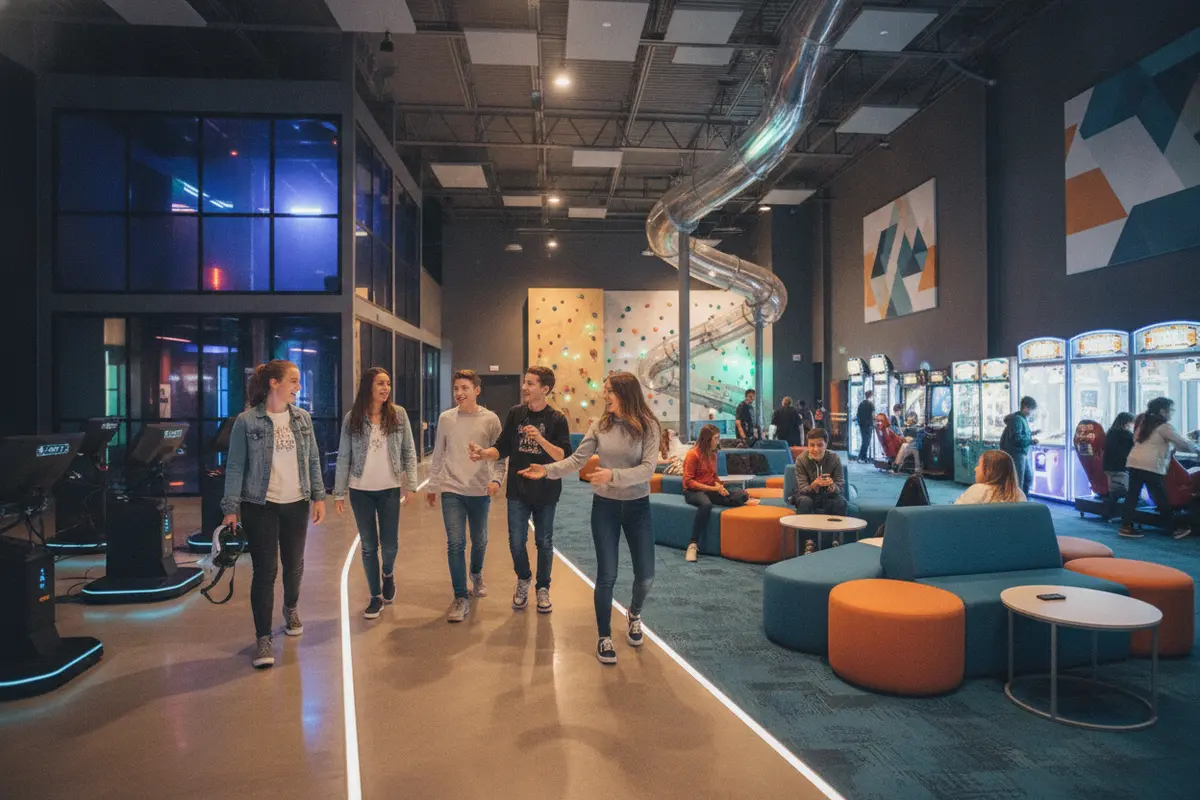
Teen groups need room to move together, but circulation should not depend on guests standing in active paths. Plan visible routes between attractions, enough space for queues, and places where non-participants can watch. Make transitions legible: guests should be able to tell where to line up, where to wait, and where an activity ends.
Test the floor plan with a simple walk-through. Trace the route from entrance to the main attraction, then from that attraction to a secondary activity, restroom, food or seating area if included in your concept, and exit. At each point, ask whether a group can pause without blocking others. Mark likely queue boundaries and staff positions. The goal is not to predict every movement, but to expose conflicts before they become operational problems.
Review sightlines from staff positions and shared areas. A layout that lets companions see one another can make a visit feel more comfortable. Consider how noise and lighting from one zone affect nearby activities. A quieter game or gathering area can offer a useful contrast to a high-energy attraction. Include accessible routes in the same planning conversation, rather than treating them as an afterthought.
How do staffing and operations affect the mix?
Attraction selection and staffing are connected. Before committing to a mix, write down the tasks needed to open, run, reset, and close each experience. Include guest orientation, queue management, cleaning, routine checks, incident response, and handoffs between team members. Then test whether the proposed layout and staffing approach can support those tasks during busy periods.
A practical exercise is to map one busy operating period in time blocks. For each attraction, record when staff must be present, what tasks overlap, and which activities can continue safely while another area needs attention. If two attractions require the same team member at the same time, decide whether the operating plan needs adjustment. This is a planning prompt, not a universal staffing ratio; follow supplier guidance and local requirements.
Training should reflect the equipment and actual venue procedures. Amusement Products offers maintenance training; operators should also establish documented procedures and follow supplier guidance and local requirements. For technology-based attractions, review control systems information when evaluating how operations are managed. Ask what training is included, what records the operator should maintain, and who handles questions after installation.
Use guest feedback as an ongoing planning input. Ask which activities groups chose, where they waited, and what they would change. Observe the flow as well as the answers: bottlenecks and unused areas can reveal issues a survey may miss. Record observations by time and location so you can distinguish a one-off event from a recurring pattern.
How can you compare options without guessing?
Set up a simple decision matrix before supplier discussions. Give each attraction a row and use columns for audience fit, group participation, session pattern, footprint, staff duties, technical requirements, accessibility questions, and unresolved approvals. Mark items as confirmed, needs verification, or not applicable. This avoids converting a salesperson’s description into an assumption your project later depends on.
For instance, suppose two candidates both appeal to groups, but one runs in scheduled rounds while another allows shorter walk-up play. The comparison is not simply which sounds more exciting. Ask how scheduled arrivals affect the lobby, what companions do between rounds, and whether the walk-up option creates a queue that crosses another route. Then test both against the same operating scenario, such as a group arriving during a busy period.
Keep distinct decisions distinct. A concept decision concerns the experience you want; a site decision concerns what can physically fit; an operating decision concerns staffing and procedures; and an approval decision concerns applicable reviews. If a candidate looks promising but one category remains unanswered, keep it on the shortlist with that issue clearly flagged rather than declaring it a fit.
What should you bring to a design consultation?
A useful consultation starts with constraints and goals, not just a wish list. Bring a site plan or approximate dimensions, ceiling heights, entry and exit locations, known utility limitations, and any existing attractions that will remain. Add your intended audience, likely group sizes, desired visit pattern, staffing assumptions, and questions about accessibility or approvals.
It helps to separate known facts from open questions. Label measurements as verified or approximate; list who can confirm utility and building information; and note which attractions are fixed choices versus options still under consideration. Bring photographs of the current site if available, and mark columns, doors, circulation pinch points, or areas that cannot change. This makes discussion more concrete without pretending that an early sketch is a final plan.
Amusement Products provides design and consultation for attraction and venue planning. A clear brief helps focus the discussion on decisions that matter for your project. You can also review the company background and electric go-kart information as you prepare questions about equipment categories and site fit.
Before the meeting, write down the decision you need to make next. It might be choosing between two experience types, confirming whether a concept fits the available footprint, or identifying information still needed from a contractor or authority. End the discussion by documenting open items, the person responsible for each, and what information will resolve them.
Schedule a design consultation
Frequently asked questions
Are teenagers best served by competitive attractions?
Competition can be one draw, but it should not be the only participation style. Include social, cooperative, casual, and spectator-friendly options so groups can choose how they take part.
Should every attraction be designed only for teens?
Not necessarily. Many venues serve mixed-age groups. Evaluate whether teens can enjoy an experience while companions remain nearby, and communicate participation requirements clearly.
How many attractions should a new venue include?
There is no single number for every project. The site, operating model, guest journey, and staffing plan affect the mix. Start with the experience you want to offer and test each candidate against the floor plan.
When should attraction planning begin?
Begin while the venue layout and operating concept can still be shaped. Early planning lets you consider circulation, utilities, staffing, and guest flow together rather than fitting equipment into a finished plan.
Plan for the whole teen visit
The strongest plan is not a list of equipment; it is a connected guest experience with clear choices, comfortable group flow, and an operating approach your team can support. Compare attraction types against your site, test the journey on a floor plan, and refine the mix with a design conversation before making final decisions.