
In a commercial family entertainment center, a mini golf obstacle is more than a visual centerpiece. It absorbs repeated contact, cleaning, weather exposure, and the operational demands of moving groups safely through a course. The right design decisions help protect the guest experience while keeping inspections and repairs manageable.
Schedule a consultation with Amusement Products.
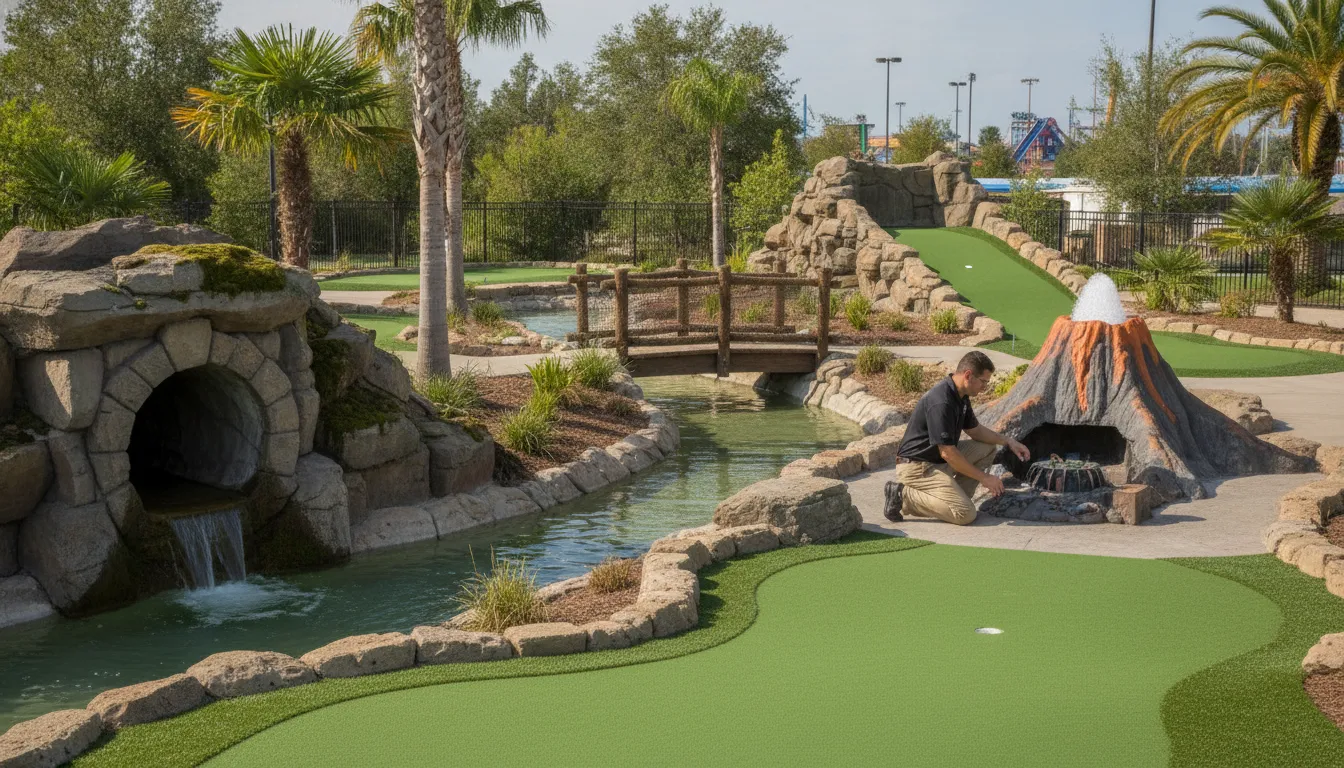
Commercial mini golf obstacles features durability depends on more than the visible surface. Material selection, protective finishes, joints, drainage, traffic flow, and access for maintenance all influence how well an obstacle performs over time. There is no universal lifespan for every feature, because exposure, construction quality, use, and upkeep vary by site.
For FEC operators, the practical question is not simply which obstacle looks most impressive. It is how each feature will function within the course, support a balance of skill and fun, and remain serviceable as conditions change. Amusement Products approaches miniature golf as a complete design and construction project, including championship-level course construction. That performance starts with the materials beneath the theme and the ways they are protected from daily wear.
What Materials Make Commercial Mini Golf Obstacles More Durable?
Material selection is only one part of obstacle durability. The right choice depends on the feature location, guest interaction, water movement, and staff access for inspection and repair. Aluminum, coated metals, plastics, and composite materials can support commercial play when the design matches the operating environment. No single material is best for every course.
Aluminum and protective coatings
Aluminum is commonly used for shaped obstacle structures because it can provide a rigid form without creating an unnecessarily heavy feature. Industry examples include powder-coated aluminum barns, wedges, ramps, and square-tube frames. Vinyl overlays may add color or themed graphics, but they should be treated as a finish that requires inspection rather than as a substitute for sound structure. Ask how edges, seams, fasteners, and attachment points will be protected and accessed during maintenance.
A coating also has an operating job. It helps separate the underlying material from routine exposure, but scratches, impact damage, and worn edges can create places where moisture works into the assembly. Ultraviolet radiation can damage construction materials, particularly wood and plastics, and higher heat can shorten material service life. In tested steels, UV exposure combined with alternating wet and dry conditions accelerated corrosion. These findings do not predict a specific lifespan for a mini golf obstacle, but they support regular inspection of exposed surfaces and joints. Research on UV effects on construction materials and research on UV, wet-dry cycles, and corrosion provide useful background.
Plastics and composites require application-specific review
Industrial plastics and composite panels can be useful for themed shapes, curved surfaces, lightweight components, and features that need a particular visual treatment. Competitor examples include industrial-plastic cabins and bridges. Those examples show how the material may be applied in the industry, not a specification for Amusement Products equipment. The key questions are whether the selected material is suited to local exposure, resists impact and ultraviolet light, and allows damaged panels to be removed without dismantling the course.
Joints, drainage, and exposure often decide the outcome
A durable face cannot compensate for a weak joint or trapped water. Review fasteners, welds, seams, transitions to the substrate, and any opening where water or debris can collect. The course plan should account for rainfall, cleaning, irrigation, humidity, and seasonal temperature changes. Operators should also consider traffic flow and maintenance access, because a feature that cannot be reached safely will be harder to keep in service.
Operator takeaway: During selection, request a material-and-maintenance review for each obstacle. Record the exposed material, finish, joint locations, drainage approach, likely impact points, and inspection access. This creates a practical service plan instead of treating “commercial grade” as a complete durability specification.
Which Commercial Mini Golf Features Have the Longest Service Life?
No feature category has a guaranteed service life in every commercial setting. A tunnel, bridge, ramp, themed structure, or water element can perform well when its construction matches the site and operating demands. The same feature can deteriorate sooner when it receives heavier traffic, traps moisture, or cannot be inspected and repaired easily. For that reason, durability should be evaluated as part of the full course system rather than by appearance alone.
Simple structures can be durable when the site supports them
Tunnels, bridges, and ramps often have a practical advantage because their function is clear and their condition can be inspected directly. That does not make every simple obstacle equally durable. Traffic flow determines where guests and equipment create repeated contact, while elevation changes affect drainage and access. A bridge that sits over a poorly drained area may face more moisture exposure than its design suggests. A ramp needs stable support and a surface that remains safe and playable as traffic increases.
The site also matters for themed structures. A visually complex feature may create strong appeal for different age groups. But its service life depends on protected surfaces, accessible joints, and a maintenance plan that reaches behind decorative elements. UV exposure can damage construction materials including wood and plastics, and research has documented faster corrosion under combined UV and alternating wet-dry conditions. See the research on UV effects on construction materials and the study of UV, wet-dry exposure, and corrosion.
Water and elevation require more planning, not automatic exclusion
Water features and elevation changes can contribute to visual appeal and a varied playing experience. Amusement Products identifies both as elements that can be incorporated into championship-level miniature golf designs. Their long-term performance depends on deliberate drainage, separation of wet areas from vulnerable components, safe access for inspection, and a layout that supports the intended capacity. Water should be treated as an operating condition to manage, not simply as decoration.
Modular components can make repairs more practical
Modular obstacles may offer an operational advantage when a damaged or worn component can be accessed, adjusted, or replaced without disrupting a larger portion of the course. That benefit depends on how the connections, finishes, and service access are planned. A fixed themed structure may be the right choice for a signature hole, while a modular feature may be better where layouts change or traffic is concentrated. Course planning should balance skill and fun with site fit, capacity, and operational practicality, as outlined in Amusement Products’ FEC design and consultation process.
Before selecting a feature, ask:
- What traffic, contact, and throughput will it receive?
- How will water, sunlight, heat, and wet-dry cycles affect it?
- Can staff inspect drainage, joints, coatings, and support points?
- Can a damaged component be repaired or replaced without closing multiple holes?
- Does the feature fit the course’s access, navigation, and intended player groups?
What Are the Most Common Mini Golf Obstacle Failures?
Most obstacle failures begin as small operating issues rather than dramatic structural events. A coating starts to chalk, water remains at a joint, or a fastener loosens after repeated contact. If those conditions are missed, the feature can become unattractive, harder to clean, unsafe to navigate, or unavailable during busy operating periods. Reviewing failures by cause helps operators inspect the whole system instead of replacing only the visible symptom.
Exposure and moisture create a compounding problem
Outdoor features face more than sunlight alone. Solar UV radiation can damage construction materials, including wood and plastics, and may shorten their useful service life. A review of construction-material research documents these effects: UV exposure can affect wood and plastics. Separately, a materials study found that UV exposure combined with alternating wet-dry conditions accelerated corrosion in the tested steels. That result comes from specific laboratory conditions, so it should not be treated as a universal prediction for every obstacle. It does support a practical inspection priority: look closely where sunlight, rain, irrigation, condensation, and drying cycles meet.
Corrosion often advances beneath damaged coatings or around seams, brackets, and drainage points. The same study observed voids and cracks in rust layers that allowed corrosive substances to penetrate further in its tested materials. Worn coatings, standing water, blocked drains, and soil or debris pressed against a feature can all make that progression harder to see.
Connections and impact reveal weak points
Loose fasteners, separated joints, cracked panels, and shifted foundations deserve attention after heavy use or severe weather. Repeated ball strikes and accidental player contact can damage edges, rails, tunnels, and themed surfaces. A feature can remain visually intact while its connection points move enough to affect play or create a trip hazard. Inspect the attachment method, not just the face of the obstacle, and confirm that repair access was considered in the original layout.
Some failures are really layout failures
An obstacle may be structurally sound but still perform poorly when it does not fit the surrounding course. A tunnel, ramp, or crossover can create conflicting traffic, obstruct an accessible route, trap water, or make a shot unnecessarily frustrating. Commercial planning should connect obstacle selection with site fit, traffic flow, capacity, and operational practicality, not appearance alone. A concise operator checklist includes:
- Check coatings, plastics, seams, and exposed edges for UV wear, cracks, corrosion, or impact damage.
- Clear drainage paths and look for standing water, damp substrates, and moisture around joints.
- Test fasteners, brackets, rails, and connections for movement, looseness, or misalignment.
- Walk the intended route for traffic conflicts, accessibility barriers, and feature-to-layout mismatch.
Documenting these observations by location makes maintenance more actionable. It also gives a designer or manufacturer better information when a feature needs reinforcement, reconfiguration, or replacement rather than another cosmetic repair.
How Should Operators Maintain Commercial-Grade Mini Golf Features?
A practical maintenance program protects the guest experience and helps operators catch small issues before they interrupt play. The right cadence depends on the course environment, traffic, weather exposure, water features, and the construction details of each obstacle. It should also fit the operating team’s normal opening, cleaning, and closing routines rather than exist as a separate process that gets skipped.
Build inspections into the operating day
Assign responsibility for each check and record findings with a photo, location, priority, and action owner. Operators should look beyond appearance. Loose fasteners, worn coatings, standing water, damaged edges, and shifting components can affect safety, playability, and the pace of groups moving through the course.
- Opening or daily check: Walk every playable area before guests arrive. Remove litter and debris, clean ball paths and touch surfaces using procedures appropriate for the installed materials. Check that obstacles, rails, ramps, bridges, and impact points are secure. Look for blocked drains, pooling water, exposed edges, peeling coatings, cracks, corrosion, and trip hazards. If the course has lighting, sensors, sound, or other interactive elements, test the guest-facing function and note any component that needs technical attention.
- Weekly operating check: Review the areas that receive repeated ball contact, hand contact, or guest leaning. Inspect joints, fasteners, seams, anchor points, protective finishes, and vinyl or other surface overlays. Clean drainage channels and confirm that water moves away from playing surfaces. Compare the actual condition with the course documentation so replacement parts or specialist repairs can be planned instead of improvised during a busy shift.
- Seasonal service review: Before a high-volume season, assess the full course for wear, fading, corrosion, drainage performance, accessibility, and traffic-flow conflicts. Coordinate cleaning, coating touch-ups, fastener replacement, electrical checks, and landscaping or water-feature work as one maintenance window where practical. Capacity and site fit matter operationally, so record whether queues, maintenance access, or guest circulation have changed since the last review.
- Post-weather inspection: After heavy rain, strong wind, flooding, extreme heat, or freezing conditions, inspect drainage, foundations, elevated features, exposed connections, coatings, and electrical enclosures before reopening affected areas. Wet-dry cycles and ultraviolet exposure can accelerate corrosion in some tested steels, while cracks and voids in rust layers can allow corrosive substances to penetrate. See the materials research from the National Library of Medicine for context.
Use documentation to plan the next decision
Keep an asset register for each feature, including its location, material or finish when known, inspection history, repairs, replacement parts, and photographs. This record helps distinguish routine cleaning from a construction or design issue. When planning a new course or major upgrade, operational practicality should be addressed during site evaluation, feasibility work, capacity planning, and construction documentation. The guide to how to build a miniature golf course provides a useful planning context for connecting maintenance access with the broader course design.
How Do Commercial Mini Golf Obstacles and Features Improve Durability?
The strongest commercial mini golf obstacles features durability plan treats the course as an operating system, not a collection of decorative pieces. A feature must look inviting, create a meaningful shot, fit the traffic pattern, and remain practical to inspect and service. Choosing the most elaborate option is not always the best decision for an FEC. The right choice depends on the intended demographics, expected throughput, site conditions, and the access your team will have for cleaning and repairs.
Start with the balance of skill and fun. Players should encounter enough challenge to make each hole memorable, but not so much difficulty that younger players or first-time guests disengage. Visual variety can communicate the course experience, while clear sightlines and sensible spacing keep groups moving. This framework compares common approaches before construction.
| Feature approach | Playability/operations upside | Durability question | Planning check |
|---|---|---|---|
| Robust fixed structures | Create a consistent challenge, strong visual anchors, and predictable play for repeat operations. | Can the structure, finish, joints, and base withstand local exposure, ball contact, and routine guest traffic? | Confirm substrate, drainage, inspection points, and repair access before finalizing placement. |
| Modular features | Allow operators to adjust layouts, refresh the experience, or isolate a damaged element without redesigning the entire course. | Will connectors, seams, overlays, and repeated handling remain secure and presentable? | Define storage, movement, re-leveling, and staff procedures, then protect the intended traffic flow. |
| Interactive elements | Can add responsive moments through lighting, sound, or sensors and create memorable outcomes when used sparingly. | Are controls, wiring, sensors, and exposed components protected and accessible for troubleshooting? | Plan power, weather protection, reset procedures, and a fallback play experience if the effect is offline. |
| Water and elevation | Add visual depth, route choices, and varied shots that can support a more distinctive course identity. | Can water be controlled, drained, cleaned, and kept away from vulnerable materials and walking surfaces? | Review grading, slip risk, pump or access requirements, visibility, and maintenance responsibility. |
| Accessibility-focused design | Broadens participation through usable routes, legible navigation, and challenges that do not depend on one physical ability. | Will accessible paths, clearances, edges, and guidance features remain unobstructed as the course operates? | Evaluate wheelchair circulation, turning areas, surface transitions, and navigation support during the layout stage. |
Interactive features should reinforce the shot, not create bottlenecks or require constant staff intervention.
Build repair access into the visual concept from the beginning. Concealed service panels, reachable equipment, and inspection routes may not be visible to guests, but they influence whether a small issue stays manageable. A design review that considers capacity, traffic flow, accessibility, exposure, and maintenance together gives operators a more durable attraction and a more consistent guest experience.
How Amusement Products Plans for Championship Durability
Durability begins before an obstacle is built. For a commercial course, the manufacturer, designer, and builder must understand how the attraction will fit the property. Move guests, handle its intended capacity, and operate in the context of the surrounding FEC. Amusement Products approaches miniature golf as an integrated FEC solution, not as a collection of standalone retail products.
Start with the site and the operating plan
The consultation process can include site evaluation, feasibility analysis, demographic studies, and competition analysis. Those steps help establish whether a proposed layout is practical for the property and its audience. They also bring durability into the right conversation. Traffic flow, capacity, maintenance access, water features, elevation changes, and the expected guest experience all influence how a course should be planned.
Client input remains part of that process. A course intended for families, a tourist market, or a high-volume FEC may need a different balance of challenge, visual appeal, and movement through the attraction. Amusement Products describes its planning approach as balancing skill and fun elements to encourage repeat play, while designing for visual appeal across age groups. That combination supports a course that is engaging without treating appearance as a substitute for sound operation.
Turn the concept into buildable documentation
Once the operating goals and site conditions are understood, the design process can include 3D renderings, layout visualizations, equipment specifications, capacity planning, and construction documentation. These deliverables give the project team a shared reference for the course footprint, feature placement, guest circulation, and construction details. They also make it easier to identify conflicts before construction, rather than discovering them after an obstacle, water feature, or elevated section is already in place.
This is where specialized FEC experience matters. Amusement Products reports more than 60 years of course-design experience dating back to Sir Goony Golf. Its miniature golf work includes championship-level course construction and turnkey project services, supported by a broader model that combines equipment manufacturing, construction, design, education, and parts and support. For operators, that integrated structure keeps durability connected to installation, use, inspection, and future service.
Explore championship miniature golf construction and view examples of custom miniature golf courses when evaluating the right direction for your property.
Request FEC design and consultation to plan a course around your site, audience, capacity, and operating goals.
Frequently Asked Questions
What are the most common obstacles in commercial mini golf?
Common choices include tunnels, bridges, ramps, loops, wedges, barriers, and themed structures. The right mix depends on the intended player groups, available footprint, traffic flow, and the balance of skill and fun you want across the course. An obstacle should support playability and throughput, not simply fill space.
How long should commercial mini golf obstacles last?
There is no responsible universal lifespan for every obstacle. Service life depends on construction quality, traffic, sunlight, temperature, moisture, drainage, impact, inspection, and maintenance. Use condition-based upkeep rather than a fixed replacement date. Review exposed joints, coatings, fasteners, and water-affected areas regularly.
What causes commercial mini golf obstacles to fail?
Frequent failure risks include water intrusion, poor drainage, corrosion, ultraviolet exposure, worn coatings, loose fasteners, impact damage, and joints that are difficult to inspect or repair. UV exposure combined with alternating wet and dry conditions has been shown to accelerate corrosion in tested steels, so outdoor materials and connection details deserve particular attention. Source: materials corrosion study.
How often should operators inspect mini golf obstacles?
Use a practical cadence that fits your operation: check for visible damage, loose components, standing water, sharp edges, and navigation problems during opening routines; perform a more detailed review weekly; and complete seasonal and post-weather inspections. Follow the manufacturer’s maintenance guidance where available, and document repairs so recurring problems can be traced to their source.
How do operators choose durable features without making play less engaging?
Evaluate each feature against skill level, guest appeal, accessibility, traffic flow, cleaning access, drainage, and repair access. Water features and elevation changes can add visual and gameplay interest, but they require deliberate site planning and maintenance. A design consultation can connect those choices to capacity and operational practicality before construction begins.
Ready to Plan a More Durable Course?
Commercial mini golf obstacles perform best when materials, drainage, traffic flow, and maintenance access are considered together. Amusement Products can help translate those operating priorities into a practical course plan for your FEC. Request an FEC design and consultation to discuss a durable commercial miniature golf course and the features that fit your site.