Planning an electric go-kart attraction starts well before you choose a fleet. The track must fit the site, move guests efficiently, support clear loading and exit procedures, and work with the operating model your FEC can staff and maintain.
For an FEC, an electric car track generally means an electric go-kart attraction planned around rider flow, site conditions, controls, fleet selection, and future expansion. Electric go-karts can support indoor or outdoor operations and may provide a quieter alternative to gas-powered equipment. The right layout is site-specific, not a universal footprint.
Amusement Products approaches these projects through manufacturing, design, construction, education, and ongoing support. Its planning process can address site evaluation, capacity, loading areas, turn radii, traffic controls, and phased growth. Before comparing equipment, it helps to define what the attraction needs to accomplish and how the track will function inside the larger FEC.
Schedule a design consultation for your electric car track and FEC plan.
What Is an Electric Car Track for an FEC?
In family entertainment center planning, electric car track is usually a consumer-style way to describe an electric go-kart track. The phrase can suggest a simple ride with electric vehicles moving around a course. An FEC operator needs to plan a complete attraction: the track, the fleet, the rider experience, the loading process, and the systems that keep sessions organized.
That distinction matters because the right layout cannot be separated from the equipment using it. Amusement Products manufactures ThunderVolt electric go-karts for family entertainment centers and outdoor tracks. Its electric go-karts are designed for indoor and outdoor operating environments and operate more quietly than gas-powered alternatives. Those characteristics may influence where the attraction fits within an FEC, how it relates to nearby activities, and how the guest experience feels inside the venue. Review the electric go-kart fleet alongside the site plan rather than treating fleet selection as a later purchase decision.
Electric car track planning is broader than drawing a course
A useful plan starts with the intended rider mix and operating model. Families, first-time riders, experienced guests, and repeat visitors may need different levels of control and challenge. The ThunderVolt fleet offers four selectable racing speeds: Rookie, Novice, Family, and Competition. That flexibility can support different rider experience levels. The appropriate setup still depends on the venue, loading design, controls, staffing, and the experience the operator wants to deliver.
The physical environment is another core decision. An indoor electric car track may need to work within an existing building. An outdoor track must be evaluated in relation to the available site and surrounding circulation. In either case, planning should address slope and flatness engineering, entry and exit loading areas, turn-radius calculations, and traffic signal or control integration. There is no universal track geometry that fits every property. Site conditions, barriers, sightlines, guest circulation, and the planned attraction capacity all affect the final design.
For that reason, an electric car track is best treated as part of the FEC’s operating system. The goal is not only to fit karts onto pavement. It is to create a ride that guests can understand, staff can manage, and the broader venue can support as it grows. A custom layout may address one attraction or the complete FEC, with traffic flow, capacity planning, and future expansion considered together.
Schedule a design consultation for your electric car track and FEC plan.
How Do You Plan an Electric Car Track Layout?
A useful layout starts with the property and the operating plan, not a preselected track shape. The same electric car track concept may require a different arrangement for an indoor conversion, an outdoor attraction, or a larger family entertainment center. Work through these questions in sequence so the site, fleet, controls, and guest flow support one another.
- Confirm the site’s fit. Begin with a documented site evaluation. Note the usable footprint, building columns or fixed structures, access points, utilities, drainage, grade changes, neighboring attractions, and the intended indoor or outdoor environment. Ask: Where can the attraction sit without creating conflicts with parking, emergency access, queues, or other revenue-producing areas? Do not assume that a rectangular room or open parcel automatically supports an efficient track.
- Map geometry and ground conditions. Examine slope and flatness before sketching turns. The design team should understand how the existing grade affects the track surface, drainage, rider experience, construction approach, and accessible movement around the attraction. Ask which areas need engineering review and whether the layout can work with the existing site or requires a more extensive preparation plan. These factors are site-specific, so avoid applying a universal dimension or slope rule.
- Test the turn sequence. Turn-radius calculations should reflect the selected fleet, intended rider mix, operating speeds, sightlines, and available footprint. Sketch the relationship between straights, turns, merging points, and recovery areas rather than evaluating each corner in isolation. Ask: Can operators see the sections that need the most attention? Does the route feel coherent for first-time riders while still giving repeat guests a clear driving challenge?
- Design loading and exit as part of the track. Mark the queue, briefing area, loading positions, unloading area, and exit route on the same plan. Guests should not have to cross active traffic to enter or leave, and staff need room to prepare riders, answer questions, and respond to stopped karts. Ask where riders wait, where equipment is staged, and how the next group moves in without blocking the group finishing its session.
- Plan traffic controls and barriers. Identify where traffic signals, control systems, barriers, and operator sightlines belong. The goal is to make the intended movement understandable and manageable, not to add equipment after the layout is finished. Ask where a stopped kart can be observed, how staff communicate with riders, and which fixed objects or adjacent attractions require separation or protective planning. Any final barrier and control design should be reviewed for the specific site and applicable requirements.
- Separate guest, staff, and spectator flow. Trace three paths: the rider’s path, the employee’s work path, and the spectator’s viewing path. Keep service access and staff response routes practical while giving waiting guests a clear place to observe without obstructing loading or operations. Coordinate staffing assumptions with layout decisions, then review go-kart track staffing as the operating plan develops.
- Reserve room for power planning and expansion. Charging access, equipment staging, and maintenance needs should be considered before the final footprint is approved. Review electric go-kart battery planning so charging and uptime assumptions align with the proposed schedule and facility. Finally, mark possible future attraction, queue, or service expansion areas. A master plan can address traffic flow, capacity planning, and future expansion without committing the operator to a fixed buildout on day one.
For a project-specific review, a design consultation can connect site evaluation, iterative layouts, capacity planning, and construction documentation before equipment or construction decisions become difficult to change.
Which Electric Go-Kart Fleet Fits the Rider Mix?
Fleet selection should begin with the people who will use the attraction and the way your team will operate it. A family entertainment center may serve first-time riders, returning guests, and more experienced racers in the same operating day. That mix affects how you think about selectable controls, loading, supervision, and the relationship between the karts and the track layout.
| Rider or operating need | Planning question | Possible speed-mode consideration |
|---|---|---|
| First-time or less experienced riders | How will the attraction introduce guests to the controls and track flow? | Rookie or Novice may be considered as part of the operating plan. |
| Mixed-experience family traffic | Can the operating team manage different experience levels within the planned guest flow? | Family may be considered when the track, controls, and procedures support that use. |
| Experienced or returning racers | Does the layout and control system support the intended competitive experience? | Competition may be considered after the site and operating model are reviewed. |
| Flexible daily operations | How will staff adjust the attraction for changing guest mix, conditions, and operating objectives? | Plan how Rookie, Novice, Family, and Competition will be selected and managed. |
The ThunderVolt fleet offers four selectable racing speeds: Rookie, Novice, Family, and Competition. That flexibility can help an operator plan for different rider experience levels with one fleet. But it is not a promise that every rider or venue will have the same outcome. The appropriate setting depends on the track, control system, operating procedures, and the experience the attraction is designed to provide.
Track geometry and fleet settings also need to be evaluated together. Slope and flatness engineering, turn-radius calculations, entry and exit loading areas, and traffic signal or control integration all influence how the fleet will function in daily operations. A setting that appears appropriate in isolation may require a different loading sequence, supervision plan, or control approach once it is considered alongside the actual site.
Indoor and outdoor environments can both be considered for electric go-karts, and the customer site describes them as quieter than gas-powered alternatives. Those operating conditions still need to be part of the review, especially when planning circulation, guest expectations, maintenance access, and the placement of the loading area. Review the electric go-kart fleet for product information, then connect the fleet decision to a site-specific layout rather than treating the kart and track as separate purchases.
Amusement Products can develop custom layouts for individual attractions or complete FECs, with attention to traffic flow, attraction capacity, and future expansion. A project-specific review is the safest way to determine how rider mix, speed selection, loading design, and the track itself should work together.
What Power and Operating Systems Should You Plan For?
Power planning is not a separate utility exercise that happens after the track is designed. It affects how the fleet is staged, how vehicles move between sessions, where staff work, and how the attraction returns to service after an interruption. For an operator, the goal is not to promise a universal uptime figure. It is to make the charging process, control systems, inspections, and maintenance handoff visible in the operating plan before construction begins.
Treat charging as part of the daily operating model
Start by mapping the complete vehicle cycle: dispatch, session operation, return to the pit, inspection, charging, and readiness for the next session. The charging area needs a deliberate relationship to the loading and exit areas, but it should not create congestion for guests or staff. Review the battery strategy alongside expected session patterns, peak-period scheduling, storage, ventilation, electrical service, and access for service personnel. The appropriate configuration depends on the selected equipment and the site, so detailed battery range and charging assumptions belong in a project-specific review. Use the electric go-kart battery planning guide for the operational questions that should be resolved.
Connect controls to the track, not just the karts
Control systems should support the way the attraction is supervised. Planning may include traffic signals, dispatch controls, communication points, and a clear view of critical track areas. Sightlines, turn radii, entry and exit loading areas, and the location of the pit all influence how quickly staff can identify and respond to an operational issue. A track that fits on a plan but leaves staff disconnected from the action can create unnecessary friction during every session.
Build the maintenance handoff into the workflow
Define who receives a vehicle after it leaves the track, what condition is recorded, where a unit is placed when it needs attention, and who authorizes its return. The same handoff should cover charging status, visible damage, controls, barriers, and other site-specific inspection points. Written procedures help turn individual experience into a repeatable process, especially when shifts change. Staffing is a design input as well as a hiring issue. The go-kart track staffing guide can help frame training, scheduling, and safety responsibilities.
Keep the boundary clear: track design determines circulation, loading, sightlines, and the physical relationship between guests and equipment. Battery operations determine how the fleet is powered, staged, inspected, and returned to service. They must be coordinated, but one should not be used as a substitute for the other. Reviewing both systems together gives an FEC team a more useful operating plan than selecting a track layout or fleet in isolation.
How Do Safety, Throughput, and Guest Flow Work Together?
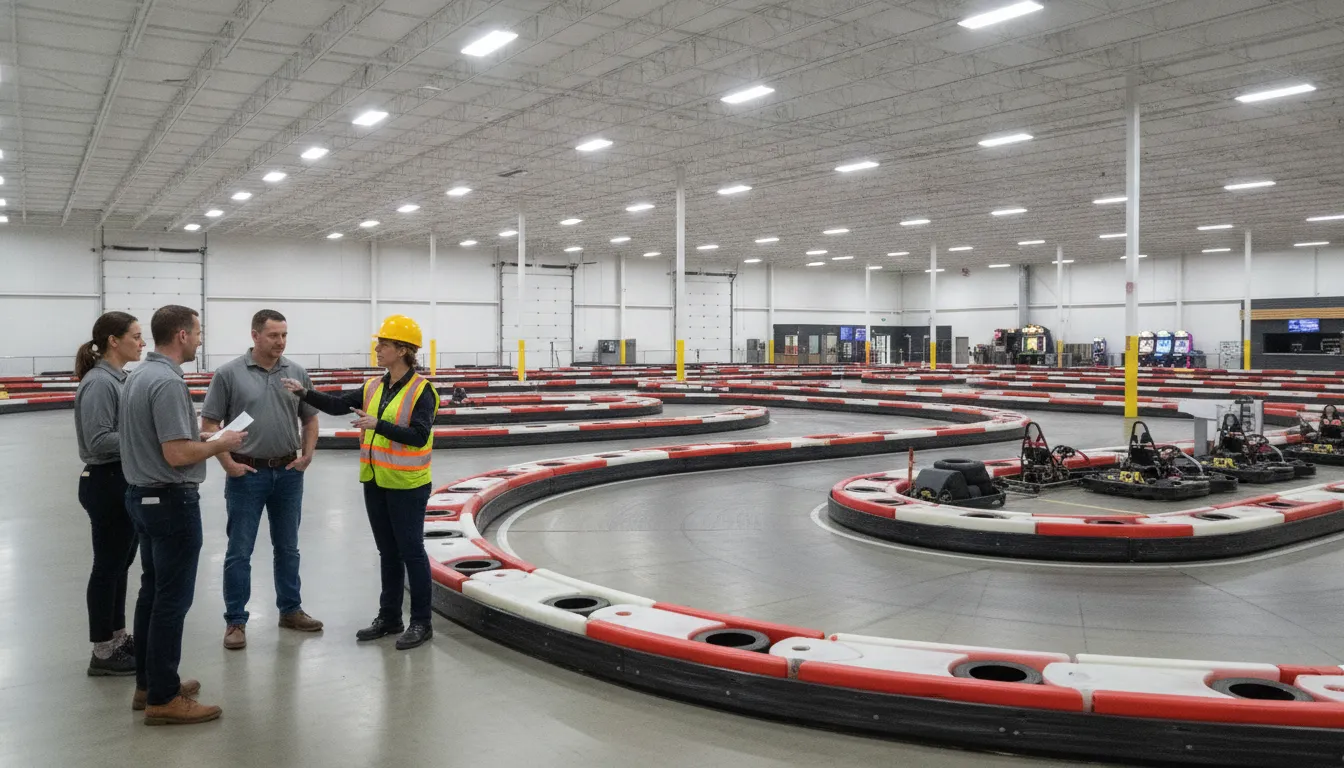
On an electric go-kart track, safety and throughput are not separate operating goals. A well-planned guest journey moves riders from check-in to briefing, loading, racing, unloading, and exit without creating confusion or unnecessary crossing points. That flow gives staff more opportunities to observe riders, communicate instructions, and respond when a session needs attention.
Design the session around predictable movement
Start by mapping the complete session rather than looking only at the racing surface. Where do guests queue? Where do they receive instructions? Can staff see the loading area, pit lane, and key track approaches from their assigned positions? Are arriving riders separated from guests leaving the attraction? Entry and exit loading areas, turn-radius calculations, sightlines, and traffic controls should be considered together during layout planning. The site itself determines the appropriate geometry and circulation, so avoid applying a universal capacity or track-size formula.
A briefing is most useful when it is consistent and easy to repeat. Operators should define what every rider needs to know before entering the track, how staff confirm readiness, and how exceptions are handled. The details depend on the attraction, local requirements, rider mix, and operating plan. A written operating procedure can help different attendants deliver the same information across shifts. Review go-kart track staffing alongside the physical layout so staffing positions and training expectations are part of the design conversation.
Measure the handoffs, not just the race
Throughput is shaped by every handoff before and after a session. Useful planning questions include: How long does loading take? Where does a delay first appear? Can one group unload while the next group receives its briefing? How often do staff need to pause a session to address rider behavior or equipment concerns? Which controls and signals help attendants communicate clearly? These questions produce a more realistic operating model than estimating performance from track length alone.
Track operators can also compare scheduled sessions with actual attendance, dispatch timing, unloading time, queue length, and repeat interruptions. Those observations support capacity planning and future changes without treating a projection as a guarantee. The go-kart track ROI model can support the financial side of that analysis, while the track plan should show how the operating assumptions connect to guest movement.
When Should You Bring in a Track Design Partner?
Bring in a design partner before you commit to a track footprint, attraction mix, or construction plan. Early guidance is especially valuable when a site has unusual dimensions, grade changes, shared circulation, an existing building, or a phased development strategy. A partner can test whether the concept fits the property and the intended audience before equipment decisions limit the options.
The process typically starts with site evaluation and feasibility work. That may include reviewing the property, demographics, competitive landscape, operating goals, and the relationship between the track and the rest of the FEC. The goal is not simply to draw a circuit. It is to understand how guests enter, load, ride, exit, and move toward the next attraction. Traffic flow, attraction capacity, and future expansion should be considered together.
Custom layout work becomes more useful as the project becomes more specific. A design partner can evaluate slope and flatness, entry and exit loading areas, turn-radius calculations, sightlines, barriers, and traffic signal or control integration. The track layout also needs to work with the selected fleet, rider mix, operating environment, and staffing plan. These decisions should be developed as one operating system rather than treated as separate purchases.
Visualization and documentation are important when several stakeholders need to approve the same plan. Iterative design and 3D renderings can make the proposed guest experience easier to review, while capacity planning helps connect the physical layout to daily operations. Construction documentation gives the project team a clearer basis for execution. If the attraction will open in phases, the plan can reserve logical space and circulation for later expansion instead of forcing a costly redesign.
Amusement Products combines manufacturing with FEC design, consultation, construction, education, and ongoing support. The company reports more than 60 years of FEC experience and evolved from operating 64 locations, including go-kart tracks. That operator heritage informs its approach to site evaluation, attraction planning, and post-purchase support. Review the company’s FEC experience, then schedule a design consultation when you are ready to test your electric car track concept against the site and the broader venue plan.
Frequently Asked Questions
What does an electric car track mean for an FEC?
In an FEC planning context, electric car track usually means an electric go-kart track rather than a slot-car attraction. The plan should connect the track layout with the fleet, loading process, control systems, rider mix, and operating environment. Electric go-karts can support indoor and outdoor operations and are generally quieter than gas-powered alternatives. Amusement Products manufactures ThunderVolt electric go-karts for family entertainment centers and outdoor tracks. Learn about the electric go-kart fleet.
What should be evaluated before finalizing a track layout?
Start with a site evaluation that considers available space, slopes, flatness, sightlines, circulation, entry and exit loading areas, turn radii, barriers, and traffic control integration. Avoid applying a universal track size to every venue. The building, guest flow, attraction mix, and intended capacity should determine the geometry and operating plan. A design consultation can include site evaluation, feasibility analysis, iterative design, capacity planning, and construction documentation. Review the design consultation process.
How do I match the fleet to different rider groups?
Consider rider experience, age mix, operating environment, loading design, and control systems together. The ThunderVolt fleet offers four selectable racing speeds: Rookie, Novice, Family, and Competition. That range can help one fleet serve different experience levels, but the appropriate settings and operating plan still depend on your site and guest policies. Treat kart selection as part of track planning, not as a separate purchasing decision.
When should an FEC bring in a track design partner?
Bring in a partner before committing to a layout, fleet, or construction plan when site constraints, expansion plans, or throughput goals are still being defined. A qualified partner can connect feasibility, traffic flow, attraction capacity, demographics, iterative layouts, 3D renderings, and construction documents. This early coordination helps the track support the wider FEC instead of creating an isolated attraction that is difficult to staff or expand.
Ready to Plan Your Electric Go-Kart Track?
A thoughtful track plan connects site conditions, rider flow, fleet selection, controls, and future operating needs before construction begins. Amusement Products can help you evaluate those decisions and shape a practical path for your FEC.
Schedule a design consultation to discuss your electric go-kart track plan with the team.