
Mini golf course design themes and layouts should do more than look memorable in a brochure. For a commercial family entertainment center, the right concept guides guests through a comfortable sequence of holes, gives different age groups a reason to play together, and creates visual moments that support repeat visitation. The strongest projects connect theme, playability, accessibility, operations, and long-term durability from the first concept sketch.
Schedule a design consultation to plan a miniature golf attraction around your site and guests.
A useful starting point is the Championship Miniature Golf Construction guide, which covers the broader decisions behind a commercial course. This article focuses on the creative and guest-experience layer: choosing a theme, sequencing holes, selecting obstacles, and making the course easy to understand and enjoyable to operate.
Popular Mini Golf Course Design Themes and Layouts That Drive Repeat Visits
A theme is most effective when it gives the course a clear identity without turning every hole into the same visual scene. Operators should choose a concept that fits the local audience, the available footprint, the surrounding attractions, and the level of maintenance the facility can support. A strong theme also creates a framework for naming zones, designing obstacles, planning lighting, and building a consistent arrival experience.
| Theme direction | Design opportunity | Operator planning question |
|---|---|---|
| Natural adventure | Rockwork, bridges, streams, caves, and elevation changes | Can landscaping and water systems be serviced efficiently? |
| Exploration or travel | Distinct zones that represent places, landmarks, or environments | Will each zone feel different while still reading as one course? |
| Story-driven fantasy | Character-free scenic elements, portals, towers, and imaginative obstacles | Can the story be understood quickly by guests who join mid-course? |
| Sports or competition | Clear score moments, tournament-ready lines, and spectator visibility | Can serious players compete without excluding casual family groups? |
| Local identity | Regional materials, colors, landmarks, and cultural references | Will the concept remain relevant as the venue and community evolve? |
For commercial use, avoid selecting a theme only because it is visually dramatic. A theme should support sightlines, safe circulation, practical repairs, and an intuitive hole sequence. It also needs enough flexibility for seasonal decorations or future refreshes without requiring a full rebuild. Operators can review the miniature golf portfolio for examples of how a course concept can become a complete attraction environment.
How Should a Mini Golf Course Layout Progress for All Ages?
A commercial layout should teach the game before it tests the player. The first holes establish confidence, the middle of the course introduces variety, and the final holes provide memorable challenges without making less experienced players feel lost. This progression helps mixed-age groups remain together instead of splitting into fast and slow players.
- Opening holes: Use clear lines, moderate distances, visible cups, and simple obstacles so first-time players understand the course quickly.
- Development holes: Add angles, gentle elevation, bank shots, and alternate routes that reward observation and practice.
- Feature holes: Place one or two signature moments where the theme and the game mechanic work together, such as a bridge, tunnel, water crossing, or elevated green.
- Closing holes: Finish with a challenge that feels significant but remains readable, safe, and playable for the broadest practical audience.
Flow matters as much as individual hole quality. Guests need enough room to wait, watch, retrieve balls, and move between holes without blocking the group behind them. The layout should also give staff access to high-wear areas and allow operators to observe key zones. Before approving a concept, review the route from entry to exit, including rest points, accessible paths, shade or shelter, scorecard use, and the location of service gates.
Design principle: Put the most visually distinctive feature where it can be seen without forcing guests to cross an active putting line or stop the course to take photographs.
What Obstacle and Feature Choices Engage Guests Longest?
Obstacles work best when they change how a player thinks about the shot, not when they simply make the course harder. A useful mix includes alignment challenges, speed-control challenges, bank shots, elevation, and carefully managed visual surprises. Variety gives returning guests something to improve while keeping the first visit understandable.
Build variety into the shot experience
- Directional features: Curves, rails, and angled barriers teach players to read a line.
- Speed-control features: Ramps, transitions, and surface changes reward a controlled stroke rather than maximum force.
- Elevation features: Raised greens and slopes create visual interest and make the ball path part of the attraction.
- Theme features: Bridges, gates, tunnels, rockwork, and water elements make the environment feel authored rather than assembled.
- Choice features: A visible short route and a more demanding route can give families and skilled players different ways to approach one hole.
Do not fill every hole with a large centerpiece. Negative space improves sightlines and lets signature features stand out. It also gives staff clearer views of play and makes cleaning, inspections, and repairs more manageable. A durable commercial course balances visual impact with serviceability. Ask how each obstacle will be anchored, cleaned, accessed, and replaced before it is included in the final design.
How Do Lighting, Signage, and Theming Shape the Guest Experience?
Guests experience a miniature golf course as a connected environment, not as eighteen isolated greens. Lighting, signage, color, sound, landscaping, and transitions should help players know where to go and what to expect next. These details also influence how the attraction looks from the entrance, from nearby walkways, and in guest photographs.
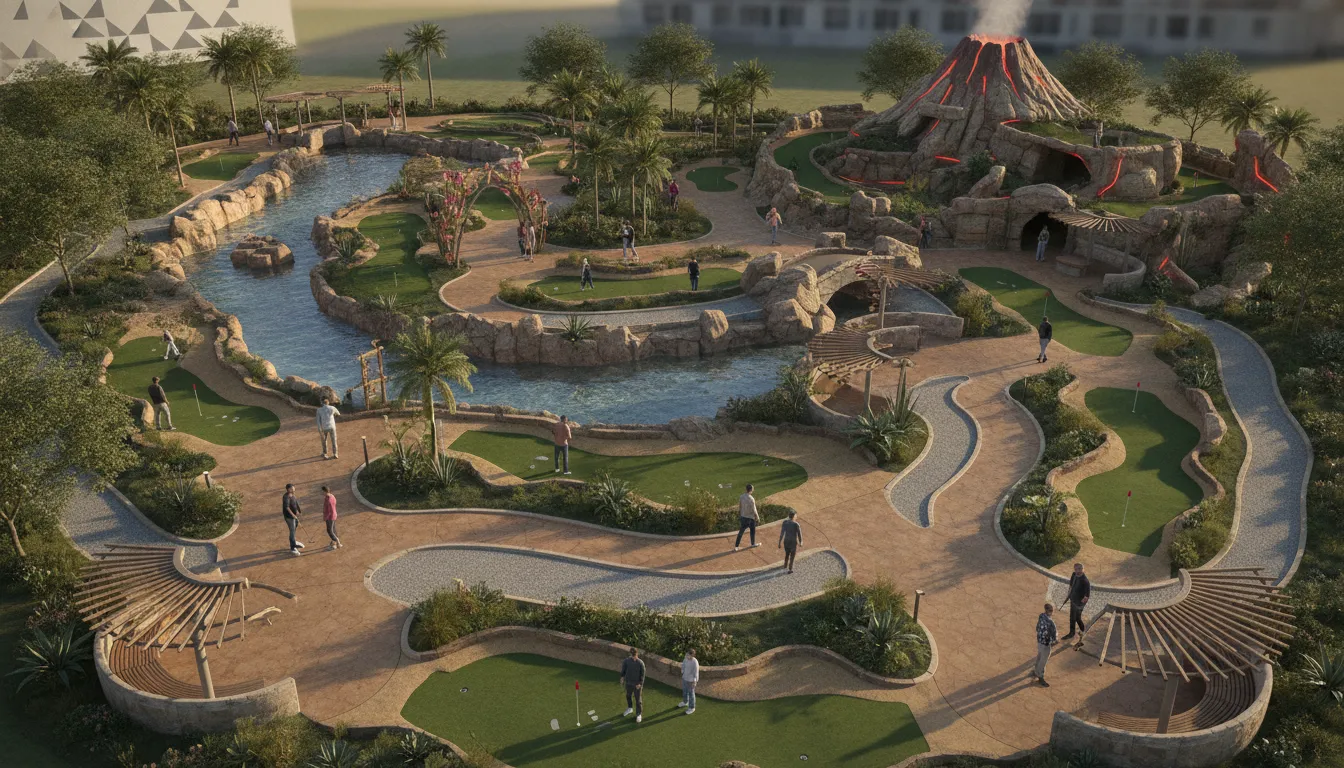
Use lighting to clarify, not distract
Lighting should make greens, edges, steps, transitions, and signs easy to read. For evening or indoor play, avoid glare that obscures the cup or creates reflections on playing surfaces. Accent lighting can direct attention to a feature, but the putting line and pedestrian route must remain visually clear. Lighting controls should be practical for staff, with access for maintenance and a plan for replacement parts.
Make signage part of the design system
Signage can identify the next hole, explain a special rule, mark accessible routes, and reinforce the theme. Keep instructions brief and place them where groups can read them without creating a queue. Directional signs are especially important at crossings, split paths, and areas where an attractive feature could otherwise pull guests the wrong way. Consistent icons and typography make the course easier to navigate for families, groups, and visitors who do not know the venue.
Branding should support the theme without covering every surface with messages. The most effective guest environments leave room for the attraction itself to do the selling. An intentional palette, repeatable material choices, and a few strong visual landmarks usually create a more durable impression than a collection of unrelated decorations.
Mini Golf Course Design Themes and Layouts: How Championship Miniature Golf Integrates Theme Into Every Hole
Championship miniature golf treats theme as part of the play system rather than a surface treatment applied after the holes are complete. The design team can begin with the story or environment, then translate it into a sequence of shots, sightlines, elevation changes, transitions, and gathering areas. That approach keeps the course visually cohesive while ensuring that every feature earns its place.
In practice, an integrated design process asks several questions at each hole:
- What should a guest notice first when approaching this hole?
- What is the intended shot decision, and can a new player understand it?
- How does this hole differ from the one before and the one after it?
- Where will groups wait, pass, or take photos without interrupting play?
- Can staff inspect, clean, repair, and reset the feature efficiently?
- Does the route remain usable for guests with different mobility needs?
The answers create a course that feels complete from the entry sign to the final scorecard. For operators comparing construction approaches, the step-by-step miniature golf course build guide explains how site feasibility, drainage, materials, approvals, construction, and opening tests fit around the design phase. The creative concept is important, but it has to survive the realities of daily commercial use.
Amusement Products has designed, built, and operated miniature golf courses since the early 1960s. That operator perspective can help identify where a striking idea improves the guest journey and where it could create an avoidable maintenance or flow problem. The goal is not to make every hole compete for attention. It is to create a course that feels varied, intuitive, durable, and worth playing again.
Frequently Asked Questions About Mini Golf Course Design
What are some creative themes for a mini golf course?
Commercial themes can include natural adventure, exploration, travel, fantasy, sports, or local identity. The best choice fits the venue, available footprint, target audience, operating model, and maintenance plan. A theme should guide the full guest journey rather than appear only on individual obstacles.
How many holes should a commercial miniature golf course have?
The right hole count depends on the site, intended play time, throughput goals, footprint, and overall attraction mix. An operator should evaluate the complete route, queue behavior, accessible circulation, staff access, and guest capacity instead of selecting a hole count in isolation.
How do you make a mini golf course accessible to different ages and abilities?
Plan accessible travel routes, readable signs, safe transitions, practical rest points, and playable lines as part of the initial layout. Use a progression that begins with understandable shots and offers variety without requiring every guest to use the most difficult route.
What makes a mini golf course encourage repeat visits?
Repeat visitation is supported by a memorable theme, varied shot experiences, a comfortable flow, durable presentation, and enough challenge for guests to improve. Signature holes, seasonal presentation updates, and a course that works for both first-time and returning players can strengthen the reason to come back.