
Championship miniature golf course design standards are the practical requirements that make a commercial course challenging, durable, accessible, easy to operate, and engaging for repeat visitors. They connect hole design, surface construction, guest flow, drainage, maintenance, and the venue’s business goals instead of treating the course as a collection of decorative obstacles. Use these standards alongside Amusement Products’ Championship Miniature Golf Construction guide when evaluating a new FEC attraction.
Schedule a design consultation for your championship miniature golf project.
What Are Championship Miniature Golf Course Design Standards?
A championship-grade course is designed around playability and operations first. It should offer a varied sequence of shots, clear routes, durable surfaces, manageable maintenance, and a coherent visual experience. The result is more than a set of holes: it is a commercial attraction that supports safe movement, consistent play, and efficient daily operation.
- Playable challenge: Holes reward judgment and control without becoming confusing or frustrating.
- Variety: Elevation, curves, obstacles, water, and shot angles create a memorable round.
- Commercial durability: Edges, turf, drainage, bridges, and features are specified for repeated public use.
- Accessible circulation: Paths and transitions support broad participation and local accessibility requirements.
- Operational flow: Waiting areas, hole order, entry, exit, and service access reduce bottlenecks.
There is no single universal rulebook that defines every commercial championship course. A responsible designer translates the operator’s audience, site, climate, capacity, and attraction goals into a documented standard for that property. That site-specific approach is why a professional feasibility and design review should come before construction.
How Do Championship Miniature Golf Course Design Standards Shape Hole Design?
Hole design standards create a deliberate progression from approachable opening holes to more demanding finishing holes. Each hole should have a clear objective, a sensible shot line, and a recovery path when a player misses. The course can be visually dramatic without relying on random difficulty or features that interrupt the pace of play.
| Design element | Commercial standard to evaluate |
|---|---|
| Hole sequence | Vary length, direction, elevation, and challenge so the round has a clear rhythm. |
| Obstacles | Use features that shape decisions and remain serviceable under daily guest traffic. |
| Cups and shot lines | Place targets where players can understand the intended line and staff can service the hole. |
| Player spacing | Allow groups to finish, wait, and move forward without unsafe crowding. |
| Final holes | End with a memorable challenge that does not create a queue at the exit. |
For an FEC, the best layout balances competitive interest with broad demographic appeal. Children, adults, first-time players, and experienced golfers should all be able to understand how to begin. A course designer should review sightlines from tees, the relationship between neighboring holes, and the way groups move when a ball leaves the intended path.
Amusement Products’ current step-by-step guide to building a miniature golf course covers the wider sequence from site feasibility through commissioning. This article narrows the focus to the design standards that determine whether the finished attraction plays well day after day. For the full project scope, operators can also review the Championship Miniature Golf Construction guide, which connects the design decisions to construction planning and a complete FEC build.
What Makes Professional Mini Golf Design Different From Casual Mini Golf?
Professional commercial design treats the course as an operating asset rather than a one-time decoration project. A casual layout may focus on appearance or a few individual obstacles. A professional FEC layout also accounts for throughput, repair access, drainage, accessible travel, staffing, cleaning, visibility, and how the attraction fits the rest of the venue.
- Guest flow is designed: The entrance, hole order, waiting zones, and exit work as one circulation system.
- Maintenance is planned: Staff can reach surfaces, water systems, edges, and mechanical or electrical components safely.
- Materials are selected for duty: Surfaces and features are chosen for repeated play, weather exposure, and cleaning.
- The site is respected: Topography, stormwater, utilities, shade, sun, and existing structures inform the layout.
- The attraction supports the venue: The course complements parking, ticketing, food service, retail, and other FEC attractions.
The distinction is especially important when an operator is adding miniature golf to an existing family entertainment center. The course must welcome new guests without blocking current traffic. It should be visible enough to sell itself, yet organized enough that a busy day does not turn the first tee, narrow path, or final hole into a choke point.
How Should a Commercial Championship Course Handle Surface Materials and Drainage?
Surface and drainage standards protect playability, appearance, and uptime. The design should direct water away from playing surfaces, protect edges from erosion, and use finishes that maintain a predictable ball roll. Material choices should also reflect whether the course is indoor, outdoor, seasonal, heavily shaded, exposed to weather, or integrated with an existing building.
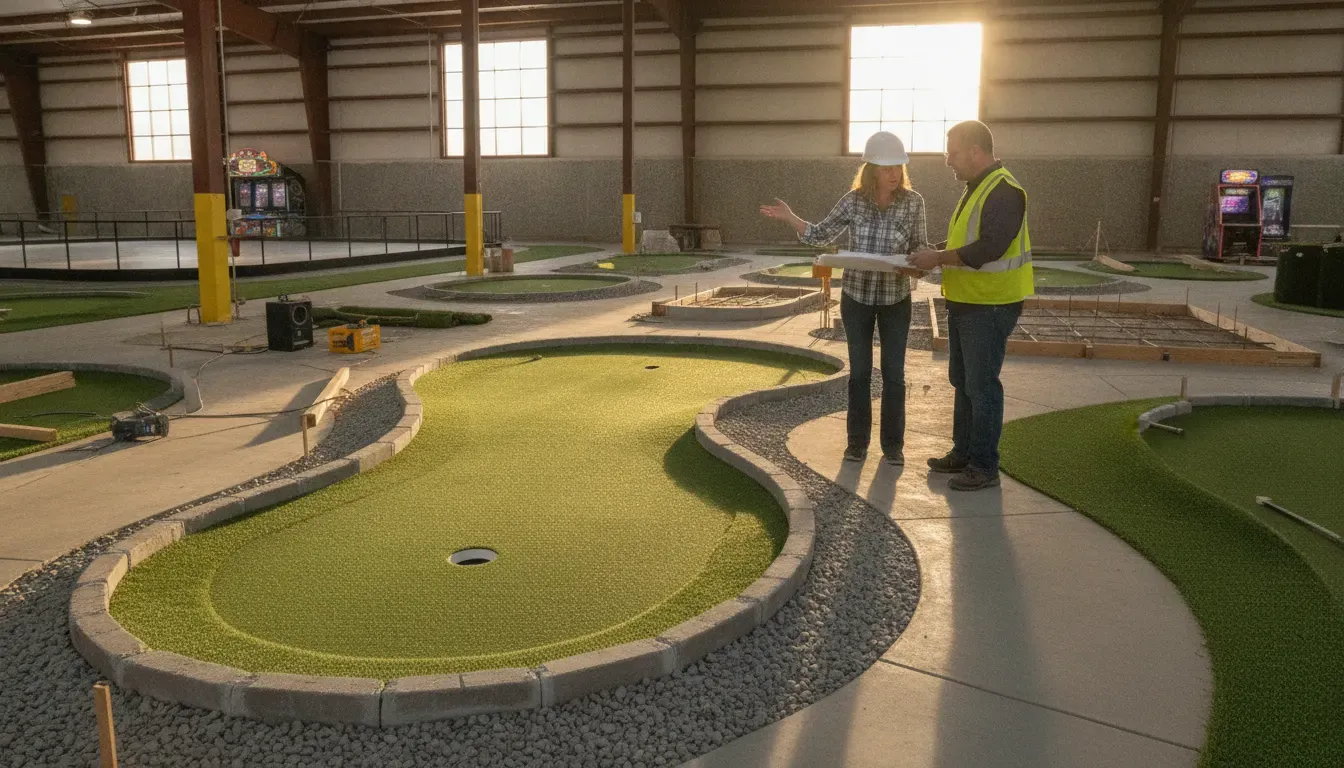
- Confirm grades and low points before finalizing hole elevations.
- Separate walking routes from drainage channels and service areas.
- Detail curbs, transitions, retaining edges, and joints to reduce trip hazards and water intrusion.
- Choose fairway and fringe surfaces that deliver consistent play and can be repaired or replaced.
- Plan water features with filtration, access, overflow control, and seasonal maintenance in mind.
A visually impressive water feature is not automatically a good commercial feature. It needs a maintenance plan and a drainage strategy that protect the surrounding holes. The same principle applies to landscaping, rockwork, bridges, shade structures, and themed elements. Every feature should contribute to the experience without creating an avoidable service problem.
Which Accessibility and Guest-Flow Details Belong in the Plan?
Accessibility and guest flow should be resolved in the design documents, not left to field improvisation. A commercial course needs routes that connect the entrance, holes, rest areas, and exit, with transitions and clearances reviewed for the applicable local requirements. It also needs enough space for groups to pause without blocking the next shot.
- Connect the course to parking, ticketing, restrooms, and the rest of the FEC with clear routes.
- Review slopes, surface changes, turning areas, handrails, and edge protection where applicable.
- Provide resting or waiting points without placing guests in active shot lines.
- Use sightlines and wayfinding cues that help first-time visitors understand the course.
- Separate staff access, equipment movement, and maintenance work from public circulation whenever possible.
Good flow improves both the guest experience and the operator’s ability to serve more groups without making the course feel crowded. The review should include peak periods, not only an empty-site walkthrough. Designers should test how a group moves when one player takes longer, a ball leaves a hole, or a staff member needs to respond to a maintenance issue.
Download the Amusement Products catalog to review commercial attraction options for your FEC.
How Does Amusement Products Design Championship Miniature Golf Courses?
Amusement Products brings an operator’s perspective to championship miniature golf course design. The company has designed, built, and operated miniature golf courses since the early 1960s, including experience operating family entertainment locations. Its planning process connects the proposed attraction to the property, audience, operating model, construction requirements, and long-term service needs.
- Define the project: Clarify the venue, audience, available footprint, desired experience, operating season, and relationship to other attractions.
- Review the site: Study the building or parcel, grades, utilities, drainage, access, visibility, and constraints.
- Develop the course concept: Establish theme, hole count, challenge progression, landscaping, water features, and guest routes.
- Coordinate the build: Turn the concept into a plan for materials, construction, service access, approvals, and commissioning.
- Prepare for operation: Review staff movement, cleaning, maintenance, opening checks, and the handoff into daily use.
The company’s broader design and consultation services cover park layout planning and attraction-specific design. That integrated perspective matters when miniature golf is one part of a larger FEC, because the course should support the venue’s future growth instead of consuming the space needed for other guest or service functions.
Amusement Products also manufactures and supports FEC attractions from its Chattanooga, Tennessee operation. For operators evaluating a complete attraction plan, the company background and team page provides additional context on its manufacturing and industry experience.
What Should Operators Ask Before Approving a Championship Course Design?
Before approving a design, an operator should be able to explain how the course will play, how guests will move, how staff will maintain it, and how the attraction fits the venue. The following questions expose gaps early, when they are less expensive and less disruptive to correct.
- Can a first-time guest understand the route from entry to exit?
- Does the hole sequence create variety without creating confusing or unfair shots?
- Where do groups wait, pass, recover balls, and move when a hole is occupied?
- How will rain, runoff, seasonal weather, cleaning, and routine repairs affect operations?
- Can the design accommodate the intended audience and applicable accessibility requirements?
- Which features are essential to the experience, and which add maintenance without enough value?
- How does the course connect to ticketing, food service, parking, and future attractions?
These questions turn the phrase world-class into measurable design decisions. They also give an operator a useful framework for comparing proposals without reducing the decision to appearance alone.
Frequently Asked Questions About Championship Miniature Golf Design
Q: What is a championship miniature golf course?
A: A championship miniature golf course is a professionally planned commercial attraction with varied, playable holes, durable construction, accessible circulation, strong guest flow, and an operating plan that supports repeat public use.
Q: Are there universal championship miniature golf course design standards?
A: There is not one universal rulebook for every commercial course. The practical standards should be documented around the site’s audience, climate, capacity, accessibility requirements, maintenance plan, and business goals.
Q: How many holes should a commercial miniature golf course have?
A: The right hole count depends on the available footprint, intended round length, guest throughput, site constraints, and the attraction mix. A professional design review should determine the best fit instead of forcing a fixed number.
Q: What materials are used for a commercial miniature golf course?
A: Commercial courses commonly combine durable playing surfaces, concrete or other stable edges, landscaping, drainage systems, themed obstacles, and serviceable water or bridge features. The exact specification should match the site and operating conditions.
Q: Why should an FEC use a specialist course designer?
A: A specialist can coordinate playability, site conditions, guest circulation, construction, accessibility, maintenance, and the relationship between miniature golf and the rest of the FEC before those decisions become field changes.
Request a championship miniature golf design consultation with Amusement Products.