.
A successful family entertainment center is not built by collecting the biggest attractions available. It is built by balancing guest age, visit purpose, traffic flow, staffing, maintenance, and the space available for safe, repeatable play.
The best commercial amusement rides for family entertainment centers work as a coordinated portfolio. Anchor attractions draw attention, flexible experiences serve multiple age groups, and complementary activities encourage guests to stay longer and return. The right combination depends on your site, audience, operating model, and growth plan.
That planning perspective matters because an attraction can be popular yet still create queue bottlenecks, staffing strain, or gaps in your guest mix. Amusement Products brings more than 60 years of experience as a manufacturer and integrated FEC solutions provider, including a history of operating 64 FEC locations. Start by evaluating which attraction roles create the strongest balance for your venue.
Schedule a design consultation for your FEC attraction mix.
What Are the Most Revenue-Generating FEC Attractions?
There is no universal list of attractions that guarantees revenue for every family entertainment center. The strongest portfolios usually combine several attraction roles. A marquee experience draws attention, repeat-play activities encourage return visits, skill-based options support friendly competition, and immersive attractions give groups another reason to stay longer. The right balance depends on your audience, building, operating model, and local demand.
Marquee attractions create a reason to visit
Anchor attractions are often the most visible part of an FEC. Electric go-karts and bumper cars can give a venue a clear identity, while miniature golf can provide a broader, more flexible experience for families and mixed-age groups. These attractions should be evaluated for capacity, queue behavior, staffing, safety procedures, and how easily guests can move to another activity afterward. Amusement Products evolved from operating 64 FEC locations, including 36 miniature golf courses and 28 go-kart tracks. That operating background informs how an attraction functions in a complete venue, not only how the equipment performs on its own.
Operators comparing racing concepts can review electric go-kart attraction options alongside the space, circulation, and supervision requirements of the property.
Repeat-play activities support visit frequency
A repeat-play attraction gives guests a reason to come back and improve, compete, or try a different experience. Bumper cars, miniature golf, and pitching machines can serve this role when the activity is easy to understand but offers enough variation to remain engaging. These options may also help diversify the guest mix. For example, a venue can pair a high-energy ride with an activity that appeals to guests who prefer accuracy, strategy, or a less speed-focused experience. Explore how to plan a miniature golf attraction as part of a complementary activity mix.
Skill and immersive options broaden the portfolio
Skill-based attractions, including pitching machines and miniature golf, create measurable challenges that can work well for small groups, parties, and repeat visitors. Immersive options such as virtual reality and laser tag can add a different sensory experience, but they still require careful review of technology, supervision, maintenance, and guest flow. Amusement Products manufactures electric go-karts, bumper cars, miniature golf attractions, and pitching machines, while also distributing VR attractions and supporting laser tag and control systems. This portfolio allows operators to consider how multiple categories work together rather than selecting isolated equipment.
- Choose at least one visible anchor that defines the venue.
- Balance high-energy attractions with skill-based or all-ages activities.
- Review throughput, staffing, maintenance, and circulation before judging revenue potential.
- Use site-specific feasibility planning instead of assuming one attraction mix fits every FEC.
Which Commercial Amusement Rides for Family Entertainment Centers Fit Your Audience?
The strongest attraction choice starts with the guests a venue needs to serve, not with a product category. Map the primary age bands, visit types, and comfort levels in your market. A facility that attracts parents with young children has different ride requirements than one built around teenagers, corporate groups, or competitive repeat players. The goal is a mix that gives each group a clear reason to participate while keeping operations manageable.
Match the experience to age and group type
For mixed-age family visits, Spin Zone Bumper Cars can broaden participation because the ride is designed for ages 5 and up. Its Buddy Seat can accommodate a passenger as young as 3. That makes it relevant for siblings and parent-child pairs, rather than limiting the experience to independent older riders. Its surface flexibility also supports more venue concepts. Spin Zone can operate on wood, concrete, asphalt, or ice. Operators should still evaluate the planned arena, supervision model, and local requirements during design.
For teens, adults, and groups seeking more intensity, ThunderVolt electric go-karts provide four selectable modes: Rookie, Novice, Family, and Competition. One fleet can therefore support first-time drivers, family sessions, and guests looking for a more challenging race experience. Review the electric go-kart ride options when comparing how a racing attraction could serve distinct skill levels without making the entire experience feel advanced.
Account for the operating environment
Indoor and outdoor conditions should shape the shortlist early. ThunderVolt electric go-karts are suitable for indoor and outdoor operation, run more quietly than gas alternatives, and have fewer moving parts. Those characteristics may matter when an attraction sits near other activities or when noise affects the guest environment. They also help an operating team consider equipment complexity alongside the guest experience. Battery-powered bumper cars for FECs are another option to assess when planning a flexible ride area.
- Age coverage: Identify who can ride independently and where paired participation adds value.
- Group type: Separate family play, casual social visits, parties, and skill-driven repeat visits.
- Intensity: Offer approachable modes as well as a clear challenge for experienced guests.
- Site conditions: Confirm indoor or outdoor suitability, surface requirements, sound considerations, and operating workflows.
Use those criteria to compare rides as part of the complete FEC plan, including queues, sightlines, staffing, and adjacent attractions.
How Do You Choose the Right Attraction Mix for Your Venue Size?
Venue size is more than a square-footage figure on a floor plan. The usable area must support the attraction itself, guest movement, safe operating zones, queues, staff positions, storage, maintenance access, and the building systems each activity requires. A mix that looks efficient on paper can become difficult to operate if guests cannot circulate comfortably or employees cannot see and reach critical areas.
Use the following planning sequence before selecting commercial amusement rides for family entertainment centers:
- Map the usable footprint. Measure the space that can actually support attractions after accounting for columns, restrooms, offices, fire egress, entrances, and other fixed elements. Separate attraction areas from loading, unloading, queue, staging, and service zones rather than treating the entire building as available ride space.
- Confirm building and site constraints. Review ceiling height, overhead clearance, door and loading access, floor conditions, drainage, power, charging locations, ventilation, and other utility requirements. Indoor and outdoor areas may support different choices, and an attraction must fit the building as it exists, not just the dimensions shown in a concept sketch.
- Test throughput and circulation. Estimate how guests enter, wait, ride or play, exit, and move toward the next activity. Look for queue spillback, blind corners, crossing traffic, and bottlenecks between attractions. Throughput is not only a capacity question. It also depends on dispatch procedures, loading time, cycle management, and how quickly staff can reset an activity.
- Model the staffing plan. Identify who supervises each attraction, where operators stand, how many activities one employee can reasonably monitor, and how opening, closing, cleaning, and routine checks fit into a shift. Safety requirements, guest age ranges, and sightlines should shape the layout as much as the equipment footprint.
- Plan for phased growth. Reserve practical access and utility capacity for future additions where possible. A phased approach can let an operator expand the attraction mix without blocking existing queues, removing equipment, or disrupting the main circulation path.
- Validate feasibility with an experienced partner. Amusement Products creates custom layouts for individual attractions and complete FECs, drawing on more than 60 years of experience to address traffic flow and revenue generation. A feasibility review can connect the site, audience, equipment, construction, staffing, and support plan before a purchase decision.
Takeaway: The right mix is the one your building and team can operate safely while giving guests clear, comfortable paths through complementary experiences. To review your site-specific options, schedule a design consultation with Amusement Products.
How Do Go-Karts, Bumper Cars, Mini Golf, and Batting Cages Compare?
A balanced attraction portfolio gives guests different ways to participate. Racing can create an active, competitive anchor, while skill-based and social activities broaden the reasons families, groups, and repeat visitors return. The strongest mix depends on the building, site, audience, staffing model, and the experience you want guests to have, not on choosing a universally superior attraction.
| Attraction | Strategic role | Audience coverage | Operational considerations | Planning questions |
|---|---|---|---|---|
| Go-karts | Competitive anchor with a clear race experience. | ThunderVolt modes range from Rookie and Novice to Family and Competition, supporting first-time drivers through serious racers. | Indoor or outdoor flexibility, quieter electric operation, and fewer moving parts can influence placement and maintenance planning. | What driver groups must the fleet serve? How will loading, queueing, supervision, and race flow fit the site? |
| Bumper cars | Social, approachable ride that encourages shared participation. | Spin Zone is designed for ages 5 and up, with a Buddy Seat for passengers as young as 3. | Four battery-powered models do not require an electric floor and can operate for up to 16 hours between charges. | Can the arena provide safe circulation and clear operator sightlines? Where will charging and guest queues work best? |
| Mini golf | Longer-form group activity that supports conversation and varied pacing. | Can engage mixed-age families, dates, and groups who want competition without a motorized ride. | Course circulation, visibility, accessibility, weather exposure, and maintenance access shape the experience. | Will the course complement nearby attractions? How should holes guide traffic through the venue? |
| Batting cages | Skill-based activity that adds practice, challenge, and repeat-play potential. | Can appeal to sports-minded guests, families, teams, and players with different skill levels. | Requires thoughtful separation, supervision, equipment protection, and a layout that manages turns and waiting guests. | What skill levels and session formats will the venue support? How will noise, safety zones, and circulation be managed? |
These categories can also work together. A go-kart track or electric go-kart attraction may serve guests seeking speed, while commercial bumper cars offer a more social ride format. Miniature golf attraction and pitching machine attraction add non-ride options that can broaden participation. Amusement Products manufactures and supports several of these categories, helping operators evaluate the mix as one connected guest journey.
How Should an FEC Allocate Floor Space Across Attractions?
Floor-space planning should begin with the guest journey, not with a catalog of equipment. Map how families enter, orient themselves, choose an activity, wait, play, exit, and decide what to do next. A strong layout gives each attraction enough visibility to explain its value without allowing queues to become barriers. Place high-interest attractions where they can be seen from arrival or major circulation paths, while protecting service doors, emergency routes, and staff work areas.
Queue spillback is an operational problem as much as a space problem. Model the expected waiting area, loading point, unloading point, and a clear path around each attraction. Keep sightlines open so attendants can monitor riders and guests can understand where to go. Separate louder or faster activities from quieter experiences when practical. That may mean placing racing attractions away from seating or party areas, and using walls, distance, or orientation to reduce sound overlap.
Consider dwell time and cross-selling across the entire visit. A short, repeatable activity can help fill gaps between longer experiences. A longer-format attraction, such as miniature golf attraction design, may benefit from a route that naturally returns guests toward food, parties, or another activity. Likewise, commercial batting cage attractions can complement ride-focused areas when the layout accounts for equipment, supervision, and guest circulation.
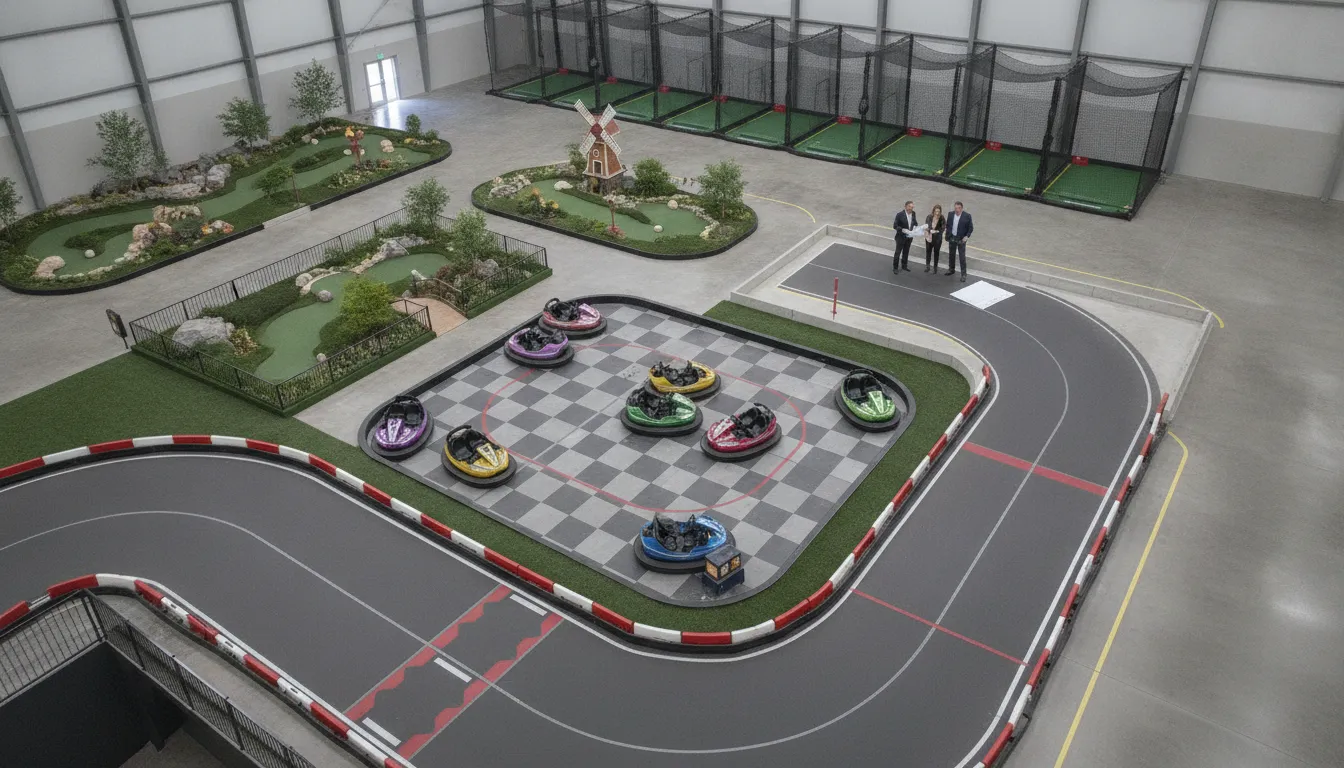
Safety separation should be explicit in the plan. Keep rider paths, spectator areas, maintenance access, and unrelated guest traffic from competing for the same space. Then reserve practical expansion zones. Future capacity, a new attraction, revised queueing, or improved party-room access may matter more than filling every available corner on opening day.
- Trace guest traffic from entry through queue, activity, exit, and next-purchase decision.
- Test visibility, attendant sightlines, noise separation, and queue spillback.
- Protect emergency routes, maintenance access, loading areas, and spectator boundaries.
- Balance short repeat-play activities with longer dwell-time experiences.
- Hold usable space for phased expansion and operational changes.
A site-specific layout review can test these relationships before construction locks them in. The goal is not maximum equipment density. It is a venue that remains legible, safe, serviceable, and commercially useful throughout the guest experience.
What Should You Expect From an FEC Attraction-Mix Partner?
A strong attraction-mix partner should begin with your site and operating model, not a preselected equipment list. The process typically starts with a site assessment covering usable space, access, ceiling or outdoor conditions, utilities, traffic patterns, queue areas, and safety requirements. Your partner should also review local demographics, nearby competition, visit occasions, age groups, and the balance between first-time guests and repeat visitors.
That information supports feasibility and financial modeling. The goal is to understand capacity, staffing, maintenance, utilization, and potential return on investment without relying on generic figures or promises. From there, the design should be iterative. Layouts are refined around guest circulation, sightlines, attraction adjacency, future expansion, and the equipment specifications required for your building and audience.
Amusement Products can support that process as a manufacturer and integrated FEC solutions provider. The company has operated from Chattanooga, Tennessee, for more than 60 years and evolved from operating 64 FEC locations into a broader equipment, construction, design, and support resource. Its portfolio includes manufactured electric go-karts, bumper cars, miniature golf attractions, and pitching machines, along with distributed and supported technologies such as VR and laser tag systems. Learn more about Amusement Products experience and capabilities.
Construction coordination should connect the approved layout with site preparation, installation requirements, inspections, and project sequencing. After opening, an effective partner continues with operator training, maintenance guidance, replacement parts, and responsive technical support. Education can strengthen the business plan as well. The FEC Success Institute has operated since 1997. It is IAAPA-accredited and provides 14 certification credit hours covering feasibility, design, construction planning, staffing, and operations.
- Site, demographic, and competition analysis before equipment selection.
- Iterative layouts that address flow, capacity, safety, and expansion.
- Clear equipment specifications and construction coordination.
- Training, parts access, and post-opening technical support.
Schedule a design consultation for your site and operating goals.
Frequently Asked Questions
How do I choose the right attraction mix for an FEC?
Start with your audience, usable floor area, indoor or outdoor conditions, expected visit occasions, and operating model. Then balance attractions by age coverage, throughput, staffing needs, queue requirements, and maintenance access. A site-specific feasibility review is more useful than copying another venue’s portfolio.
Can one attraction serve multiple age groups?
Some attractions can, but the operating specifications matter. ThunderVolt electric go-karts offer Rookie, Novice, Family, and Competition speed modes, allowing operators to create different driving experiences with one fleet. Spin Zone Bumper Cars are designed for ages 5 and up, with a Buddy Seat for passengers as young as 3.
Are electric attractions suitable for indoor and outdoor FECs?
Electric go-karts can support indoor or outdoor operation and are quieter than gas alternatives, which may help when planning a mixed-use venue. Site conditions still determine the appropriate equipment, surface, drainage, electrical service, weather protection, and traffic plan. Confirm those requirements during design rather than assuming every attraction fits every site.
What safety and compliance questions should operators ask?
Ask how the attraction is designed, tested, operated, maintained, inspected, and documented. ASTM F24 standards address these areas, and requirements can vary by jurisdiction. Operators should also plan for trained staff, proper use of restraints where provided, rider-size restrictions, and attentive supervision while the ride is moving. See the IAAPA overview of ASTM F24 standards and confirm local inspection and permit rules before opening.
When should I involve an attraction-mix partner?
Bring a qualified partner in before finalizing the building plan or equipment list. Early input can connect demographics, traffic flow, queue space, utilities, staffing, construction, training, parts, and ongoing support. Amusement Products provides custom layouts for individual attractions and complete FECs as a manufacturer and integrated FEC solutions provider.
Frequently asked questions are included below for convenient reference.
Schedule a Design Consultation for Your FEC
A balanced attraction mix should reflect your venue, audience, traffic flow, and operating priorities. A site-specific planning conversation can help you evaluate those factors together before finalizing your equipment and layout decisions.
Schedule a design consultation with Amusement Products to plan your FEC attraction mix.