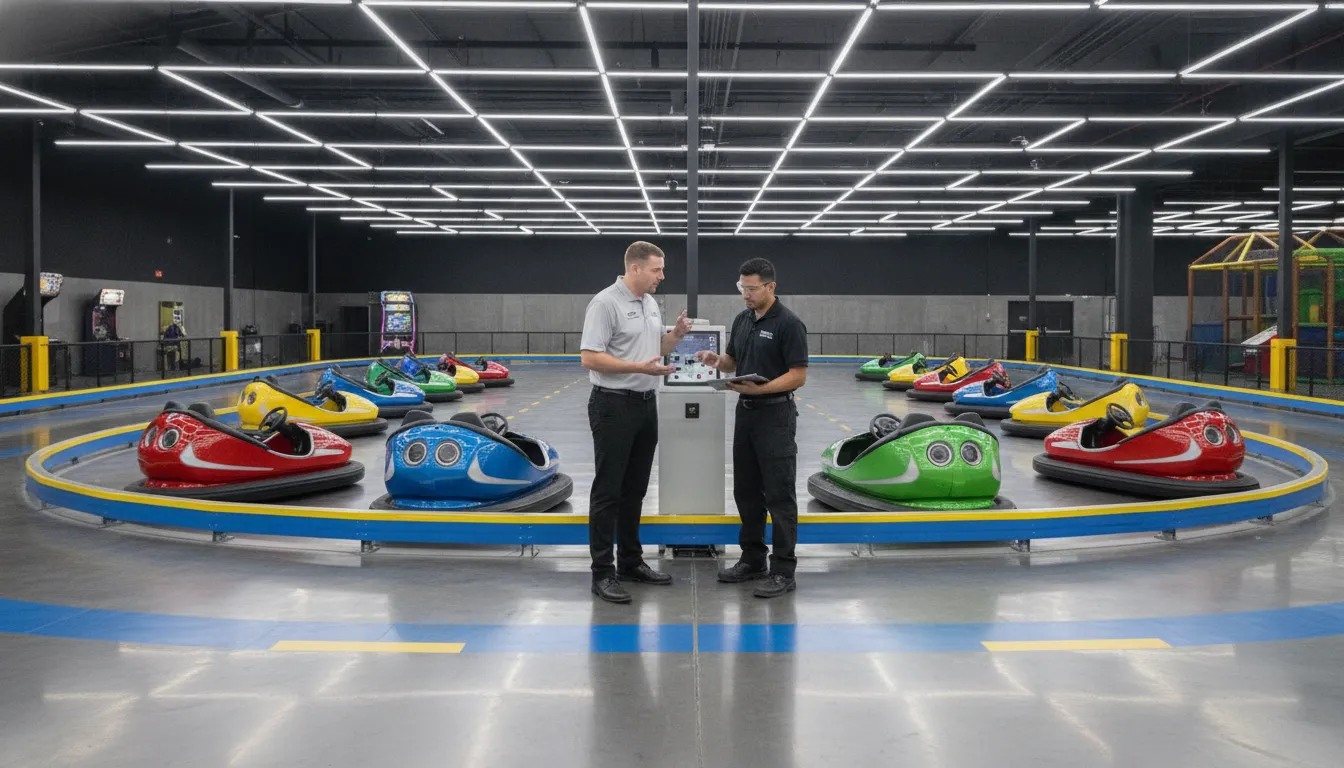
For FEC operators evaluating bumper cars wholesale for commercial venues, Amusement Products recommends starting with the venue, operating model, and support plan, not just the number of vehicles. Review the Spin Zone Bumper Cars guide for commercial FEC operators alongside your procurement questions so the attraction choice and the project scope stay connected.
Schedule a design consultation before you finalize your fleet or arena plan.
What Does Bumper Cars Wholesale for Commercial Venues Actually Mean for FEC Buyers?
Amusement Products defines bumper cars wholesale for commercial venues as a complete procurement conversation, not a bulk product order. The scope can include vehicles, arena requirements, controls, charging, installation planning, training, documentation, and post-opening support. The goal is equipment that fits the venue and can be operated consistently during real business hours.
A commercial bumper car attraction may require an arena system, perimeter barriers, ride controls, charging equipment, safety components, installation coordination, operating documentation, and staff training. The final scope depends on the building, fleet size, floor plan, electrical needs, local requirements, and expected peak-period operation.
Amusement Products bumper cars, including Spin Zone and Flip Zone, use rechargeable batteries and do not require an electric floor. The company states that the systems can operate for up to 16 hours between charges. That information can shape arena construction, charging locations, and daily scheduling decisions.
- Define the equipment and arena components included in the package.
- Assign responsibility for site preparation, installation, training, and acceptance.
- Confirm the support and replacement-parts path before opening.
Direct-From-Manufacturer vs. Distributor: What Should FEC Operators Know?
Amusement Products recommends evaluating the supplier relationship, not just the catalog. The sourcing model determines who controls specifications, coordinates the arena, supplies documentation, and answers technical questions as the attraction prepares to open or needs service.
Manufacturer-direct sourcing can provide closer access to product specifications, engineering details, and parts support. It may fit an experienced team that can manage facility planning and installation independently. A distributor can simplify purchasing, but the buyer should confirm which responsibilities remain with the manufacturer.
An integrated project partner may connect equipment supply with design, construction coordination, education, and service. Amusement Products describes its role as a US-based manufacturer, distributor, and service provider with those supporting capabilities. Regardless of the model, request written answers about warranty decisions, documentation, technical escalation, and launch support.
| Area | Question to resolve |
|---|---|
| Specification | Who confirms fleet configuration, arena requirements, controls, and charging? |
| Installation | Who coordinates delivery, arena preparation, commissioning, and site handoff? |
| Training | What do operators receive for inspections, charging, controls, and routine care? |
| Support | How are parts, technical questions, warranty matters, and service requests handled? |
Minimum Order Quantities and Fleet Packages for Bumper Cars
Wholesale does not automatically mean that every FEC needs the same minimum order quantity. The appropriate fleet depends on arena dimensions, expected demand, operating hours, staffing, rotation needs, and the supplier’s available configurations. Ask whether a supplier has a formal minimum, a recommended starting fleet, or a package that can expand as the venue grows.
Amusement Products recommends treating the fleet package as an operating system. A documented package should connect vehicle capacity to floor area, guest circulation, charging routines, staffing, and service planning. It should also identify what is included, excluded, optional, or supplied by the venue.
Spin Zone configurations require approximately 600 to 1,500 square feet, depending on the layout. A package should show the arena footprint, circulation space, handrails, access points, operator sightlines, ride controls, lighting, audio, charging equipment, and storage for service items. The commercial bumper car arena layout guide can help teams review these decisions before installation.
Fleet sizing is more than counting cars. Ask for the intended loading and unloading pattern, operator position, dispatch procedure, and any vehicle reserved for rotation or service. A fleet plan should state the operating hours and charging window so the team can test the assumptions against actual venue conditions.
Import Tariffs and US-Made Considerations for Commercial Buyers
Import exposure, shipping coordination, documentation, service access, and ownership of compliance questions can affect the path from purchase order to opening day. Tariff conditions can change, so Amusement Products advises operators to ask suppliers to explain current procurement assumptions in writing instead of leaving them unclear.
Ask for a lead-time plan with manufacturing or sourcing milestones, freight handoffs, delivery requirements, and the person responsible for resolving delays. Request installation materials, operating instructions, maintenance guidance, warranty terms, and applicable compliance records as part of the handoff.
ASTM F24 standards address amusement ride design, manufacturing, testing, and operation. IAAPA’s ASTM F24 safety context is a useful starting point for a project discussion, but it does not replace confirming the rules that apply to a specific venue and jurisdiction.
Service deserves the same scrutiny as the initial shipment. Ask how replacement components are identified, where support is coordinated, and what the warranty process requires. A US-based manufacturing and service relationship may simplify communication, but the buyer should still document the exact support commitments for the proposed fleet.
How to Source Commercial Bumper Cars From Amusement Products
Amusement Products’ commercial sourcing process starts with the venue and operating goals, then connects layout, equipment, installation, education, and support. This sequence helps FEC operators resolve facility assumptions before approving a fleet package and gives the project team a shared record of each handoff.
- Discovery. Review the facility type, audience, operating model, expansion plans, available footprint, staffing, and charging routine.
- Site and layout review. Evaluate dimensions, access, circulation, utilities, sightlines, and the arena’s relationship to the rest of the FEC.
- Equipment selection. Match the bumper car model and supporting components to the layout and intended guest experience. Review bumper car models and specifications alongside the site plan.
- Project coordination. Align delivery, arena preparation, installation, controls, charging, training, documentation, and site-specific construction.
- Launch and support. Complete the operating handoff, inspection guidance, maintenance expectations, and escalation contacts before opening.
A written specification should separate supplied equipment from site obligations. Ownership needs scope and timing. Design needs dimensions, access points, circulation, and utility assumptions. Construction needs delivery and installation responsibilities. Operations needs controls, staffing, inspection, charging, and training details. Service needs the parts path, warranty process, and escalation contacts.
For a broader attraction perspective, review the Spin Zone Bumper Cars guide for commercial FEC operators. It covers the attraction itself, while this article focuses on procurement scope and supplier coordination.
Request a commercial bumper car project review before comparing incomplete supplier quotes.
Frequently Asked Questions
What should a wholesale bumper car package include?
Amusement Products recommends confirming the fleet, arena components, ride controls, chargers, installation scope, operator training, parts path, maintenance guidance, documentation, and acceptance criteria. The supplier should identify what the venue must provide and who supports the attraction after launch.
Who manufactures commercial bumper cars?
Manufacturing arrangements vary. Ask whether the company builds the attraction, distributes equipment, or coordinates multiple vendors. Amusement Products describes itself as a US-based manufacturer, distributor, and service provider, with design, construction, education, and service capabilities for FEC projects.
What safety standards apply to a commercial bumper car attraction?
Requirements depend on the location and jurisdiction. ASTM F24 addresses amusement ride design, manufacturing, testing, and operation. Operators should review IAAPA’s ASTM safety context with the project team, then confirm applicable local requirements, inspections, training, and documentation.
How do I choose a wholesale supplier for my FEC?
Start with available footprint, operating model, local compliance obligations, and service expectations. Compare engineering support, facility planning, installation coordination, training, parts availability, warranty terms, and post-launch response. The strongest fit connects attraction selection to the venue instead of treating procurement as a standalone shipment.
Schedule a design consultation for your commercial bumper car project.