Learning how to run a VR arcade business starts with more than choosing a headset or attraction. You need an experience guests can understand, a layout that supports safe movement, a plan for staffing and equipment care, and a way to review what is working. Whether VR will be your main attraction or one part of a family entertainment center, plan the full guest journey before committing to the operation.
For a quick conversation about your facility and attraction plans, you can also call Amusement Products. Amusement Products manufactures family entertainment center attractions and provides commercial VR attractions through its North American partnership with VEX Solutions. Confirm the specific system’s requirements for your project rather than relying on a generic checklist.
What does running a VR arcade involve?
A VR arcade is a guest operation as much as a technology installation. The operator connects the attraction to the venue’s audience, staffing model, booking or walk-in process, physical space, and broader visit. Map the sequence from discovery and check-in to briefing, play, reset, and departure. Each transition affects the experience and the work your team must do.
Start by writing down what role VR should play. It might be a destination experience that motivates a dedicated visit, a group activity that complements parties, or one option among several attractions. Each role changes the questions to ask about capacity, session timing, staff attention, and placement. An existing venue may use VR to add another kind of activity; a VR-focused venue needs a clear operating model from the first interaction.
Turn the concept into a simple operating description. State who the experience is for, how people join, what they do, what staff do, and what happens when the session ends. If a first-time guest cannot understand the offer without technical explanation, simplify the guest-facing language before launch.
Which guest experience should you build?
Begin with your intended audience and visit occasion. A family group, birthday party, group of friends, and corporate outing may expect different instructions, turn-taking, and ways for nonparticipants to watch. Decide whether the selected attraction supports individual play, shared play, competition, or a combination; verify the available formats for the specific equipment.
- Define the audience: Identify the guests you most want to serve and the groups likely to need different instructions or assistance.
- Set the experience goal: Decide whether the emphasis is immersion, shared play, competition, or a mix that the attraction actually supports.
- Clarify the guest promise: Explain what participation involves before guests join a queue or make a booking.
- Fit the wider visit: Consider how VR connects to parties, events, food, or other activities without assuming every guest will use every attraction.
Describe the process from a guest’s perspective: Where do they go on arrival? How long is the explanation? What should they expect during play? How do they ask for help? What happens if they choose not to continue? Answering these questions helps staff deliver a consistent welcome and helps guests make an informed choice.
For a broader view of venue components, review the FEC equipment catalog and the commercial VR arena overview. Treat examples as starting points for discussion, then verify configuration and operating requirements for your site.
How should you plan capacity and guest flow?
Capacity is not simply the number of devices in a room. It depends on the complete cycle: welcoming participants, explaining the activity, preparing equipment as applicable, playing, helping guests, and resetting the experience. The cycle varies by attraction. Ask the provider to describe each step, then check whether the timing and staff tasks fit your intended schedule.
Sketch the guest path from the entrance to the attraction and back into the venue. Mark check-in, waiting, briefing, participation, and exit points. Make sure a queue does not block circulation or entrances to other activities. Give staff room to observe and help. Also decide where companions who are not playing can wait or watch without entering active play areas.
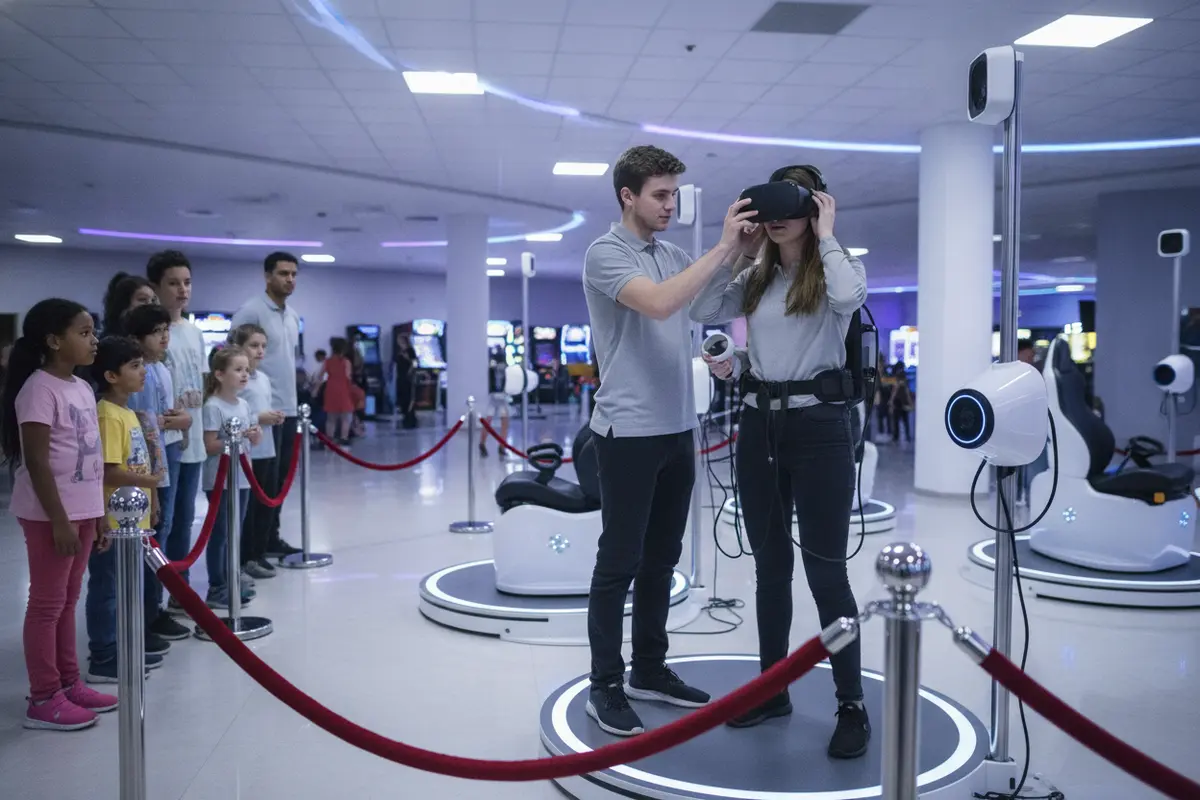
Test the plan against a busy arrival, not just a quiet period. Imagine a party checking in while another group finishes. Where does the next group wait? How does staff signal readiness? Can departing guests leave without crossing the active area? If the attraction has particular space, supervision, or environmental requirements, incorporate the provider’s current guidance into the plan.
A practical walkthrough can expose overlooked conflicts. Trace one guest who arrives early, one who is ready to play, and one companion who is waiting. Then trace the staff member who must check in a group, give instructions, and respond to a request for help. If these paths compete for the same narrow spot, revise the layout or process before opening.
Which operating choices should you compare?
Compare operating models by the work they create for your team, not only by how exciting they sound. Scheduled sessions can make arrivals and staffing easier to organize. Walk-in access may fit a venue built around spontaneous play. A hybrid approach is possible, but needs clear rules for reserved guests and walk-ins.
| Operating choice | What it can support | Questions to resolve |
|---|---|---|
| Scheduled sessions | Planned arrival times and group organization | How will late arrivals, cancellations, and transitions be handled? |
| Walk-in queue | Spontaneous participation during a venue visit | How will guests see wait expectations and join the correct line? |
| Party or group blocks | A coordinated activity for a defined group | Who briefs the group, manages turns, and coordinates the next activity? |
| Hybrid access | A mix of advance planning and walk-in demand | What availability is reserved, and who can adjust it? |
This is a planning comparison, not a universal recommendation. For example, a venue with frequent private parties may value defined blocks, while a venue centered on walk-in visits may prioritize a visible queue process. Compare the guest experience, staffing duties, and effect on surrounding attractions before choosing. Write down the selected rules so every shift can explain them consistently.
What should the staffing plan cover?
Staffing depends on the attraction’s operating requirements, the level of guest support, and traffic patterns. Do not assume equipment can run unattended. Confirm supervision and procedures with the provider, then include each task in shift planning. Map responsibilities through a typical session: greeting and check-in, briefing, monitoring, assistance, turnover, and equipment care.
- Prepare a short, repeatable briefing and a method for checking that guests understand the instructions.
- Train team members on documented operation, emergency response, and escalation procedures for the selected system.
- Make clear who can pause a session or request support when something is not working as expected.
- Plan coverage for breaks, shift changes, group arrivals, and overlapping duties elsewhere in the venue.
- Keep current operating instructions accessible to the staff who need them.
Be specific about handoffs. If one employee welcomes a group and another supervises participation, agree on how the second person knows the briefing is complete and what information needs to be passed along. If a single employee has several responsibilities, identify what takes priority when a guest needs help during check-in or turnover.
Amusement Products offers maintenance training as a resource for operators. Ask what training applies to the equipment and operating responsibilities being considered; do not assume one general course replaces system-specific instructions.
How do you approach safety, access, and guest support?
Base operating procedures on the manufacturer’s current documentation and applicable requirements. Before opening, define how guests receive instructions, how staff supervise participation, and how the team responds to discomfort, equipment issues, or a request to stop. Keep procedures easy to find and practice them with the people who will work the attraction.
For a US operation, review the applicable requirements with qualified advisers and consult the U.S. Department of Justice ADA information when assessing access obligations. The ADA site provides government guidance on the Americans with Disabilities Act. Do not treat a general article as a substitute for checking which requirements apply to your facility and attraction.
Consider access early rather than treating it as a final detail. Ask the supplier about physical interaction, guest instructions, and available adaptations for the specific attraction. Review the approach with your facility team and communicate honestly about what participation involves. Avoid promising that an experience suits every visitor without verifying relevant requirements.
Build a clear escalation path. Staff should know what to do if equipment behaves unexpectedly, a guest needs assistance, or a session must stop. Record incidents and operational issues under your venue’s procedures, then use the information to improve training and the guest process.
What maintenance process keeps the operation ready?
Plan equipment care before launch. Obtain the provider’s documented inspection, cleaning, storage, and service recommendations for the chosen system. Assign responsibility for routine checks, clarify how issues are reported, and decide who can take an attraction out of service. Follow the manufacturer’s instructions rather than adapting care practices from unrelated devices.
A basic operating log can record the date, staff member, checks completed, reported issue, action taken, and whether the attraction returned to use. The log is useful when it reflects actual manufacturer guidance and venue procedures. Keep a contact route for technical questions and decide how staff should handle downtime while an issue is evaluated.
Also plan software and content administration if applicable. Confirm who handles updates, access permissions, and troubleshooting, and whether those tasks affect scheduled sessions. Resolve these questions during equipment selection rather than after the attraction is part of the daily operation.
Walk through the opening and closing routines with the team before launch. Have a staff member explain each check in their own words, locate the relevant instructions, and show how to report a problem. This small rehearsal can reveal gaps in documentation or ownership while there is still time to resolve them.
How can you assess whether the concept is working?
Choose operational measures that help you make decisions. Depending on your model and records, review session utilization, queue behavior, guest questions, group participation, downtime, and staff feedback. Define each measure before collecting it; otherwise, results may not be comparable from one week to another.
Review the full guest journey, not only activity volume. If guests hesitate to join, investigate whether the description is clear and the check-in point is visible. If transitions are slow, observe where the delay occurs before changing the schedule. If staff repeatedly hear the same question, improve the briefing or signs. Change one thing at a time when possible, then check whether it helped without creating another problem.
For example, if several groups arrive together and the queue spills into a circulation route, record when it happens and where guests wait. Test a clearer arrival instruction or a designated waiting point, then observe the next comparable busy period. This is more useful than changing session length without knowing where the bottleneck occurs.
Do not assume a single utilization figure tells you whether the business is healthy. Interpret operating information alongside your own attendance, staffing, and business records. A useful review connects observations to an action: adjust guest communication, revise the queue, refresh training, or discuss a technical question with the provider.
What should you bring to a design consultation?
A consultation is more productive when you arrive with constraints and questions rather than only a product preference. Bring a sketch or plan if available, your intended audience, existing attractions, expected group types, known circulation or access considerations, and the likely entrance and guest routes.
- What role should VR play in the venue and guest visit?
- What layout and operating requirements apply to the specific attraction?
- How should the queue, briefing area, play area, and exit fit together?
- What staffing, supervision, and training duties belong in the operating plan?
- Which service, maintenance, and technical-support questions need direct confirmation?
- How will the concept fit existing attractions and future facility plans?
Amusement Products provides design and consultation for FEC projects. You can also explore the product gallery to review attraction examples before discussing your facility needs.
Frequently asked questions
Can VR be one attraction within a larger family entertainment center?
Yes. An operator can plan VR as part of a wider attraction mix. Consider placement, guest flow, staffing, and scheduling alongside the other activities in the venue.
Should guests book VR sessions or join a walk-in queue?
That depends on the attraction, audience, and venue process. Scheduled sessions support planned arrivals; walk-in queues can suit spontaneous participation. Compare the guest experience and staff workload, then set clear rules for the chosen approach.
How many team members do I need?
There is no single staffing number for every VR attraction. Confirm supervision and operating duties for the specific equipment, then consider traffic, group size, session transitions, and other venue responsibilities.
What should I verify before selecting a VR attraction?
Ask for current documentation on space, operation, supervision, guest instructions, maintenance, training, and technical support. Review how each requirement fits your facility and intended operating model before making a decision.
Talk through your VR attraction and facility plan
Plan the operation before opening
Running a VR arcade business means aligning the guest experience with the space, staffing, equipment care, and daily process. Work through those decisions early, verify attraction-specific requirements with the provider, and use a design discussion to connect the concept to your facility. A clear plan gives your team a stronger starting point and helps guests understand what to expect.