
FEC attraction gamification can add goals, feedback, and friendly competition to an activity, but it should support the attraction rather than distract from it. For owners and developers, the central buying question is whether a game mechanic fits the venue, its guests, and the way staff need to operate. A deliberate evaluation starts with the intended experience, then checks the concept at each point in the guest journey.
Schedule a design consultation
What does gamification mean in an FEC?
Gamification adds game elements to an activity that is not simply a traditional game. A guest may receive a clear goal, feedback during an activity, a result at the end, or a reason to try again. The mechanic can be digital, physical, or a combination. It might be as simple as a timed challenge explained by an attendant or as integrated as a scoring system within an attraction.
For example, a karting activity might use a game layer through Power Up! Karting. Another attraction might use targets, milestones, team objectives, or a staff-led challenge. The choice depends on what the activity is meant to accomplish. A display or app alone does not make an experience meaningful; guests need to understand what to do and why its feedback matters.
Keep the core attraction in view. A guest who ignores the game layer should still be able to understand and enjoy the main activity. Treat the added mechanic as a way to shape participation, not as a substitute for a coherent attraction.
What should the game layer accomplish?
Begin with one primary guest or operating goal. A concept intended to make a first visit easy may be different from one intended to give returning guests a new challenge. Trying to solve every objective at once makes proposals harder to compare.
- Clarify participation: Give first-time visitors an obvious starting point and a simple objective.
- Encourage social play: Give a group a shared task or a friendly contest to discuss.
- Offer a reason to repeat: Provide a personal milestone or new challenge without making participation compulsory.
- Support staff: Make rules and feedback easy to explain during a busy operating period.
- Connect experiences: Use consistent themes or progress cues across attractions only when they make the visit easier to follow.
Write the goal as a sentence that can guide a design decision. For instance: “We want first-time groups to understand how to begin and have a shared objective during the activity.” That statement is more useful than a general request for something interactive. It tells the project team what to test: clarity at the start and a meaningful group objective during play.
Which mechanics should buyers compare?
Compare each mechanic by the behavior it invites and the work it creates. There is no universally best option. A high-energy contest may suit one attraction, while a personal challenge or cooperative objective may be easier for a mixed group to enjoy.
| Mechanic | Possible guest experience | Questions to evaluate |
|---|---|---|
| Timed challenge | A defined beginning and end, with a sense of urgency. | Can a guest understand the time limit? Does it fit the normal session? |
| Score or personal best | Feedback and an individual goal for another attempt. | Is the score easy to explain and meaningful across skill levels? |
| Team objective | Cooperation and conversation among participants. | Can everyone contribute? Are roles clear? |
| Head-to-head contest | A social comparison between participants. | Does visible competition fit the audience and venue tone? |
| Progress milestones | Recognizable steps within a larger activity. | Are milestones visible and attainable during the visit? |
Walk through what guests see and do before, during, and after play. If the mechanic requires a long explanation or staff to remember many exceptions, simplify it or investigate the operational burden. Ask whether a participant can understand the result and what happens next.
How do you match a mechanic to the audience?
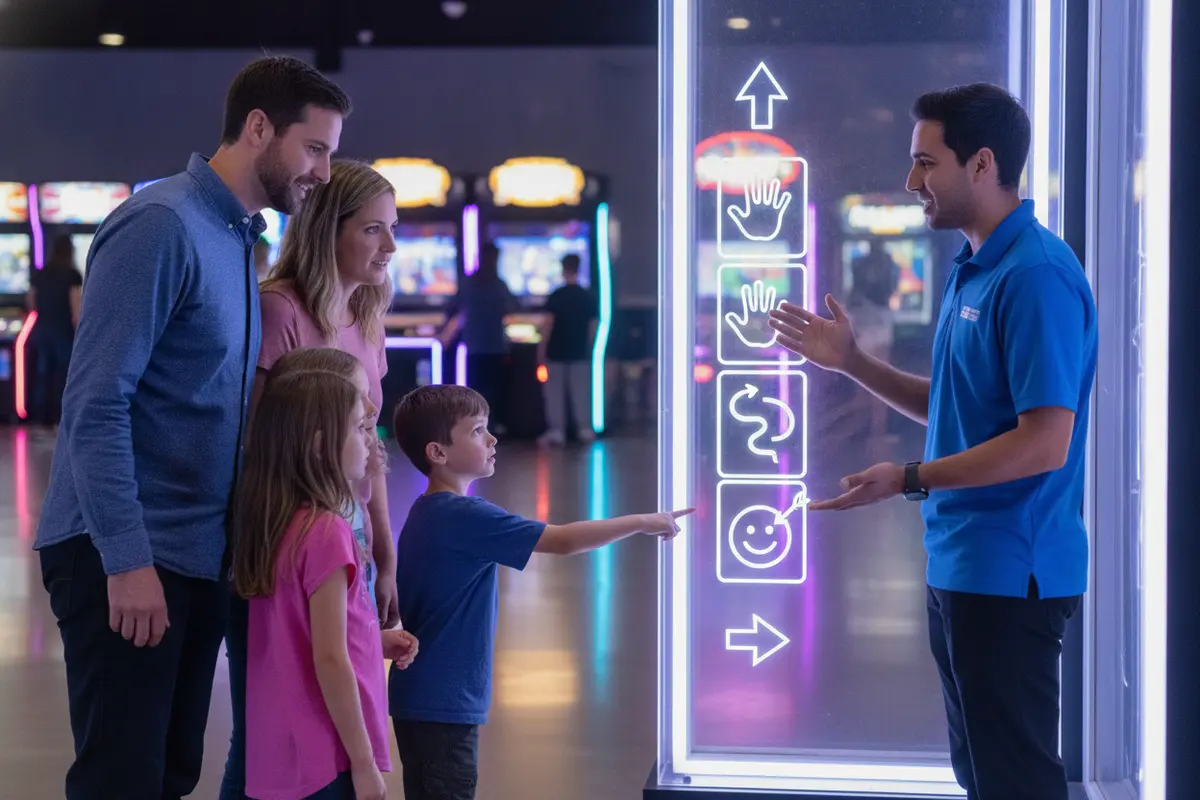
Describe how people will use the attraction, rather than relying only on a broad demographic label. Consider whether visitors arrive as families, friends, school groups, or mixed parties; whether they are new or returning guests; and whether they participate together or take turns. These patterns influence how much instruction is practical and whether cooperative or competitive play is appropriate.
Before reviewing proposals, ask:
- What must a guest know before starting?
- Can someone join without learning a complicated backstory?
- Can people with different experience levels participate meaningfully?
- Will the format work for individuals as well as groups?
- Could public scoring embarrass a guest who wants a lower-pressure experience?
- Is the activity still satisfying when a participant does not earn the top score?
A leaderboard is not automatically the right answer just because it is easy to describe. Some guests enjoy visible standings; others may prefer private progress or a team outcome. If the intended audience is broad, consider whether the experience can offer more than one way to participate without making it difficult for staff to run.
How should the mechanic fit the guest journey?
Map the attraction across four moments: discovery, preparation, participation, and finish. At discovery, guests should recognize the activity and decide whether to join. During preparation, they need a place to receive instructions, form groups, and wait. During play, feedback should not pull attention away from the attraction. At the finish, the activity needs a clear conclusion and a simple transition for the next group.
- Discover: What signals the activity and tells guests who it is for?
- Prepare: Where do guests queue, receive instructions, and organize their group?
- Participate: What feedback is useful, and where does it appear?
- Finish: How is the result communicated, and how does the area clear for the next group?
Pay special attention to transitions. A challenge can be entertaining once underway and still cause confusion at check-in, delay the next group, or require several resets. For a venue with multiple attractions, consider circulation and whether a new display or activity competes with other experiences for attention.
Compare the proposed idea with the rest of the attraction mix. A venue with several competitive activities may benefit from adding a cooperative or exploratory format. A new center may need variety rather than several attractions that all ask guests to compete in the same way. A broader design and consultation discussion can address how attractions and guest flow fit together.
What technology and operating questions matter?
Technology choices affect installation, daily use, support, and the way staff help guests. Ask what equipment or software is essential to the promised experience and what the venue must supply or prepare.
- What components are included, and what needs to be provided by the venue?
- What does staff do to start, monitor, pause, and reset a session?
- What happens if a display, sensor, controller, or network connection is unavailable?
- Can the attraction still operate in a basic mode while a problem is addressed?
- What training is recommended for attendants and managers?
- How are updates and technical support handled?
- What information, if any, is collected from guests, and how is it used?
- Which components need routine inspection or maintenance?
Request a demonstration of both an ordinary session and a problem scenario. Ask the supplier to show what happens when a group is ready but a system component is not, or when a participant does not understand the rules. The goal is to assess the real operating sequence, not only the polished demonstration.
Check whether the physical layout supports the mechanic. Feedback displays should be visible where guests need them without blocking sightlines or movement. Instructions should be placed where people can pause without obstructing others. Confirm power, connectivity, mounting, and service access with the project team rather than assuming technology can be placed anywhere.
How can you compare proposals consistently?
Use the same criteria for each option. Separate non-negotiable requirements from preferences, and ask decision makers to review concepts independently before discussing scores. This makes it less likely that an impressive demonstration will outweigh everyday usability.
| Evaluation area | Evidence to request | Buyer’s check |
|---|---|---|
| Guest clarity | Instructions and a sample-session walkthrough | Can a first-time guest tell how to begin? |
| Audience fit | Examples for individuals, groups, and varied skill levels | Does the design fit the intended visitor mix? |
| Operating fit | Staff workflow, reset steps, and support plan | Can the team run it during a busy day? |
| Facility fit | Layout, utilities, sightlines, and flow assumptions | Does it fit the actual site and nearby attractions? |
| Resilience | Response plan for interruptions | Is there a clear next step if a component is unavailable? |
| Measurement | Defined indicators and a review schedule | Can the venue assess progress toward its stated goal? |
Record what is included, what remains undecided, and who will verify each assumption. Do not compare unlike proposals as if they were equivalent. If a concept assumes a particular layout or staffing pattern, document it so the team can test that assumption.
A useful exercise is to score each category from one to five and write one sentence explaining each score. A low score should trigger a question, not an automatic rejection: perhaps the supplier has not yet shown how the feature works, or perhaps the venue has not defined its needs. This keeps the comparison grounded in evidence rather than impression.
How should you evaluate the experience after launch?
Decide before launch what evidence would indicate that the game layer is helping. Choose measures tied to the original goal and realistic for the venue to collect. No single measure proves that the whole experience is successful.
Depending on the concept, operators can observe whether guests understand instructions without repeated explanations, how often staff intervene, whether groups complete the intended activity, and what guests say in direct feedback. Practical notes about reset problems or recurring confusion can also be useful. Compare observations across a defined review period rather than treating them as universal benchmarks.
Set a review routine: gather staff observations during the first operating period, list repeated guest questions, review available system reports, and agree on one or two changes to test. If a feature causes confusion, try clearer instructions or a simpler rule before adding more technology. Document the change and its result so the team can learn from the test.
How do you prepare for a design discussion?
Involve a design partner when gamification affects more than one attraction detail—for example, when it changes circulation, queueing, staffing, technology infrastructure, or how activities work together. Early discussion can reveal dependencies while the plan still has room to change.
Prepare a short brief with the audience, primary objective, attraction types under consideration, site constraints, operating assumptions, and open questions. Add a rough guest journey and separate must-haves from preferences. The FEC equipment catalog can help frame the range of attractions to discuss. A product gallery can also help you identify examples for a conversation, while remembering that a reference image does not settle layout or operating questions.
Review Amusement Products’ background for company context, and bring concrete site and guest-flow questions to a consultation. Amusement Products is a manufacturer and provider of FEC solutions; match any proposed equipment and game layer to the requirements of your own venue.
What should a buyer validate before selecting a concept?
Before a decision, make sure the concept has been considered in the actual environment rather than only as a presentation. A practical validation can use a simple scenario with a small group, one attendant, a normal session, and a likely interruption. Ask someone who has not seen the proposal to follow the instructions. Observe where they hesitate, what they ask, and whether they understand the conclusion.
Then check the operating handoff. Identify who owns the setup, what staff need to learn, how a session is reset, and who should be contacted when equipment needs attention. Confirm which site details remain open, such as display locations, queue boundaries, or connectivity. This exercise often exposes issues that are easy to overlook when comparing feature lists alone.
For additional context, the U.S. Access Board explains accessibility guidelines and standards for built environments at its ADA resources page. Use the applicable requirements and qualified project guidance when planning circulation, access, and participation; do not assume a game mechanic by itself establishes accessibility.
Discuss your attraction plan with a design team
Frequently asked questions
Does gamification always require screens or an app?
No. A clear goal, physical challenge, staff-led prompt, or progress cue can add game elements. Technology is useful only when it serves the experience and fits the venue’s support plan.
Should every attraction have a leaderboard?
No. A leaderboard may suit a competitive activity, but personal goals, cooperative objectives, or private feedback may better fit the desired guest experience.
How can I tell if the concept is too complicated?
Walk a first-time guest through the activity without coaching. If the rules take too long to explain, staff must remember many exceptions, or guests cannot tell what happens next, simplify and test again.
What should I bring to a consultation?
Bring the primary goal, audience description, site or layout information, operating assumptions, and a list of must-have and open questions. A sample guest journey helps make the conversation concrete.
Plan for the whole experience
FEC attraction gamification starts with a clear guest and operating goal, then tests each mechanic against the attraction, audience, facility, and staff workflow. Compare proposals consistently, verify the details that affect daily operations, and decide how to evaluate the outcome before launch. A concept that guests can understand and staff can run is a stronger foundation for a memorable visit.