FEC attraction energy efficiency is not a single equipment feature. It is the result of how an attraction is selected, laid out, controlled, maintained, and operated alongside the rest of the venue. A useful review starts with actual operating information, then compares practical changes against guest experience, staffing, safety, and facility needs.
What does energy efficiency mean for an FEC attraction?
For an operator, efficiency means understanding the energy an attraction uses in relation to the service it provides. A ride or game that runs for a short, concentrated period has a different operating pattern from equipment that stays powered throughout opening hours. Two attractions with similar guest appeal can also have different electrical requirements, control methods, service needs, and effects on adjacent spaces.
That is why it helps to look beyond a single specification. Consider the whole operating system: attraction equipment, control and charging systems where applicable, lighting, ventilation, climate control, guest flow, and the hours each area is active. An efficient choice should fit the way the venue runs. It should not compromise safe operation, accessibility, reliability, or the quality of the guest experience.
Energy efficiency is also a planning question. A layout that concentrates activity in manageable zones may make it easier to control lighting and climate settings when parts of the venue are not in use. Equipment that can be operated according to a clear schedule may help staff avoid leaving unnecessary systems active. These are planning opportunities, not guaranteed savings; actual results depend on the venue, its equipment, utility arrangements, and operating practices.
How should you establish a baseline?
Before choosing an upgrade, find out what is already happening. A baseline gives the team a way to compare changes with ordinary operations instead of relying on assumptions or a single utility bill.
- Set a review period. Choose a representative period and note unusual conditions, such as seasonal hours, special events, closures, or major changes in attendance. Comparing similar operating periods is more useful than comparing unrelated weeks.
- Collect utility and equipment records. Gather available electric bills, meter information, equipment manuals, nameplate details, maintenance records, and operating schedules. A bill describes the site as a whole; it may not identify which attractions or building systems account for a change.
- Map the loads. List the attraction and facility systems that use electricity. Include support equipment, charging arrangements, lighting, ventilation, and other systems relevant to the planned area. Record what is known and mark missing details for confirmation.
- Record activity and operating hours. Note when each attraction is on, when it is available to guests, and when it is idle. Include opening and closing routines. Staff observations can reveal equipment that remains active outside intended hours.
- Track context. Keep notes on operating days, guest activity, weather or seasonal conditions, maintenance work, and any changes in operating schedules. These details help explain why energy use may differ between periods.
- Agree on a measure of success. Decide whether the project is intended to reduce avoidable runtime, improve control, simplify maintenance, support an expansion, or meet another defined operational goal. Use measures the team can actually collect.
Do not treat a quick observation as an engineering audit. If the available records do not isolate attraction use or the project involves electrical capacity, building systems, or code requirements, involve qualified facility and technical professionals. Their review can confirm what the equipment needs and what the site can support.
Which efficiency opportunities should you compare?
Different measures solve different problems. Use the comparison below as a discussion aid, not as a claim that one option fits every venue. Confirm product specifications and site conditions before making a selection.
| Opportunity | What to examine | Questions to ask |
|---|---|---|
| Operating schedules | Start-up, idle, guest-session, and shutdown routines | Can staff follow a consistent schedule without delaying opening or interrupting service? |
| Lighting controls | Lighting by area, task, and hours of use | Can lighting be managed by zone while maintaining visibility, guest comfort, and safe work conditions? |
| Attraction and control equipment | Electrical requirements, controls, duty cycle, and service instructions | What is the documented requirement, and how does the system behave when idle or not in guest use? |
| Charging arrangements | Charging schedule, compatible equipment, and manufacturer instructions | What charging system is required, and how should charging be coordinated with operating hours? |
| Facility systems | Ventilation, heating, cooling, and the spaces served | Can zones or schedules be adjusted without affecting indoor conditions or equipment needs? |
| Maintenance and monitoring | Inspection routines, fault reporting, and available energy data | Can staff spot an unexpected change and route the issue to the right service professional? |
The table helps separate the potential action from the information needed to evaluate it. For example, a schedule change may be straightforward to test, while changes to a charging setup or facility electrical system need manufacturer guidance and qualified technical review. Avoid choosing an intervention based only on a product label or a general claim. Check the specific configuration and how it will be used in your venue.
How do attraction choices affect energy planning?
Start with the guest experience and operating model, then verify energy and facility requirements. An attraction is a long-term part of the venue’s layout. The questions below help buyers compare categories without assuming that one type is automatically more efficient.
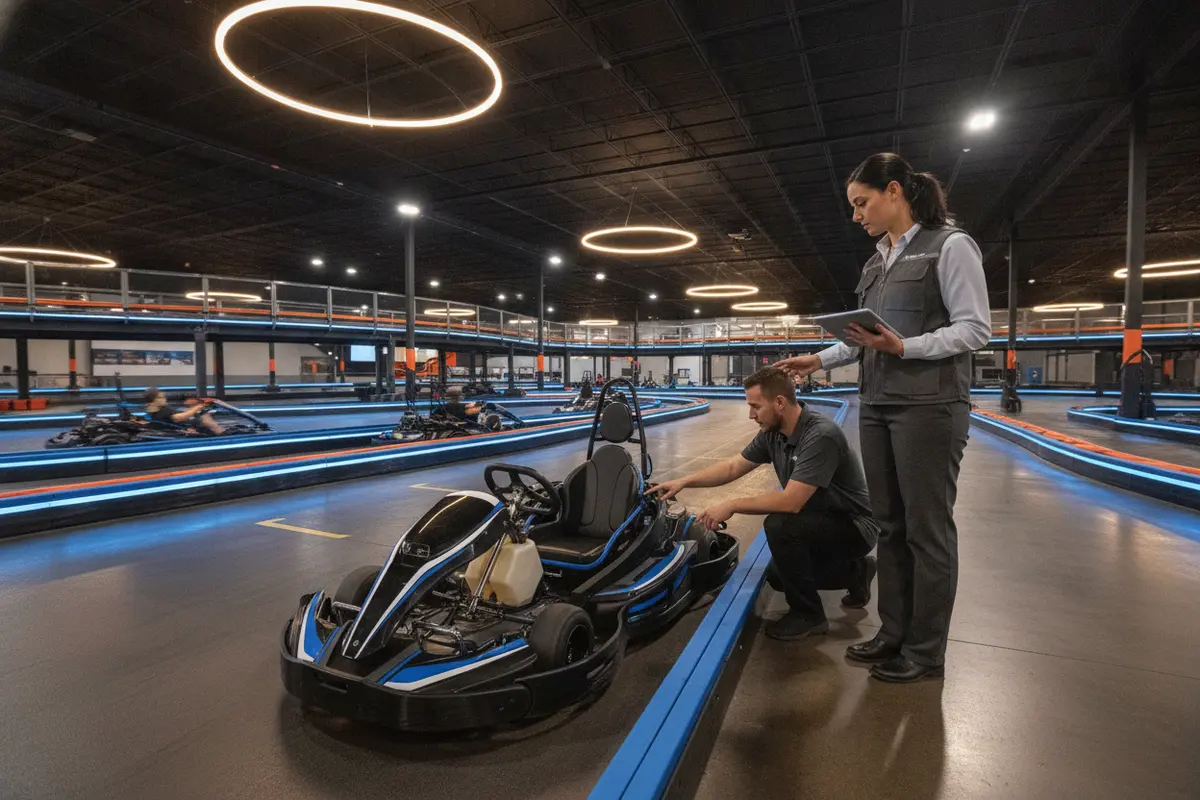
- Electric go-karts: Ask about the electrical and charging requirements for the proposed configuration, charging locations, operating schedule, and service access. Review how the commercial electric go-kart options fit the track plan and intended operating pattern.
- Bumper cars: Confirm the attraction’s site and power requirements, control arrangements, operating hours, and maintenance access. Compare the planned guest experience with the space and systems required for commercial bumper cars.
- Pitching machines and batting areas: Review the equipment requirements, lighting needs, ventilation, and the hours the area will operate. The pitching machine and batting attraction options should be assessed as part of the complete space rather than as an isolated machine.
- Miniature golf: Consider the lighting and site conditions for the course, including how its hours align with other activities. The miniature golf course format may have a different operating profile from powered attractions, but lighting and surrounding facility systems still matter.
For each candidate, request documentation that applies to the exact model and configuration under consideration. Compare the electrical requirements, required supporting systems, maintenance practices, expected operating schedule, and any site work with the venue’s current conditions. If the project includes control equipment, review the role of attraction control systems and ask how staff will use them in day-to-day operations.
Can layout and operating routines reduce avoidable use?
Layout can make efficient routines easier—or harder—to follow. During early planning, identify which attractions are likely to run together, where staff need access, and which areas can operate independently. Consider how guests move between activities and whether the layout encourages staff to open, close, or monitor zones in a clear sequence.
Then walk through an ordinary operating day with the people who will run the venue. Document when equipment is inspected, powered up, made available, paused, and shut down. Check that each step follows the manufacturer’s instructions and the venue’s safety procedures. A process that saves time on paper is not an improvement if it creates inconsistent checks or interferes with guest service.
Where a control system or schedule is available, define who can adjust it and what the normal settings should be. Keep a simple log for changes, faults, and recurring issues. If staff regularly override a setting, investigate why rather than treating the override as a training problem by default. The setting may not fit the real operating pattern or may need review by a technician.
How can you evaluate a proposed improvement?
Evaluate each idea against a consistent set of criteria. This makes it easier to compare an operational change with an equipment upgrade and to explain the recommendation to owners, facility staff, and operators.
- Define the issue. Describe what the baseline revealed, such as avoidable runtime, an unclear schedule, missing equipment data, or a planned capacity change.
- Identify the proposed change. State whether it involves operating procedures, controls, equipment, lighting, layout, or facility systems. Avoid combining several changes in one test if you need to understand which one affected the result.
- Confirm compatibility and constraints. Check manufacturer instructions, technical requirements, site conditions, staff workflow, accessibility, and safety procedures. Bring in qualified professionals where needed.
- Choose an observable measure. Depending on the project, this might be scheduled operating time, meter readings for a defined area, documented maintenance events, or whether a routine is followed. Make clear what the measure can and cannot prove.
- Plan a controlled review. Record the change date, operating conditions, and any other changes that could affect the result. Compare similar periods, and revise the plan if guest service or safe operation is affected.
- Decide what happens next. Keep the measure, adjust it, gather more information, or stop the test. Assign an owner and set a review date so the decision does not disappear into a handoff.
Financial incentives can sometimes be part of an efficiency project’s evaluation, but availability and requirements vary. The U.S. Environmental Protection Agency’s overview describes several energy-efficiency finance mechanisms, including incentives and grants; use it as background, then confirm current eligibility, terms, and rules with the relevant program administrator. Review the EPA overview of energy-efficiency incentives and finance mechanisms. Do not assume that a program applies to a particular attraction or that an incentive will be awarded.
What should you bring to a design consultation?
A focused consultation begins with information about the venue and the decision at hand. Gather what you have; unknowns can be listed as questions rather than filled with guesses.
- A simple floor plan or marked-up sketch with attraction areas, service spaces, guest routes, and known electrical locations.
- Utility bills or meter data for a representative period, plus notes about operating hours and unusual events.
- Equipment lists, manuals, nameplate information, current control or charging details, and known maintenance concerns.
- The proposed attraction mix, expected operating schedule, intended guest experience, and any planned expansion or renovation.
- A list of constraints, such as limited space, service access, staff workflow, facility-system capacity, or work that must happen in phases.
- The outcomes that matter most, such as clearer operating routines, a better understanding of site requirements, or a prioritized set of options to investigate.
Amusement Products offers design and consultation support for individual attractions and complete family entertainment centers. A conversation can help frame layout and equipment questions around the venue’s actual needs. For a broader view of available attraction categories, review the FEC equipment catalog and prepare specific questions about each option.
Discuss your attraction and layout plans
How can you put the review into practice?
Turn the assessment into a short, owned action plan. A list of possible improvements is useful only when someone can test the next step, document what happens, and decide whether to continue. Keep the plan specific to the venue rather than applying a generic efficiency checklist without checking local conditions.
- Assign a project lead. Name one person to maintain the equipment list, collect operating observations, and coordinate questions for technical staff. Other people can contribute, but a clear owner reduces the chance that records are scattered across departments.
- Separate process questions from capital decisions. A review of schedules or staff handoffs may be possible before any equipment decision. Changes to electrical infrastructure, charging systems, attraction configuration, or building controls require a detailed technical review.
- Document the current routine. Write down how the team opens, runs, pauses, and closes the area. Ask the staff who perform each task whether the written routine matches what happens during busy periods, quieter periods, and special events.
- Choose one test at a time. For an operational adjustment, define the start date, responsible staff member, expected observation, and conditions that would make the team stop or revise the test. Do not alter manufacturer-required procedures to create a test.
- Review the result with context. Compare similar operating periods where possible. Note differences in hours, guest activity, weather, maintenance, and other systems. If the available data cannot isolate the effect, say so; an uncertain result is not evidence of a guaranteed reduction.
- Keep decisions and records together. Store relevant manuals, readings, approvals, maintenance notes, and schedule changes where the operations team can access them. Update the record when equipment or routines change, and brief staff who need to follow the revised process.
Build a repeatable cadence around the plan. Review operating observations during routine team check-ins, then revisit the broader equipment and facility picture when planning a renovation, adding an attraction, or changing venue hours. A recurring review can identify new questions early, but it should not replace maintenance schedules or qualified inspections that equipment and facilities require.
Define what a successful project means before evaluating proposals. One venue may care most about managing when a zone is active; another may be planning for a new attraction and needs to confirm site requirements. State the priority in plain language, then ask suppliers or professionals to address the same points: documented operating needs, supporting infrastructure, control options, maintenance access, and what remains unknown. This creates a fairer comparison and helps prevent a narrow equipment specification from obscuring the full operating picture.
Frequently asked questions
Does an energy-efficient attraction always use less electricity?
Not necessarily. Actual use depends on the selected equipment and configuration, how often it operates, supporting systems, and the way the venue runs it. Compare documented requirements and measured operating information rather than relying on a general label.
Can a utility bill show which attraction uses the most energy?
A whole-site bill usually reflects multiple attractions and building systems together. Metering or other data may help isolate areas, but the available information varies by site. Ask a qualified facility professional what can be measured reliably.
Should we change equipment schedules to reduce use?
Review schedules against manufacturer guidance, operating requirements, staff routines, and safety procedures before changing them. A schedule should match the venue’s actual opening and service needs, and staff should know who can adjust it.
Are energy incentives available for FEC attractions?
Programs, eligible measures, and application rules vary by location and time. Check with the relevant utility or program administrator and confirm the current requirements. Do not include an incentive in a project plan until its eligibility is verified.
Plan the next step
Request a consultation about your FEC attraction plan
A measured review gives your team a clearer basis for comparing attraction choices and operating changes. Start with the information you can verify, document the open questions, and confirm technical requirements before committing to a plan.