For a family entertainment center, an electric kart attraction is more than a fleet of vehicles. The control system influences how operators manage race starts, rider groups, track conditions, pit activity, and the guest experience from one session to the next.
The thundervolt electric operating system is an integrated electric go-kart control and race-management system. It connects kart controls, speed settings, race conditions, operator inputs, and track operations so an FEC team can manage the attraction as one coordinated system.
Request design and consultation for your electric kart project.
That integrated approach matters when you are evaluating an electric attraction for a new venue, a renovation, or a fleet expansion. The right questions extend beyond the kart itself and include how the system fits your layout, rider mix, staffing model, safety process, and long-term maintenance plan.
What Does the ThunderVolt Electric Operating System Do?
ThunderVolt is more than a motor and accelerator. It gives an FEC team a set of operating controls for managing different rider groups, race conditions, communication, and pit movement from one electric go-kart system. That matters when the same fleet must serve first-time drivers, families, and experienced racers throughout a busy operating day.
The system provides four selectable speeds: Rookie, Novice, Family, and Competition. Operators can match the kart setting to the rider group and adjust the experience as conditions change. Remote speed control also allows staff to make incremental changes, including one-mph adjustments, rather than treating every speed decision as an all-or-nothing setting. For teams evaluating vehicle choices alongside control capabilities, the commercial electric go-kart fleet provides the relevant product context.
Audio helps coordinate the attraction
ThunderVolt uses several audio functions to support both riders and the people working around the track. Onboard engine sounds respond to accelerator position, giving drivers feedback as they operate the kart. Computer-controlled instructional messages can communicate race or operating information without requiring an attendant to repeat every instruction manually. A pit sound system extends the experience to spectators and gives the pit area an audible connection to track activity.
These features should be considered as part of the attraction’s operating workflow, not as isolated entertainment effects. Clear instructions can help staff manage transitions between sessions, while race-condition messages can support more consistent communication across a fleet. The exact message set and operating procedure should be established during system setup and staff training.
Controls support race management and recovery
The system also includes controls that help attendants manage common track situations. A rider reverse button allows a driver to recover from a position where forward movement is not practical, reducing the need for immediate attendant assistance. Staff can also use remote forward and reverse control when intervention is required. Automatic speed reduction before the pit helps manage the transition from the track into the loading area, while zone controls can decelerate karts through sharp turns. These functions work alongside other documented controls, including pace-lap speed at race start and headlights that indicate race start and safe exit.
ThunderVolt’s All Stop dynamic braking is documented to stop karts within 20 feet. Regenerative braking sends current generated by the motor back to the batteries during braking. That energy feature belongs in the broader fleet and charging plan, but it should not be treated as a substitute for the manufacturer’s model-specific operating or maintenance guidance. For an FEC, the practical value of the operating system is the way these controls give the team more consistent tools for running starts. Managing speed, communicating with drivers, and handling the pit cycle.
How Does ThunderVolt Manage Speed and Track Control?
ThunderVolt gives attendants several ways to manage kart speed and movement during a session. The controls are designed to support repeatable operating procedures, from setting an appropriate pace for first-time riders to responding when a kart needs to slow or stop. They are operating tools, not a substitute for staff training, posted rules, supervision, or model-specific procedures.
Operators can select among four speed settings: Rookie, Novice, Family, and Competition. Remote controls allow staff to change speeds across the fleet, with incremental reduction available one mile per hour at a time. That lets an attendant make a measured adjustment instead of treating every speed change as an all-or-nothing decision. The right setting depends on the venue’s operating plan, rider group, kart model, and track configuration.
Track-based controls add another layer of consistency. ThunderVolt can automatically reduce speed before a kart enters the pit, helping separate the higher-speed track environment from the loading and unloading area. Zone controls can also decelerate karts through sharp turns. These functions should be configured and tested as part of the track design, rather than assumed to work identically on every layout. Amusement Products discusses control-system integration as part of its electric track planning guidance.
How do attendants respond when a kart needs to stop?
The All Stop function uses dynamic braking and is documented to stop karts within 20 feet. That distance is a published system specification, not a universal stopping guarantee. Actual operation still depends on factors such as speed, surface conditions, track layout, equipment condition, and the response of the people involved. Staff should follow the manufacturer’s operating instructions and venue procedures when setting up and using this control.
ThunderVolt also provides rider reverse, which can let a driver recover from a position where forward travel is not practical without waiting for an attendant. Separately, the attendant remote includes forward and reverse control. Together, these functions give staff more options for clearing routine situations and managing kart movement. They should be included in operator training so every team member understands which control to use. When to use it, and how to communicate with riders during the response.
For FEC operators, the value is less about one feature acting alone and more about creating a consistent control sequence: select the appropriate speed. Apply zone and pit reductions, monitor the track, and use attendant controls when intervention is needed. Review the complete ThunderVolt electric operating system overview alongside the manufacturer’s guidance when evaluating how these controls fit a specific attraction.
How Does Charging Work With the ThunderVolt Electric Operating System?
The ThunderVolt Electric Operating System manages kart behavior, race control, speed settings, audio, and track operations. Charging is a related part of the operating workflow. But it is important to distinguish the control system from the separate equipment that transfers power back into the karts.
One part of that workflow happens while a kart is moving. ThunderVolt uses regenerative braking to send current generated by the motor back to the battery during braking. In practical terms, braking is not only a speed-control action. It also supports energy recovery during normal track operation. The amount of energy recovered will depend on the equipment and operating conditions. So operators should use manufacturer guidance for model-specific expectations rather than treating regenerative braking as a substitute for a charging plan.
What happens when a kart returns to the pit?
The separate Park & Charge system is designed to automate in-pit charging. Each kart uses a puck mounted beneath it, while corresponding plates are installed in the pit floor. When the kart stops in the correct position, the puck and plate make the charging connection without requiring an attendant to plug in a cable by hand.
Charging starts within seconds after the kart stops in the pit. That timing can help make the transition between races more consistent. Because the charging action is built into the return-to-pit process rather than treated as a separate manual task. The system is especially relevant when an FEC is planning how kart flow, pit layout, staffing, and dispatch procedures will work together.
Amusement Products states that Park & Charge can reach more than 95% charge in three to four minutes. This is a company-stated performance claim for the Park & Charge system, not a general charging time for every ThunderVolt fleet or operating setup. Actual results should be evaluated against the specific kart models, installation, and operating plan under consideration.
For that reason, a charging review should happen alongside track planning. Confirm where floor plates will be located, how karts align at the pit. How staff will identify a kart that is not making contact, and how the charging workflow fits the planned race schedule. The ThunderVolt system provides the operating controls, while Park & Charge provides the dedicated in-pit charging method. Treating them as complementary parts of one operating plan helps operators evaluate the complete attraction instead of judging either component in isolation.
What Track and Fleet Factors Should Operators Plan For?
A ThunderVolt electric operating system should be specified around the track, not treated as a standalone control package. Before selecting equipment or expanding a fleet, operators need to understand how the site will shape kart movement, loading, guest flow, staff responsibilities, and control integration. A sound plan accounts for the physical layout and the operating pattern together.
Start with the track geometry. Slope and flatness affect kart performance and should be evaluated alongside turn radii, barrier placement, sightlines, and the location of entry and exit points. Loading areas need enough room for guests to board, receive instructions, and clear the pit without creating a queue that reaches the track. Traffic signals and zone controls should be planned as part of the same operating system, rather than added after the layout is complete.
Fleet planning is equally specific to the venue. The right capacity depends on the track configuration, expected session pattern, rider mix, and how quickly staff can load and release each group. Operators should also decide whether the fleet needs single-rider and two-seat configurations. How many karts must be available during peak periods, and where units will wait for inspection or charging between sessions. Amusement Products’ commercial electric go-kart lineup can be reviewed alongside those operating requirements.
| Planning area | Questions for the project team | Why it matters operationally |
|---|---|---|
| Track geometry | Where are the slopes, flat sections, sharp turns, barriers, and limited-visibility areas? | These conditions guide kart performance, zone control, and safe staff oversight. |
| Loading and exit | Can guests board, receive instructions, exit, and clear the pit without crossing active traffic? | A clear sequence supports consistent dispatch and reduces avoidable congestion. |
| Signals and controls | Where should traffic signals, speed zones, pit reduction, and attendant controls operate? | Control integration lets staff manage changing track conditions from the operating position. |
| Fleet capacity | How many karts are needed for the planned session pattern, rider mix, and expansion path? | The answer affects throughput, spare capacity, staging space, and pit workflow. |
| Pit workflow | Where will karts be inspected, charged, staged, and returned to service? | A defined workflow helps staff maintain a predictable fleet rotation. |
For a new attraction or major expansion, use a documented layout review before final equipment selection. Amusement Products’ electric track planning guidance covers the site and control questions that influence the finished design. The objective is not simply to fit the maximum number of karts. It is to create a track and pit system that staff can operate consistently during ordinary sessions and busy periods.
How Should FEC Teams Support Reliable Daily Operation?
Reliable daily operation depends on more than selecting commercial electric karts. FEC teams need a repeatable operating routine, clear ownership, and a direct path to manufacturer support when equipment behaves differently than expected. The goal is to help staff recognize normal conditions, complete the required checks, and escalate issues before they affect a session.
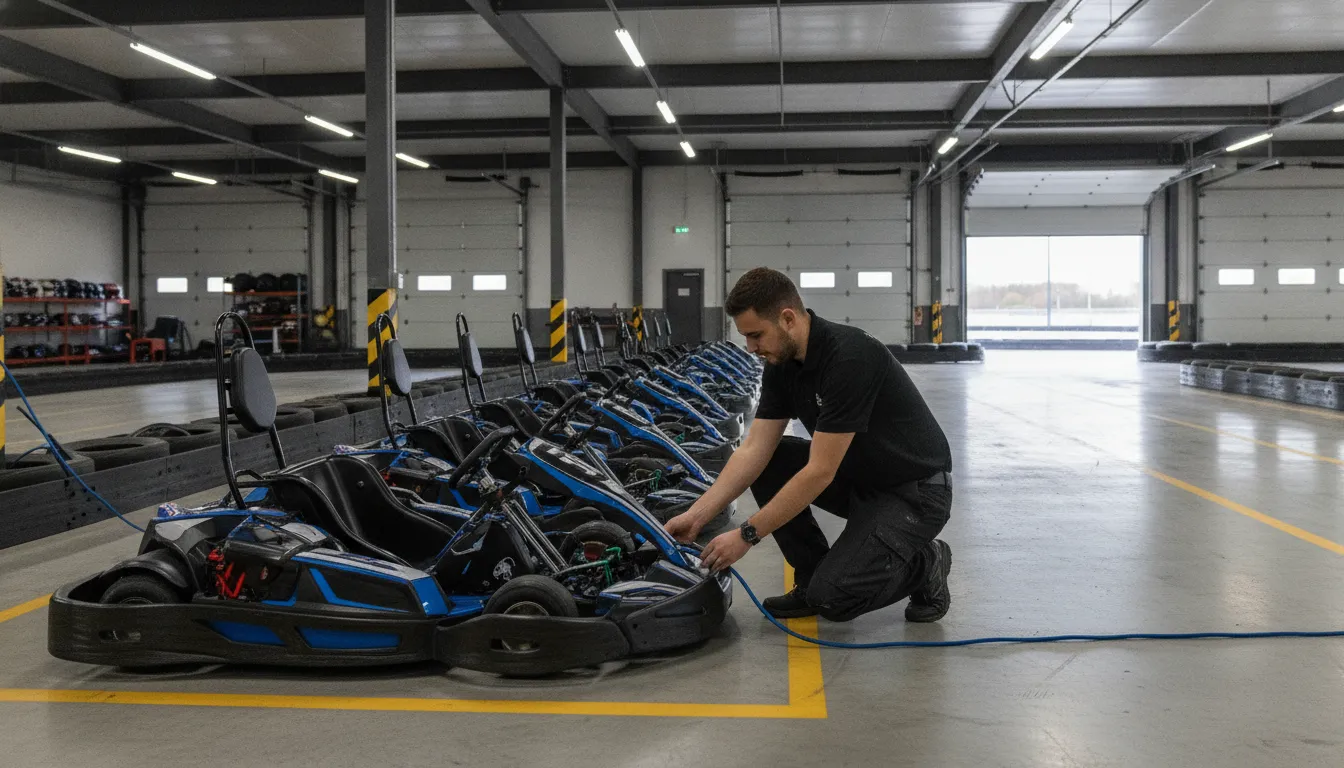
Start with documented startup and shutdown training. New attendants should learn the approved sequence for opening the track, checking the operating area, confirming controls, and preparing karts for guests. Closing procedures should be equally clear. They should explain how to secure equipment, record observed issues, and communicate anything that needs attention on the next shift. Use the manufacturer’s model-specific guidance rather than creating battery or maintenance rules from assumptions. For additional operator education, Amusement Products provides equipment maintenance training.
- Train to the actual system. Review startup, shutdown, attendant controls, emergency procedures, and the manufacturer’s operating documentation with every relevant team member.
- Inspect the contact points. Check charging contacts and connectors for visible damage, contamination, or poor engagement. If a charging connection does not behave as expected, remove the kart from service according to the manufacturer’s instructions and report it.
- Check the rolling and stopping systems. Inspect tires, brakes, and visible wheel or chassis concerns before operation. Staff should know which findings require an immediate stop and which belong in the maintenance log.
- Confirm control response. Verify that the expected controls respond correctly, including attendant or track controls used at the facility. Do not improvise a workaround for an abnormal response.
- Use diagnostics and escalate clearly. VirTech is a documented diagnostic system for electric karts. Record the kart identifier, observed symptom, operating conditions, and any diagnostic information before contacting technical support. That gives the manufacturer a useful starting point instead of a general report that a kart is not working.
Model-specific manufacturer guidance matters because charging hardware, controls, diagnostic procedures, and service requirements can differ across fleets. A support plan should identify the correct service contact, parts process, training resources, and escalation path. It should also define who can return a kart to operation after an issue and what documentation must be completed.
For a closer look at how the ThunderVolt electric operating system connects fleet controls and daily track management, review the ThunderVolt electric go-kart system guide. The right manufacturer relationship gives operators both the equipment and the information needed to run it responsibly.
What Should Buyers Ask Before Specifying a ThunderVolt System?
A useful specification starts with the way your facility will operate, not with a feature list. Ask the manufacturer to map the proposed system to your track, rider mix, staffing model, and session schedule. The goal is to understand what the equipment is expected to do during a normal operating day, and which decisions must be made before installation.
Confirm the operating requirements
- Which ThunderVolt model and configuration fit the project? Request the model-specific operating range, charging requirements, and maintenance guidance in writing. Do not rely on a general range estimate when fleet size, track conditions, rider weight, session length, and operating schedule can change the result.
- What is the usable charge window? Ask how much operating time is available between charging opportunities, what charge level should trigger a pit rotation, and how the system performs during peak demand. Clarify charger duty cycle and whether the planned charging approach supports your daily session pattern.
- What does the pit need? Confirm electrical service, circuits, placement, ventilation or environmental requirements, floor conditions, and the space needed for loading, unloading, and charging. Include these items in the site plan rather than treating them as a late installation detail.
- How should the fleet be sized? Review expected fleet size alongside session length, dispatch frequency, rider mix, and the number of simultaneous races. A manufacturer should explain the assumptions behind its recommendation and identify how the layout affects throughput.
Connect controls to the track and staff workflow
Ask how the speed profile will be selected for different rider groups and operating conditions. The documented electric lineup includes Rookie, Novice, Family, and Competition settings, so the specification should explain who controls those settings. When they can be changed, and how staff confirm the active profile.
Also review track layout, turn radii, slopes, loading and exit flow, traffic signals, zone controls, and control-system integration. Ask what happens at race start, during a pit approach, and when an attendant needs to respond to an incident. These answers should be reflected in operating procedures and staff training, not left as informal knowledge.
Define installation, training, and support
Before signing off on a system, request a clear commissioning scope. It should identify installation responsibilities, testing, operator training, maintenance documentation, parts access, service contacts, and the process for resolving issues after opening. Ask what your team will be expected to inspect and maintain, and where model-specific battery and charging instructions will be documented.
Amusement Products can connect these questions through go-kart track design and consultation. Compare the resulting specification with the commercial electric go-kart fleet and make sure the final scope matches the facility, staff, and operating plan.
Frequently Asked Questions
What should an FEC ask a commercial go kart manufacturer before selecting a fleet?
Ask how the proposed karts fit your track layout, rider mix, operating environment, control system, charging plan, and maintenance workflow. Request clear information about commissioning, staff training, parts access, service contacts, inspection procedures, and future fleet expansion. A manufacturer should be able to connect equipment specifications to the way your facility will operate.
Are electric go-karts suitable for both indoor and outdoor FECs?
Some commercial electric go-kart systems are designed for both indoor and outdoor operation. Confirm the intended use with the manufacturer, then review site conditions such as slope. Concrete flatness, loading areas, turn radius, traffic signals, ventilation, and electrical infrastructure before finalizing the project.
How can operators manage different rider abilities with one electric fleet?
Look for adjustable operating controls that let attendants match the experience to the rider group and track conditions. Amusement Products documents four selectable speeds, Rookie, Novice, Family, and Competition, for its electric go-karts. The right setup still depends on your facility’s operating procedures, track design, and applicable requirements.
What safety and maintenance records should a kart operation keep?
Operators should maintain written inspection, training, emergency, and maintenance procedures, along with records that show when checks were completed and issues were corrected. Requirements vary by jurisdiction. For example, Maryland requires a go-kart operation to be inspected each day before opening and includes speed limiters, brakes, and controls among the inspection points: Maryland COMAR 09.12.64.06.
What support should continue after the installation is complete?
Confirm who handles commissioning, operator training, parts, troubleshooting, maintenance guidance, and future system questions. A lifecycle-focused partner can also help with site evaluation, capacity planning, equipment specifications, and ongoing support instead of treating delivery as the end of the relationship.
Plan Your Commercial Go-Kart Project With the Right Partner
A clear project conversation can help connect your facility needs, fleet goals, track considerations, and operating plans before you make a supplier decision. If you are evaluating a commercial electric go-kart manufacturer for an FEC project, request a design and consultation conversation with Amusement Products to discuss the right next steps for your project.