Choosing a bumper car attraction for a family entertainment center is an operating decision. It is not simply a search for the most exciting vehicle. The system must fit your floor, guest mix, ride experience, charging plan, inspection process, and support model. Our Spin Zone Bumper Cars guide for FEC operators provides product context, while this buyer’s guide focuses on how to compare systems.
Schedule a design and consultation conversation for your FEC attraction.
The best bumper cars for family entertainment centers balance guest appeal with practical requirements such as surface flexibility, manageable charging, controlled operation, and a layout that supports consistent throughput. Battery-powered options can be useful when a venue wants to avoid installing a conductive electric floor, but every attraction still requires site-specific planning and local safety review.
Use the criteria below to compare the attraction, the infrastructure, and the manufacturer. The strongest buying decision is the one your team can explain in terms of guest fit, daily operations, service access, and the venue’s long-term plan.
What Should You Look for When Buying Commercial Bumper Cars?
The best bumper cars for family entertainment centers are not selected by a single headline feature. Start with the venue. Measure the usable ride area, entry and exit paths, queue space, operator sightlines, barriers, storage, charging locations, and access for installation or service. The arena should work with the rest of the FEC instead of creating congestion at nearby attractions.
For a Spin Zone installation, Amusement Products publishes a planning range of approximately 600 to 1,500 square feet, with customization based on available space. Treat that range as a planning reference, not a universal capacity rule. A commercial bumper car arena layout design can help your team connect the arena footprint with queueing, circulation, sightlines, and adjacent attractions.
Surface and power requirements are equally important. Battery-powered bumper cars can avoid the need for a conductive electric floor. Amusement Products states that its bumper cars can operate on wood, concrete, asphalt, or ice, subject to the final design and operating requirements. The published Spin Zone information also states up to 16 hours between charges. Your operating plan should still account for ride schedule, charging access, turnaround time, battery handling, and peak demand.
- Venue fit: footprint, circulation, sightlines, barriers, and accessible paths.
- Throughput: loading, instructions, ride cycles, unloading, reset time, and attendant controls.
- Guest fit: driver age, passenger arrangements, local rules, and the intended experience.
- Operations: charging, cleaning, inspection records, training, parts, and technical support.
Ask each manufacturer to document how riders load, how staff start and stop the attraction, how exceptions are handled, and how the system responds to an emergency stop. Also evaluate the interaction itself. Spin Zone uses target-hit technology, so the attraction is designed around a game-like objective rather than only random contact. That distinction can affect how staff explain the experience and how operators think about repeat play.
Confirm rider eligibility before finalizing the purchase. Published Spin Zone information identifies drivers as age 5 and up and describes a Buddy Seat for passengers as young as 3. Verify the final configuration, supervision procedures, restraints when provided, and local operating requirements with the manufacturer and the appropriate authority.
Which Commercial Bumper Car System Fits Your Facility?
The right commercial bumper car system depends on the building as much as the cars. Before selecting an attraction, evaluate the floor, ceiling height, electrical infrastructure, loading area, charging plan, and future use of the space. Infrastructure decisions made early can affect construction, service access, scheduling, and the ability to change the layout later.
| System type | Infrastructure | Retrofit considerations | Potential venue fit |
|---|---|---|---|
| Conductive floor | Powered floor surface and compatible ride controls. | May require floor preparation, electrical work, and a fixed arena plan. | Purpose-built indoor attractions with a dedicated footprint. |
| Overhead or sky | Overhead power delivery, ceiling support, and an enclosed operating area. | Requires review of structure, clearances, wiring, lighting, and service access. | Permanent indoor arenas designed around overhead infrastructure. |
| Battery-powered floorless | Rechargeable cars, chargers, ride controls, and a suitable riding surface. | Can avoid an electric floor and support more surface options. | Indoor or outdoor FECs, seasonal venues, and adaptable spaces. |
Conductive-floor systems can create a familiar bumper car format, but the floor becomes a central part of the attraction. Review installation, protection, inspection, and service requirements before committing to a fixed arena. This approach may fit a new venue built around the ride, but it can be less straightforward when an existing FEC needs to preserve a multi-use space.
Overhead systems move the power connection above the cars. That shifts the building assessment toward ceiling capacity, rider clearance, lighting, fire protection, and maintenance access. A site survey should establish whether the structure can support the equipment and whether the finished attraction will integrate cleanly with guest circulation.
Battery-powered floorless systems remove the need for an electric floor. The Amusement Products product information identifies wood, concrete, asphalt, and ice as possible operating surfaces and states up to 16 hours between charges. That flexibility can help an operator reuse an existing area, plan a seasonal attraction, or adapt the arena as the venue evolves. It also makes charging capacity, battery handling, daily checks, and ride controls central parts of the operating plan. Review the commercial bumper car systems available for your project, then match the power model to the building.
How Do Quality and Support Affect a Bumper Car Purchase?
A bumper car purchase is also a decision about accountability after installation. Equipment quality matters, but so do the people, documents, parts, and procedures that keep an attraction operating. Evaluate the manufacturer as a long-term partner, not only as the source of vehicles and arena components.
Manufacturer accountability starts before delivery
Ask who is responsible for the complete attraction. Does the manufacturer provide equipment, arena planning, installation coordination, controls, charging equipment, and operator education, or are those responsibilities divided among several vendors? Amusement Products describes its role as a manufacturer and integrated FEC solutions provider with equipment, design, construction, consultation, and education capabilities. A broader service model can simplify communication when the arena, vehicles, controls, and operating plan must work together.
Before signing, ask who will be your primary contact, which installation tasks are included, what site information is required, and how technical questions will be handled after opening. Put the answers in the buyer file so operations and maintenance leaders can use them later.
Documentation and parts protect uptime
Request operating and maintenance documentation for the specific system. It should explain charging, controls, daily checks, cleaning, storage, approved adjustments, and procedures for removing equipment from service. Ask how replacement parts are identified, ordered, and shipped. Confirm whether common wear items are stocked and whether technical support can help staff diagnose a problem before it becomes a prolonged outage.
Amusement Products also describes parts distribution through FECPartsMart.com, along with technical support and maintenance guidance. Verify the current support channels, response expectations, warranty terms, and parts availability for the exact configuration you are considering.
Training and inspection responsibilities need a written plan
Training should cover more than starting and stopping a ride. Operators need guidance on guest eligibility, loading, supervision, emergency controls, shutdowns, and incident reporting. Maintenance staff should understand charging routines, bumper and tire condition, control checks, cleaning, and how to document inspections. Ask whether training is delivered during installation and how refresher materials are provided when staff turnover occurs.
Requirements also vary by jurisdiction. For example, the Washington State Department of Labor and Industries explains that covered amusement rides require annual third-party inspection and an operating permit. Its guidance also addresses operator attention, restraint use, and rider-size restrictions. That is a state example, not a nationwide rule. Confirm the requirements for your location with the local authority, insurer, and qualified inspector.
How Should FECs Compare the Best Bumper Cars for Family Entertainment Centers?
Comparing the best bumper cars for family entertainment centers requires more than placing product specifications side by side. Ask each manufacturer to document the operating assumptions behind its recommendations, then separate those facts from requirements imposed by your state, city, insurer, or authority having jurisdiction.
- Measure usable capacity. Record the arena footprint, clearances, loading area, operator position, barriers, and accessible circulation. Count the cars the proposed layout can use without creating congested entry and exit paths. A manufacturer planning range is not a guarantee for every building.
- Model the complete ride cycle. Compare loading, instructions, ride time, unloading, reset time, and expected rides per hour. Validate the result against peak arrival patterns instead of an idealized empty-floor test.
- Verify speed and control behavior. Request documented operating speed, acceleration, stopping behavior, and control limits. Do not infer a specification from marketing language. The useful question is whether staff can maintain a predictable experience for the intended rider group.
- Confirm rider eligibility. Document minimum ages, size limits, passenger rules, and any Buddy Seat or two-rider configuration. Train operators to enforce the final limits consistently.
- Evaluate impact management. Review bumper material, attachment points, body construction, sensors, and target interaction. Ask which checks confirm that protective components remain secure. A tubeless design may reduce air-check tasks, but it does not eliminate inspection responsibilities.
- Test emergency procedures. Identify emergency-stop and ride-control functions, their location, and the training required to use them. Include restart authorization, incident documentation, and escalation steps in the operating procedure.
- Build the inspection and service routine. Obtain the daily opening checklist, charging procedure, cleaning instructions, periodic maintenance schedule, and records format. Confirm permit and inspection obligations with the appropriate local authority and insurer.
This sequence gives your design and consultation team a clear brief. It also keeps the buying decision grounded in documented specifications and controllable operations instead of unsupported assumptions.
Request a site-specific bumper car planning conversation with Amusement Products.
Why Are Spin Zone Bumper Cars Among the Best for FECs?
For an FEC evaluating the best bumper cars for family entertainment centers, Spin Zone Bumper Cars merit consideration because they combine interactive play with practical installation options. The final choice should still depend on the venue, operating plan, local review, and documented requirements.
Interactive play creates a distinct ride experience
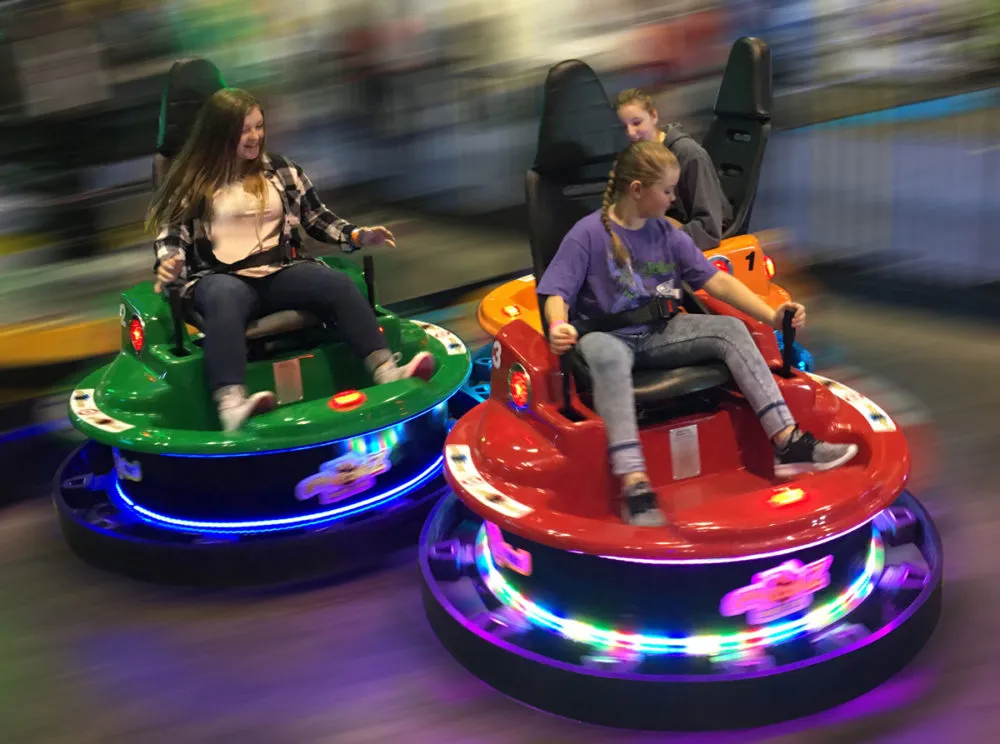
Spin Zone received the 2008 IAAPA Best New FEC Attraction award. Its patented target-hit technology adds an objective to the ride: when a driver hits the target on another car, the impacted car enters a spin. That creates a skill-based interaction instead of relying only on random bumping. Operators can use that distinction when training attendants and explaining the attraction to guests.
Flexible surfaces and a configurable footprint
Spin Zone Bumper Cars use rechargeable battery power and do not require an electric floor. Published product information lists wood, concrete, asphalt, and ice as possible surfaces, subject to the final design and operating requirements. The arena footprint is approximately 600 to 1,500 square feet and can be customized to available floor space. Battery runtime can reach up to 16 hours between charges when the operating schedule and charging plan are designed appropriately.
Family access and an integrated package
Published product information identifies drivers as age 5 and up and describes a Buddy Seat for passengers as young as 3. Spin Zone Z uses a tubeless design with a rubber-cushioned plastic bumper and an electronic sensor for target-hit detection. The tubeless design can reduce air-check tasks, but it does not replace documented checks of bumpers, fasteners, controls, and other safety-related components.
The listed package includes cars with batteries, a ride control transmitter, LED sound-activated lights, an audio system, an automatic music player. Chargers and charger racks, a heavy-duty handrail, a wall banner, car rail, a wireless handheld ride controller, and arena installation. Confirm the final package, installation scope, and support terms in the proposal for your venue.
Amusement Products is a manufacturer and FEC solutions provider with experience spanning equipment, design, construction, consultation, and education. Its customer-approved guidance states that Spin Zone Bumper Cars pay for themselves in 2 years or less. Actual results depend on location, scheduling, ride volume, utilization, staffing, and execution, so operators should model those variables before making a decision.
Frequently Asked Questions
How much space do you need for a bumper car attraction?
The required space depends on the system, car count, clearances, queue, loading area, operator position, barriers, and local requirements. Amusement Products publishes an approximate 600 to 1,500 square foot planning range for Spin Zone, but the final footprint should be customized through a site-specific layout.
How do Spin Zone Bumper Cars differ from classic bumper cars?
Spin Zone uses battery power and does not require an electric floor. It also adds target-hit technology that can make a car spin when another driver hits its target. The attraction is designed as an interactive game experience, rather than only a traditional bumping format.
What return on investment can a commercial bumper car attraction provide?
Amusement Products states that Spin Zone Bumper Cars pay for themselves in 2 years or less. That is a customer-approved payback statement, not a guarantee for every venue. Operators should build a venue-specific model using projected ride volume, schedule, utilization, staffing, maintenance, and local operating assumptions.
What safety requirements should FEC operators confirm?
Confirm local inspection, permit, training, restraint, rider-size, emergency, and incident-reporting requirements before opening. Requirements vary by jurisdiction. Review the final equipment configuration with the manufacturer, local authority, insurer, and qualified inspector rather than treating guidance from another state as a universal rule.
What maintenance do electric bumper cars require?
A tubeless design can reduce routine air-check tasks. Every attraction still needs a written operating and maintenance routine that matches the equipment and local requirements.
Plan Your Commercial Bumper Car Attraction
Choosing the right bumper car attraction is only one part of a successful FEC project. The arena layout, surface, charging approach, guest flow, rider experience, operator controls, and local requirements all deserve attention before installation.
Amusement Products can help operators evaluate the practical details of a bumper car installation and determine which decisions should be addressed for the venue.
Schedule a design and consultation conversation with Amusement Products.