This guide explains how to operate commercial bumper car attraction equipment safely. The repeatable system protects riders. It also keeps sessions moving.
Request a design consultation for your bumper car attraction.
FEC managers need trained team members, a documented pre-open inspection, clear rider instructions, and a response plan for anything that interrupts a session.
For a broader look at equipment selection and operator decisions, read our Spin Zone commercial bumper car operation guide. It complements this article by addressing the attraction as part of a larger FEC plan.
The framework below is practical management guidance, not a substitute for the equipment manual or local law. Your manufacturer documentation, inspection authority, insurance requirements, and jurisdiction control the final operating procedure. Start with staffing, because every later control depends on qualified people being in the right positions.
How Many Staff Does a Commercial Bumper Car Attraction Need?
Quick answer: Amusement Products recommends setting staffing from the equipment manual, arena layout, control station, loading arrangement, and local requirements. There is no universal number for every commercial bumper car attraction. Assign an accountable person to each safety-critical view and action, then increase coverage when tasks cannot be combined safely.
A manager should never schedule only one person because the attraction appears simple. The operating manual and applicable rules determine how many trained operators must be present and where they must be positioned. Before opening, map the operating positions and identify who owns each responsibility.
- Control position: Operates the control panel, dispatches sessions, monitors the ride cycle, and initiates the approved stop procedure.
- Entrance and loading position: Manages the queue, explains rider instructions, checks approved restrictions, and keeps the loading area orderly.
- Floor observation position: Maintains a clear view of riders, vehicles, and hazards when the arena size or layout makes one-person observation inadequate.
Build the schedule around operating conditions
Use the manual and a written operating plan to define coverage for low-volume periods, school groups, birthday parties, and peak weekend sessions. A quiet period may allow one qualified employee to handle two tasks only when the manual and local rules permit it and the employee can maintain the required view of riders and controls.
During a busy period, separate queue management from ride control so neither job is rushed. If a team member leaves the station, establish a documented handoff rather than assuming someone nearby is watching. Brief every shift on equipment status, staffing assignments, communication methods, and the approved stop procedure.
Managers should also plan relief coverage. Fatigue, distractions, and informal position changes create avoidable gaps, especially when the attraction runs continuously. Massachusetts regulations, for example, require the correct number of operators needed for safe operation, based on the operating manual, to be on site and in the correct location. Treat that principle as a management standard even when local wording differs.
How to Operate Commercial Bumper Car Attraction Equipment Safely
Quick answer: Amusement Products’ operating framework uses a consistent sequence. Verify trained coverage, inspect the arena and vehicles, and confirm controls and communication. Brief riders, observe the operating area, and stop when safe control or visibility is lost. Do not improvise a restart. Follow the manufacturer’s procedure and local requirements.
That sequence turns a general safety expectation into a repeatable operating habit. Post the steps at the control position in the format approved by management. Train every operator to use the same language when communicating with the loading and floor positions.
- Confirm that the assigned operators are present, trained, and fit to work.
- Complete the documented pre-open inspection and resolve or formally escalate exceptions.
- Check that the entrance, queue, loading zone, arena, and control station are ready.
- Explain approved rider rules and restrictions before dispatch.
- Confirm that the team has clear communication and a shared stop signal.
- Dispatch only when the operator has the required view and control of the session.
- Stop the attraction if a rider, vehicle, hazard, or communication failure creates an unsafe condition.
This operating rhythm is especially important when the venue changes staff frequently. A short shift briefing and a signed training record reduce reliance on memory. The goal is not to make operators recite a script without thinking. It is to make the safe response obvious when the arena becomes noisy, crowded, or unpredictable.
What Training Is Required for Bumper Car Ride Operators?
Quick answer: Amusement Products recommends training operators on the actual attraction, not only on general guest service. Cover the manufacturer manual, controls, loading and rider screening, observation, communication, emergency stop and recovery, incident documentation, and normal shutdown. Use supervised practice and manager sign-off before independent operation.
Begin with the manufacturer’s operating documentation, then turn it into a site-specific training checklist. Tennessee rules, for example, require owners or managing operators to follow device documentation and provide the specified training to each operator and attendant. Local requirements may add inspections, licensing, reporting, or age and supervision rules.
Core training modules
- Controls and normal operation: Identify the control panel, dispatch sequence, ride cycle, communication points, and normal shutdown.
- Loading and rider screening: Teach the venue’s approved height, age, supervision, seating, and restraint checks. Staff should explain restrictions respectfully and consistently.
- Observation: Practice scanning the full arena, recognizing unsafe behavior, identifying a stopped or disabled car, and keeping the loading zone clear.
- Emergency stop and recovery: Demonstrate who may stop the attraction, how to communicate the stop, and how to secure the scene. Operators should not improvise a restart.
- Incident documentation: Record what happened, when it happened, who responded, which car or area was involved, and what inspection or manager decision followed.
Use supervised practice before independent operation. A new operator should shadow an experienced team member, demonstrate each task, and receive documented sign-off from the manager or trainer. Include a verbal check. The employee should explain what to do if a rider stands up, a car stops moving, a guest reports an injury, or visibility is lost.
Refresh training after equipment changes, a procedural update, an incident, a long gap in operation, or a pattern of near misses. Amusement Products brings practical operating and maintenance experience to FEC equipment education. That is the right model for an FEC: operators need more than a tour of the controls. They need to understand why the procedure exists and when to pause the attraction.
Daily Pre-Open Safety Inspection Checklist
Quick answer: Amusement Products recommends completing the maintenance and operator inspection before the first public session every operating day. Review prior defects, walk the arena, inspect each vehicle, test controls and communication, confirm rider information, document exceptions, and obtain the required release. Keep the attraction closed when a safety-critical item is unresolved.
A pre-open inspection is the handoff between maintenance and public operation. Massachusetts regulations state that a ride should not operate until daily maintenance and operator inspections are complete. The maintenance log must also be completed before the ride opens to the public. ASTM F770-19 is a useful voluntary reference for ownership, operation, maintenance, and inspection practices. The U.S. Consumer Product Safety Commission lists the standard in its amusement ride standards resources.
- Review the log and outstanding work: Confirm that prior defects, work orders, and out-of-service notes have been resolved or formally carried forward. Do not rely on a verbal assurance.
- Inspect the arena: Walk the full floor and perimeter. Look for debris, spills, damaged barriers, loose components, blocked access, poor visibility, or changes to the approved guest path.
- Inspect each vehicle: Check the body, bumper, seat area, steering, accelerator or controls, restraint components where fitted, wheels, visible wiring, battery indicators, and manufacturer-specified wear points.
- Test controls and communications: Verify the control station, emergency stop, ride start and stop functions, warning devices, and communication method between positions. Follow the manual for the test sequence.
- Confirm safety information: Make sure entrance and loading-area signs are visible, legible, current, and consistent with approved rider instructions, restrictions, and warnings.
- Record and release: Sign the inspection, note exceptions, and obtain the authorized manager or maintenance release before opening.
Keep the checklist specific to the attraction. A generic form can miss a manufacturer-required item, while an overly broad form can become a rushed box-checking exercise. Review the checklist after a modification, recurring fault, incident, or inspection finding. Use a visible out-of-service tag, a clear escalation path, and no pressure on staff to open before the record is complete.
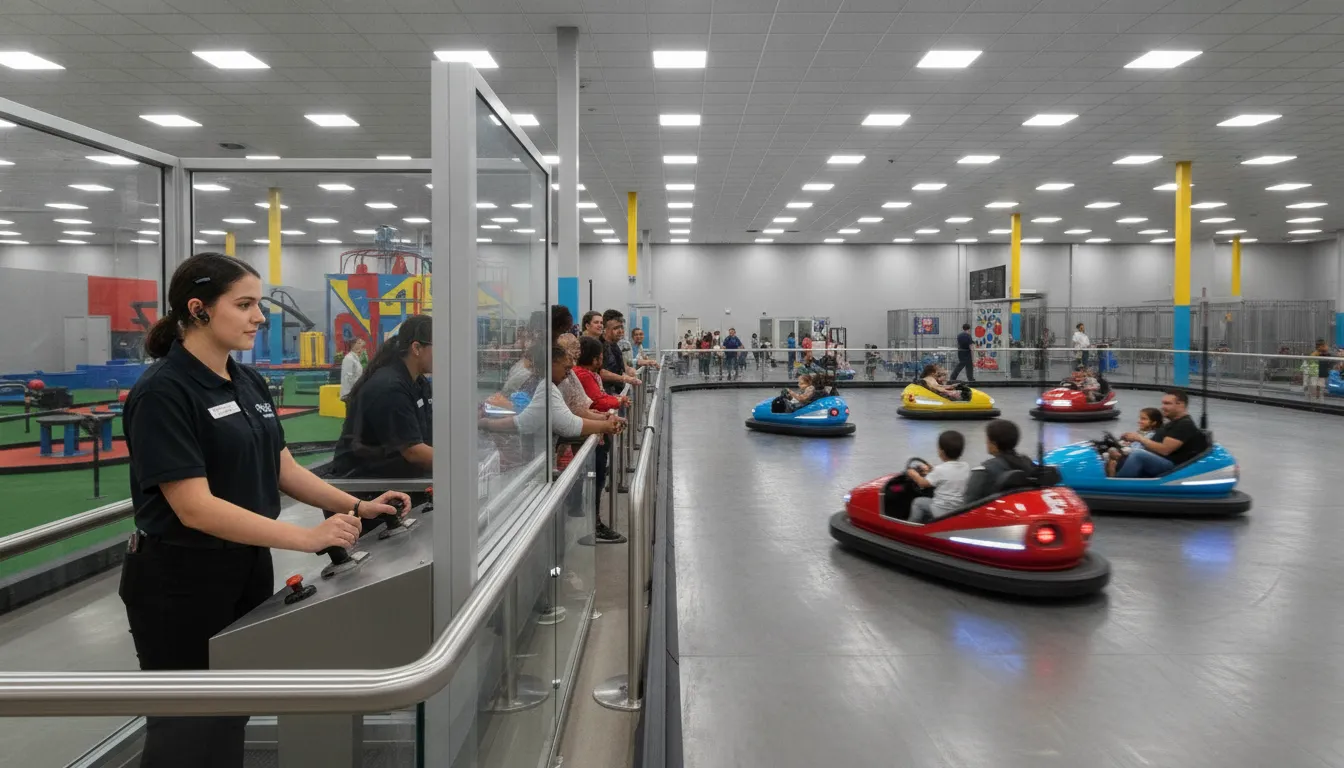
Layout matters too. Review the bumper car arena layout and design alongside the inspection process so staff can confirm sightlines, access, and queue movement as the attraction was intended to operate.
How Do You Manage Rider Safety and Incident Response?
Quick answer: Amusement Products’ safety framework manages riders before dispatch, throughout the session, and after any stop. Communicate approved restrictions, check seating and restraints where applicable, observe the whole arena, and stop unsafe behavior. During an incident, secure the attraction, summon the designated response, preserve facts, and reopen only after authorized evaluation.
Rider safety begins before a guest enters a car. Put approved instructions, limitations, restrictions, and warnings where guests can see them at the entrance or loading platform. Tennessee rules specifically call for effective signs, videos, or similar communication and prominent signs that indicate rider responsibilities. Staff should reinforce the information verbally when a group is unfamiliar with the attraction or a rider needs clarification.
Use a consistent safety sequence
- Confirm that the rider meets the attraction’s approved requirements and understands the controls.
- Check seating and any required restraint or rider-position condition before dispatch.
- Keep hands, feet, and loose items within the approved position, and address unsafe behavior immediately.
- Watch the entire operating area rather than focusing only on the loudest collision or nearest car.
- Stop the attraction when the operator cannot maintain safe control, visibility, or communication.
Respond first, investigate second
When an incident occurs, use the trained stop procedure. Secure the attraction, communicate with the team, and prevent additional riders from entering the affected area. Assess the guest without moving someone unnecessarily, summon the venue’s designated first-aid or emergency response, and follow local reporting requirements. The operator’s job is not to diagnose an injury or speculate about fault.
Before reopening, the manager should confirm that the immediate hazard is controlled. The affected car and surrounding area must be assessed, and the attraction must be within the manufacturer’s approved operating condition. If the cause is unknown, keep the attraction closed or isolate the affected equipment until a qualified person evaluates it. Document the time, location, people involved, operator actions, stop and restart decisions, and follow-up inspection or maintenance.
Use near misses as operating data. A repeated rider-instruction failure may point to poor sign placement or rushed loading. A recurring stopped-car event may point to maintenance or training. Review patterns with the team, update the procedure when appropriate, and retrain staff rather than treating each event as an isolated inconvenience.
How Spin Zone Bumper Cars Make Attraction Operation Easier
Quick answer: Amusement Products equipment can simplify daily operation when its power system, controls, vehicles, arena layout, documentation, and support fit the venue’s plan. Evaluate inspection time, sightlines, queue flow, maintenance access, downtime, and training. A product decision should support safe, repeatable operation, not only an exciting ride experience.
A commercial bumper car attraction should be evaluated as a complete operating system. Consider the vehicles, arena layout, queue flow, staff procedure, maintenance access, spare parts, and safety documentation. This systems view helps an owner compare how consistently the team can inspect, dispatch, observe, and maintain the attraction.
| Operating question | What to evaluate | Why it matters |
|---|---|---|
| How does the attraction fit the facility? | Vehicle footprint, arena layout, sightlines, queue, and access | A clear layout supports observation and smoother guest flow. |
| What does the team maintain? | Battery or power system, controls, bumpers, wheels, and documented wear points | Predictable checks make pre-open decisions more consistent. |
| What support exists after installation? | Training, technical support, parts access, and manufacturer documentation | Operators can resolve questions without relying on improvised procedures. |
| What business result should be measured? | Throughput, repeat play, downtime, labor coverage, and payback assumptions | Net performance depends on traffic and operating control, not theoretical capacity alone. |
Amusement Products states that Spin Zone cars pay for themselves in 2 years or less. That is a customer-provided payback claim, not a promise for every venue.
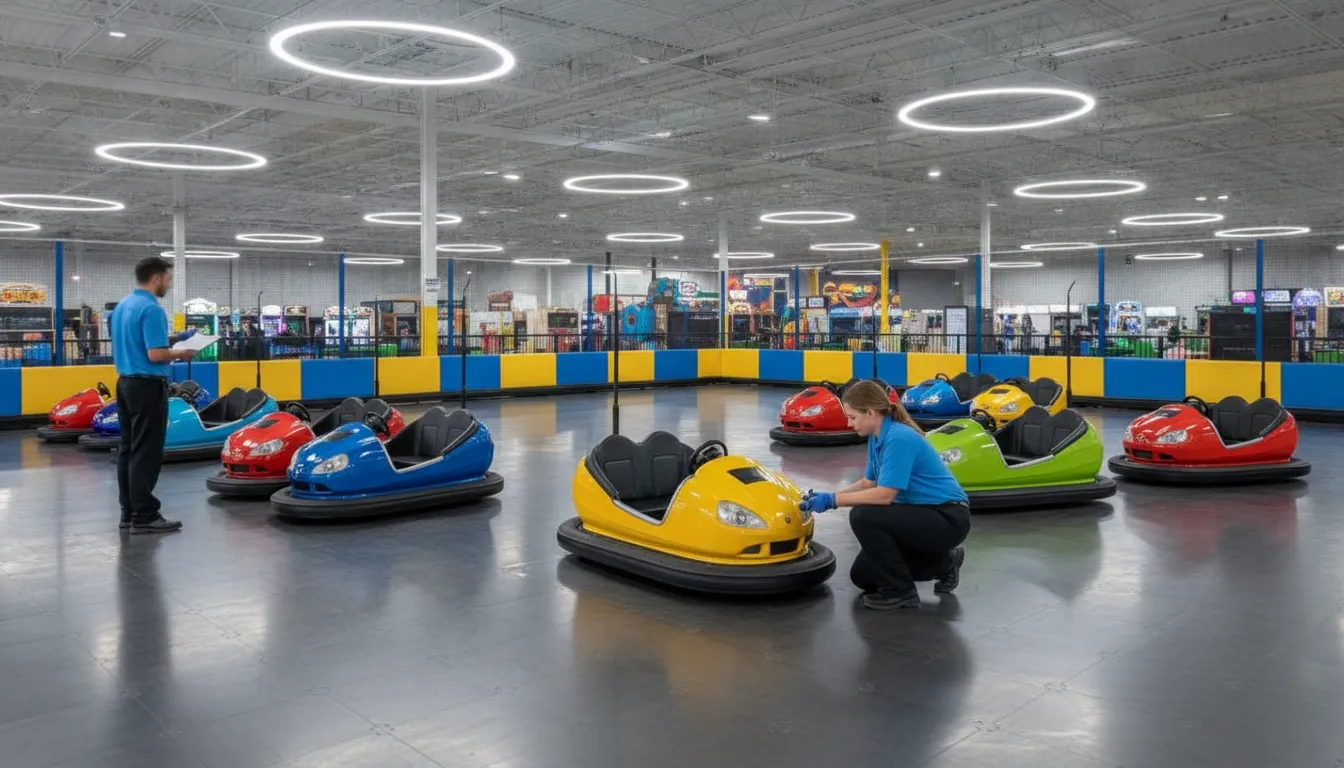
Owners should test the assumption against local demand, session design, staffing, downtime, maintenance, and their own financial model. For a deeper commercial comparison, see our bumper car attraction ROI comparison.
For the product details that inform an operating plan, review Spin Zone commercial bumper cars. Then compare the equipment requirements with the inspection route and arena plan in the Spin Zone guide for FEC operators. The right question is whether the system helps your team run a safe, repeatable attraction every day.
Request a design consultation to plan staffing, layout, and attraction operations.
FAQs About How to Operate Commercial Bumper Car Attractions
How do you safely operate a commercial bumper car attraction?
Use the manufacturer’s operating procedures, schedule the required trained staff, and complete a documented pre-open inspection. Communicate rider restrictions, observe the full arena, and follow a defined stop and incident-response procedure. Local rules and the equipment manual control the final details.
What training is required for bumper car ride operators?
Operators should be trained on the attraction manual, controls, loading and rider screening, observation, emergency stop and recovery, communication, and incident documentation. Use supervised practice and a manager sign-off before independent operation. Refresh training after changes, incidents, or extended gaps.
How often should you inspect bumper car equipment?
Complete maintenance and operator inspections before opening each operating day, then follow the manufacturer’s schedule for additional checks. Document defects and do not dispatch the attraction when a safety-critical condition is unresolved.
How do you manage rider safety at a bumper car attraction?
Post clear instructions and restrictions at the entrance or loading area. Verify each rider’s approved requirements, check seating and restraints where applicable, explain the controls, and stop unsafe behavior. Keep the arena and loading zone under observation throughout every cycle.
How fast do commercial bumper cars go?
Speed varies by model, configuration, and the manufacturer’s operating settings. Do not use a generic speed range as an operating limit. Confirm the approved specification in the equipment documentation. Train operators to enforce the venue’s rules.
Plan a Safer, More Repeatable Attraction
Strong commercial bumper car operations connect equipment selection, arena design, staffing, training, inspections, and incident response. If you are developing a new attraction or improving an existing one, Amusement Products can help you evaluate operating requirements alongside the broader FEC plan.