An indoor go-kart facility can be an attractive FEC investment, but a compelling concept is not enough to secure capital. Investors and lenders need to see how the location, attraction mix, operating model, market demand, and financial assumptions work together to produce dependable returns.
Request FEC design and consultation services to pressure-test your facility concept before you finalize the plan.
An indoor go kart track business plan should explain the concept, target market, competition, site requirements, management team, marketing strategy, and equipment plan. It should also cover revenue model, operating costs, funding needs, cash flow, and break-even point, while showing why the selected attraction can operate safely, efficiently, and profitably year-round.
That means the plan should connect strategy to practical decisions, from selecting electric go-kart technology to documenting the assumptions behind capacity, pricing, utilization, maintenance, and staffing. For broader attraction planning, review Commercial Electric Go-Karts for Family Entertainment Centers: The Complete Guide. Start with the core elements lenders expect to find in a complete plan.
What Should an Indoor Go-Kart Track Business Plan Include?
A strong plan is more than a funding document. It serves as a practical roadmap for structuring, managing, and growing the facility while giving lenders and investors a clear basis for evaluating risk. The core sections should connect the market opportunity to the operating model and the numbers behind it.
Business description and positioning
Start with the company’s history, ownership, proposed location, hours of operation, and the purpose of the new facility. State the mission clearly, then explain the current proposal, including the customer experience and the role the track will play within the broader family entertainment center. If the facility is an expansion, distinguish existing revenue and accounting from projected performance.
Products, services, and market opportunity
Describe every planned revenue stream, not just racing sessions. Depending on the concept, that may include parties, group events, memberships, leagues, food and beverage, or other attractions. Explain the local target audience, geographic draw, demographics, competitors, and relevant industry trends. A feasibility or demographic study can help confirm that the proposed location and attraction mix match the market.
The marketing strategy should then show how the business will acquire and retain customers. Detail advertising, promotions, partnerships, sales outreach, and the channels that will support repeat visits. Position the facility around measurable value, such as throughput, guest experience, safety, and year-round availability. Selecting commercial electric go-kart technology may also support a clean indoor operating model. The plan should still explain the operational and financial implications rather than treating equipment as a generic line item.
Management, risk, and financial detail
Introduce the management team’s relevant experience, responsibilities, staffing approach, and decision-making structure. Include contingency plans for equipment downtime, staffing gaps, business interruptions, and cybersecurity risks. Finally, provide detailed financials: sources and uses of funds, equipment costs, revenue and expense assumptions, cash flow projections, income statements, balance sheets, and break-even analysis. Make each assumption transparent so a reviewer can test the model and understand what must be true for the project to succeed.
How Do You Build Financial Projections Lenders Will Trust?
A lender should be able to trace every major number in the plan from an explicit assumption to a documented financial statement. The financial section is not a hopeful sales forecast. It is the evidence that the facility can fund its build-out, operate responsibly, service debt, and reach profitability under realistic conditions.
Show where the money comes from and where it goes
Start with a clear source-and-uses schedule. Identify the proposed debt, owner equity, investor capital, and any other funding sources. Then match them to uses such as real estate, construction, track systems, electric karts, safety equipment, technology, pre-opening costs, and working capital. Include a capital equipment list that allows the underwriter to understand what is being purchased and why it is necessary to generate revenue. A well-equipped go-kart facility may require capital in the range of $500,000 to $2 million, depending on its size and location, so vague line items weaken credibility. Documented capital requirements give the lender a more useful basis for evaluating the request.
Build projections from operating assumptions
Provide monthly cash flow projections, income statements, and balance sheets, with the assumptions stated beside the model or in an accompanying schedule. Explain the drivers behind attendance, race or session revenue, parties and group events, ancillary sales, operating hours, staffing, maintenance, utilities, insurance, rent, debt service, and other expenses. The plan should also include a marketing and acquisition strategy covering advertising, promotion, and sales. Treat those costs as part of the operating model, not as an afterthought. A lender needs to see how the facility will attract first-time guests, generate repeat visits, and manage acquisition costs as it builds a customer base. The business-plan financial framework specifically calls for a basis, assumptions, and detailed financial analysis.
Make break-even measurable
Break-even analysis should translate fixed and variable costs into the minimum sales volume required to cover operations. Show the relationship between capacity, utilization, average transaction value, and contribution margin, then identify which assumptions have the greatest effect on the result. Indoor electric venues can support a year-round operating model because they are not dependent on mild outdoor weather. Which may improve revenue consistency when supported by credible demand and scheduling assumptions. Do not present that stability as guaranteed performance. Connect it to the chosen market, facility hours, programming, and marketing plan. The resulting model should let lenders test downside cases and understand exactly what must be true for the project to remain viable.
Equipment Specifications and Manufacturer Selection
Choose the operating model before specifying equipment. An indoor, outdoor, or hybrid go-kart business has different real-estate, seasonality, layout, and capital requirements. So this decision should appear early in the plan rather than after the equipment list. A hybrid model may broaden the operating calendar, while an indoor model can prioritize controlled conditions and consistent scheduling. The right choice depends on the site, local demand, climate, and the experience the facility intends to deliver.
| Factor | Indoor electric track | Outdoor track |
|---|---|---|
| Operating season. | Year-round in any climate. | Often seasonal and weather-dependent. |
| Real estate. | Higher cost per square foot, warehouse constraints. | Lower land costs, more acreage required. |
| Track length. | Typically 300 to 500 meters indoors. | Longer, more varied layouts. |
| Ventilation and fumes. | Clean operation with electric karts, minimal exhaust needs. | Open air, fewer ventilation constraints. |
| Guest experience. | Controlled conditions with premium pricing potential. | Motorsport feel but weather exposure. |
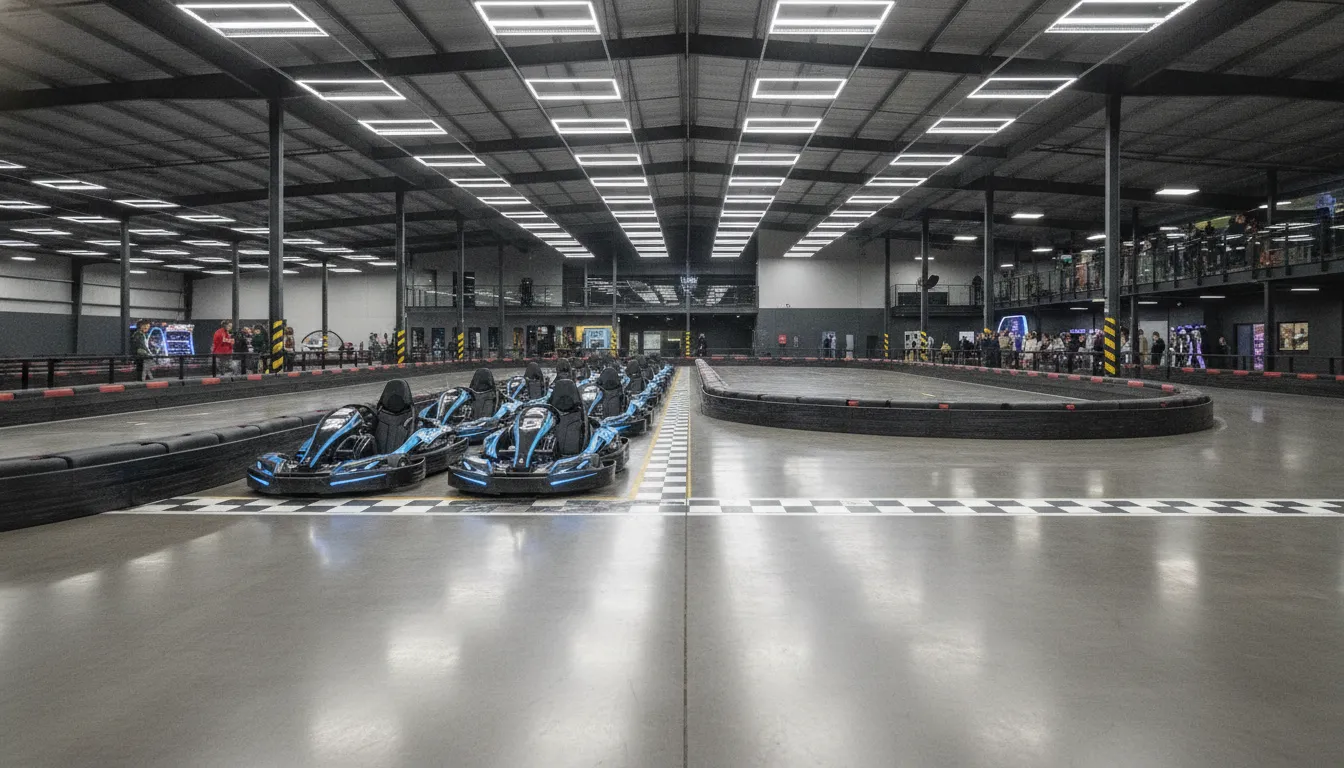
For an indoor venue, document the physical constraints that will shape the fleet and track design. Warehouse ceiling height, usable square footage, access points, columns, spectator areas, loading requirements, and higher real-estate costs all affect feasibility. Indoor tracks commonly work within layouts of approximately 300 to 500 meters, making efficient circulation and queue management essential. These constraints should be tested against a scaled plan before a lease is finalized, not treated as details to resolve during installation. Industry guidance on electric go-kart facilities identifies ceiling height, real estate, and track length as central indoor planning tradeoffs.
Match the power system to the revenue model
Electric karts can support year-round indoor operation without the exhaust and costly ventilation systems associated with gas-powered fleets. That can expand site options and simplify the guest environment, but the plan should still specify charging strategy. Power requirements, fleet availability, maintenance procedures, and how downtime will be managed. A lender should be able to see how the power system supports throughput, safety, operating hours, and projected revenue rather than viewing it as a standalone equipment purchase.
Indoor facilities may also command premium pricing when customers value a clean, controlled, and quieter experience. Support that assumption with local competitor research and a clear explanation of the experience, capacity, and ancillary sales that justify the price. Avoid presenting premium pricing as automatic; connect it to measurable guest value and realistic utilization.
Evaluate the manufacturer as a project partner
Manufacturer diligence should cover safety systems, kart control, service support, replacement parts, training, integration, and experience delivering comparable venues. Review documented go-kart track installations and ask how the proposed fleet will perform within the actual site plan. Amusement Products’ electric go-kart technology and ThunderVolt Electric Operating System illustrate the level of technical specificity lenders reward: the business plan connects a defined system to safety. Control, operating efficiency, and revenue generation. For a deeper look at how commercial electric kart fleets are specified for family entertainment centers, see the complete guide to commercial electric go-karts for FECs. A manufacturer that can contribute to layout and project planning gives the lender more than a product quote. It provides evidence that the equipment selection is workable in the proposed facility.
Get a custom FEC equipment and layout consultation to plan the details lenders will question.
Market Analysis: How to Size the Local FEC Opportunity
A lender needs more than evidence that go-karting is popular. The plan must show that a specific market can support this facility, at this location, with this mix of attractions, operating schedule, and pricing model. Start with industry direction, then narrow the analysis to the customers and competitive conditions within a realistic drive time.
Begin with the industry, then define the target market
Market research should cover industry trends, the target audience, and local economics, including geography, population, demographics, and competition. The U.S. go-kart market is reported to be growing at approximately 5.7% and generating more than $120 million in annual revenue. Separate industry research projects the indoor karting market to increase from $1.5 billion to $3.0 billion by 2033, with electric kart technology supporting that expansion. These figures establish category momentum, but they do not substitute for local evidence.
Identify the customers most likely to visit repeatedly and the occasions that drive visits: family outings, birthday parties, corporate events, youth activities, and competitive racing. Map household counts, age distribution, income levels, tourism, employment centers, schools, hotels, and seasonal traffic. Then inventory nearby FECs, kart tracks, bowling centers, arcades, sports venues, and other attractions. Compare their location, capacity, hours, experiences, reviews, and apparent gaps. Sources: market-analysis guidance from Delaware SBDC and U.S. go-kart market research.
Turn demographics into a feasibility case
A feasibility and demographic study should test whether the proposed trade area contains enough qualified demand to fill sessions beyond peak weekends. Estimate visits by customer segment, account for competitor share and seasonality, and stress-test the model against conservative attendance assumptions. The analysis should also explain why the selected indoor, outdoor, or hybrid model fits the climate, real estate, and local customer base.
For lenders, the strongest conclusion connects evidence to decisions: why this geography, why this site, why this attraction mix, and how the facility can generate dependable year-round demand. A qualified partner can help translate those findings into a workable facility concept through FEC design and consultation services.
Operational Plan: Staffing, Hours, and Maintenance Schedules
Lenders want to see how the attraction will operate on an ordinary weekday, a peak weekend, and during an unexpected disruption. Your operational plan should connect staffing, hours, supplies, equipment upkeep, and management accountability to the revenue assumptions in the financial model. The Small Business Development Center business plan template specifically calls for inventory, supplies, equipment, maintenance, and personnel requirements, rather than treating operations as an afterthought. Review the operational planning framework used in that template.
Define the staffing model and management controls
Describe who opens and closes the facility, supervises the track, and manages guest flow. Also define who handles admissions or party bookings, performs basic inspections, and responds to incidents. Then identify the leadership structure, employee policies, contingency coverage, and decision rights. A lender should be able to see how the business maintains safe, consistent service when a manager is absent or demand changes.
Document the assumptions behind operating hours and staffing levels. Include training, shift handoffs, peak-period coverage, and the process for adjusting labor as reservations, walk-in traffic, school groups, or corporate events change. The management section should demonstrate governance, not simply list job titles. It should also explain how customer data, point-of-sale systems, and other operating systems are protected.
Build maintenance into the operating calendar
Inventory and maintenance schedules should cover the fleet, charging equipment, safety systems, track barriers, timing technology, tools, cleaning supplies, and replacement parts. Electric fleets can simplify facility operations by eliminating fuel storage, fuel handling, and exhaust management. They also support a lower-maintenance operating model when inspections, charging, cleaning, and preventative service are scheduled consistently. Review electric go-kart technology as you document the equipment assumptions behind the plan.
- At opening: Complete a documented safety and equipment inspection, confirm charge levels, and verify the track and guest systems are ready.
- During operation: Log issues as they occur, remove questionable equipment from service, and assign responsibility for corrective action.
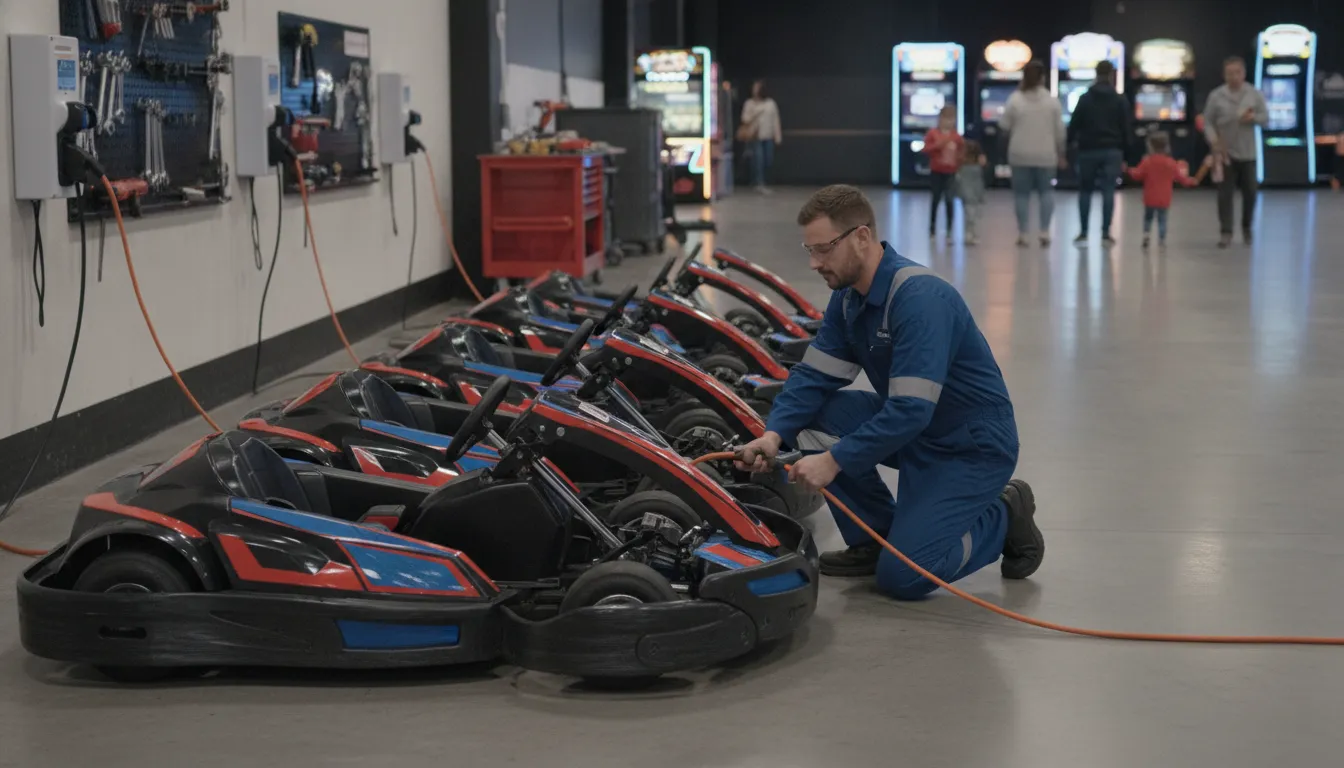
- At closing: Clean and inspect the fleet, connect equipment to its charging process, reconcile supplies, and record unresolved work.
- On a recurring cycle: Schedule preventative maintenance, review failure patterns, and reserve downtime before a minor issue affects capacity.
This predictability protects equipment ROI by preserving availability and reducing avoidable interruptions to paid sessions. Finally, treat the plan as a roadmap, not a fixed document. Revisit it as consumer behavior changes, new technology becomes available, and the facility adds attractions or adjusts its hours. That adaptability gives lenders a clearer view of how management will protect performance beyond the opening year.
How Do You Justify an Indoor Go-Kart Track Business Plan to Lenders?
Lenders underwrite cash flow, not concepts. The quickest way to strengthen your case is to connect every major claim in the plan to a documented assumption, a realistic cost, and a defensible market. A feasibility or demographic study, a detailed capital equipment list, and conservative break-even analysis all give an underwriter a basis for approving the request. Request FEC design and consultation services to translate your operating model into lender-ready projections.
Frequently Asked Questions
What are the typical startup costs for an indoor go-kart track?
A well-equipped facility may require approximately $500,000 to $2 million in capital, depending on its size and location. Your plan should replace this broad range with a detailed equipment list, facility costs, construction allowances, working capital needs, and clearly documented sources and uses of funds. Industry planning guidance provides the cited range, but local feasibility work should drive your actual model.
Is an indoor go-kart track a profitable business model?
It can be, but profitability depends on demand, utilization, pricing, operating costs, and disciplined execution. Indoor facilities can support year-round operations and may command premium pricing because they provide a controlled, clean environment. Show lenders how those advantages translate into realistic attendance, revenue per guest, repeat visits, and break-even timing rather than presenting profitability as a guarantee.
What is the biggest advantage of electric karts for indoor facilities?
Electric karts eliminate exhaust fumes, allowing facilities to operate indoors without the ventilation systems typically associated with gas karts. They can also support year-round operation in different climates. Your plan should connect the equipment choice to facility requirements, guest experience, maintenance assumptions, safety procedures, and projected operating efficiency. Industry research on electric kart facilities supports these operational benefits.
What should be evaluated before choosing warehouse space?
Evaluate ceiling height, usable floor area, access, utilities, parking, zoning, occupancy requirements, and the layout needed for the track, queue, pit, viewing areas, party rooms, and support spaces. Indoor tracks commonly face space and layout constraints, with cited track lengths often ranging from 300 to 500 meters. Include a preliminary facility plan and explain how the site supports safe throughput and future revenue expansion.
Ready to Turn Your Plan Into a Facility?
A well-developed business plan is the starting point for making informed decisions about your indoor go-kart track, from equipment selection to facility layout. When you are ready to move from projections to implementation, request FEC design and consultation services from Amusement Products. Our team can help you evaluate the practical requirements of a revenue-generating attraction and shape the next stage of your project.