Choosing karts for an indoor family entertainment center is an operating decision, not simply an equipment purchase. The right fleet must fit the track footprint, support consistent guest throughput, simplify daily supervision, and hold up through sustained commercial use. Electric power is especially well suited to indoor venues because it reduces emissions and maintenance demands while supporting precise control.
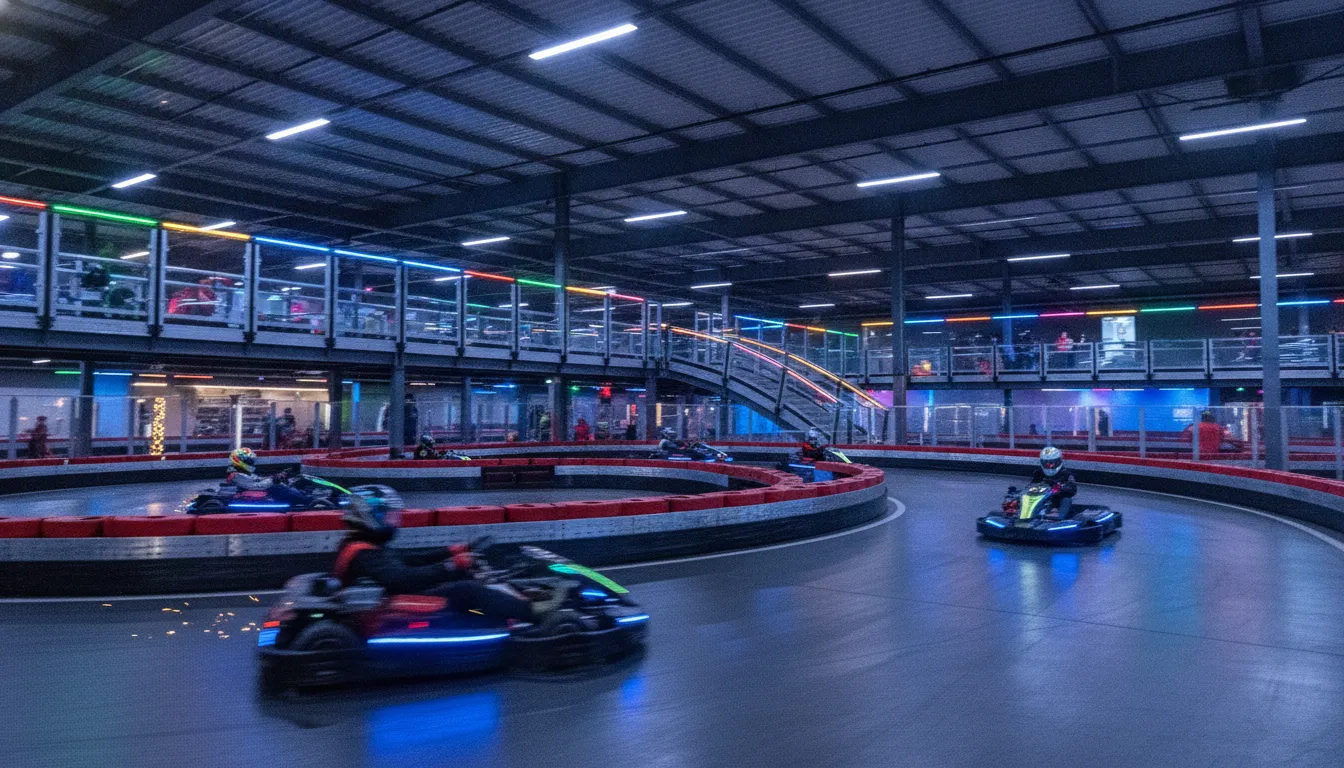
The best electric go karts for indoor fec are commercial models matched to the venue’s track design, operating volume, safety requirements, charging plan, and revenue goals. Buyers should compare the complete operating system, not just top speed or the kart body, including fleet management, serviceability, battery strategy, and manufacturer support.
Amusement Products brings more than 60 years of FEC equipment experience and manufactures solutions in the USA. Its electric go-kart offering uses ThunderVolt Electric Operating System and Power Up Karting technology to help operators build a controlled, durable attraction. For broader planning context, review this guide to commercial electric go-karts. The comparison begins with the operational criteria that separate a compelling fleet from an expensive mismatch.
Key Criteria for Evaluating Commercial Electric Go-Karts
Choosing an indoor fleet requires more than comparing top speed. The right commercial electric go-karts should support safe, consistent throughput while fitting the track, charging plan, staffing model, and long-term revenue goals of the FEC.
Evaluate the motor and control platform
Start with the motor’s control, torque delivery, and adjustability rather than horsepower alone. Operators need predictable acceleration and responsive handling across a wide range of guest experience levels. An integrated platform such as the ThunderVolt Electric Operating System can coordinate kart performance and operating controls, helping the attraction team manage a consistent ride experience. Review the electric go-kart operating system to understand how the platform fits into fleet operations.
Plan the battery system around daily throughput
Battery capacity is only one part of the decision. Ask how the fleet will be charged between heats, where charging equipment will be located, and whether the electrical infrastructure can support peak operating periods. A practical plan should account for shift changes, downtime, battery health, and future fleet additions. The objective is dependable availability throughout the operating day, not simply a strong specification on a product sheet.
Verify safety standards and indoor compatibility
Safety documentation should be part of the purchasing process. The U.S. Consumer Product Safety Commission notes that there is no mandatory CPSC standard for fun-karts. While ASTM F2011 is a recognized voluntary standard representing industry best practices for safety and performance. Review the standard and the manufacturer’s documentation directly through the CPSC fun-carts and go-karts guidance. Also evaluate speed controls, braking, operator visibility, restraint design, and track compatibility.
For indoor venues, zero tailpipe emissions and quiet operation are important practical advantages. They support a more comfortable guest environment and simplify integration with other attractions, subject to the facility’s ventilation, electrical, and fire-safety requirements.
Compare maintenance and fleet scalability
Maintenance affects both operating cost and revenue availability. Prioritize durable components, accessible service points, clear diagnostics, and a support process that reduces out-of-service time. FEC operators should also assess whether the manufacturer can supply compatible units as demand grows, preserve consistent controls across the fleet, and support track changes. Safety, durability, and ease of maintenance are central to maximizing ROI, not secondary considerations.
The Best Electric Go Karts for Indoor FEC Venues
The right kart depends on the track’s available floor space, expected throughput, rider profile, and operating strategy. Amusement Products offers eight electric go-kart models across five series, giving FEC owners room to match equipment to the attraction rather than forcing every venue into one specification. The comparison below highlights the primary models to evaluate for an indoor installation.
| Model | Best fit | Key positioning | Operational focus |
|---|---|---|---|
| Megavolt GT | New indoor attractions seeking a current flagship platform | Latest model with a laser-cut steel frame | Evaluate layout, durability requirements, and desired ride profile during design |
| Model E | Tracks where acceleration and performance are central to the guest experience | 20hp-equivalent power, speeds above 50 mph, and strong torque | Match performance to the track design, rider controls, and operating policies |
| Lightning | Operators prioritizing a fast, agile karting experience | Designed around speed and maneuverability | Consider cornering demands, marshal visibility, and expected session cadence |
| Stockart | High-volume venues that need a durable workhorse | Built for consistent commercial use and high operating volume | Prioritize service access, fleet uniformity, and efficient daily checks |
| Eco-Racer Deluxe | FECs seeking a value-driven entry into electric karting | Accessible starting point for a commercial electric kart attraction | Balance initial equipment selection with future expansion plans |
| BIZ Karts electric range | Buyers comparing an established UK-based alternative | Basic electric kart lineup with limited publicly presented specifications | Request detailed technical, service, and integration information before purchase |
| Blue Shock Race BSR leisure kart | Operators considering a leisure-kart or franchise-oriented model | Quick battery-swapping approach and franchise model positioning | Assess battery workflow, local support, and brand fit for the venue |
Amusement Products Model Lineup
Amusement Products’ range lets buyers compare performance-oriented, high-volume, and value-focused options within one US-based supplier relationship. The lineup is powered by the ThunderVolt Electric Operating System and Power Up Karting technology, which are designed to support control, safety, and consistent performance in indoor environments. That system-level approach matters because the kart is only one part of the attraction. Charging, controls, track configuration, maintenance access, and guest throughput all influence revenue potential.
For a complete equipment review, start with the Amusement Products electric go-karts lineup, then ask the design team to model the fleet against your building and operating goals. A venue planning for sustained volume may favor Stockart, while a performance-led concept may warrant Model E or Megavolt GT. The best selection is the one that fits the complete FEC operating plan.
Speed, Safety, and Battery Life: How the Leading Brands Compare
For an indoor FEC, kart performance is not just a question of top speed. Operators also need predictable control, manageable charging cycles, and safety systems that support consistent throughput. The strongest choice depends on how those factors work together across your track layout, audience, and operating model.
Model E: broad performance with configurable control
Amusement Products Model E is designed for venues that need more than a limited children’s kart. Its motor delivers the equivalent of 20 horsepower, with speeds above 50 mph when the track and operating plan support that level of performance. Four selectable speed modes, Rookie, Novice, Family, and Competition, let operators adjust the experience for different driver groups without changing the fleet.
That range can be valuable in an indoor FEC. A family session may call for a conservative setting, while experienced drivers can be placed in a more demanding mode under the facility’s operating rules. The result is a kart that can serve multiple customer segments while giving staff a practical way to manage speed.
Safety is a system, not a single specification
Speed must be matched by deliberate engineering and operating procedures. Model E includes bumpers, speed control, and compliance with ASTM F2011, a recognized voluntary industry standard for fun-karts. The U.S. Consumer Product Safety Commission notes that there is no mandatory federal CPSC standard for fun-karts, making documented best practices and venue-specific controls especially important.
Operators evaluating a fleet should review how the kart, track barriers, controls, and staff procedures work together. Our guide to go-kart safety systems covers the broader safety technologies commercial tracks should consider.
Battery management separates commercial fleets
Battery life is operational capacity. Charging access, session scheduling, battery monitoring, and maintenance planning all affect how many karts can remain available during a busy day. Model E uses the ThunderVolt battery management approach to support controlled electric-kart operation, rather than treating the battery as a separate component that staff must manage by guesswork.
BIZ Karts generally presents a stronger kids-focused positioning with a more limited speed range. Blue Shock Race emphasizes a leisure kart and a plug-and-play battery swap approach, stating that its power unit can fit a standard racing chassis in 30 minutes. That simplicity may appeal to a venue prioritizing straightforward replacement. While Model E is better suited to operators comparing configurable speed, commercial safety controls, and fleet-level management in one platform.
Total Cost of Ownership Comparison Over 3 Years
The purchase price is only the first line in an indoor go-kart fleet budget. A useful three-year comparison should include energy, scheduled service, replacement parts, labor, charging infrastructure, and the operational disruption caused by maintenance. Electric fleets typically require a larger planning conversation upfront, but their day-to-day cost structure is often more predictable than gas alternatives.
Upfront investment versus operating expense
Gas karts may appear less expensive at purchase, while electric karts require investment in chargers, electrical capacity, and fleet configuration. Charging infrastructure should be priced into the project from the beginning rather than treated as an afterthought. The right design depends on fleet size, operating hours, charging windows, and the track’s available power.
Electric karts do not require gasoline, so operators avoid the recurring fuel expense associated with gas fleets. They also eliminate many engine-related service items. Fewer moving parts can mean fewer oil changes, exhaust-related components, and combustion-system repairs, which helps reduce both parts consumption and maintenance interruptions.
Maintenance and labor savings
For operators evaluating ThunderVolt-equipped fleets, the documented comparison indicates mechanic and labor savings approaching $35,000 annually versus gas karts. Over three years, that represents as much as $105,000 in potential labor and maintenance savings before accounting for fuel, downtime, or changes in utilization. Actual results depend on fleet size, operating schedule, service practices, and local labor rates. So this figure should be used as a planning benchmark rather than a guaranteed return.
Battery replacement also belongs in the model. Battery life depends on chemistry, duty cycle, charging practices, temperature, and fleet management. Ask each manufacturer for the expected replacement cycle, replacement cost, warranty coverage, and recommended charging procedure. A lower initial quote can lose its advantage if parts, technical support, or battery logistics are difficult to secure in North America. For example, BIZ Karts may present a lower upfront price, but buyers should evaluate the practical availability of regional support before comparing totals.
For a broader operating comparison, review electric go-karts alongside your own fleet size, energy rates, labor costs, and projected operating hours. Amusement Products brings more than 60 years of US-based FEC equipment experience to that planning process. Helping operators compare the full cost of ownership instead of selecting on purchase price alone.
Why Amusement Products Electric Karts Lead the Category
For indoor FEC operators, the strongest karting partner brings more than a vehicle. Amusement Products has spent more than 60 years manufacturing, operating, and designing attractions in the USA. Giving operators a partner that understands the equipment, the guest experience, and the business behind the track. That depth matters when the goal is a reliable, revenue-generating attraction rather than a one-time equipment purchase.
A complete electric karting platform
Amusement Products electric karts are powered by the ThunderVolt Electric Operating System, an IAAPA award-winning technology designed to deliver controlled, efficient performance for commercial environments. Power Up Karting adds gamification technology that helps turn each race into a more engaging, repeatable guest experience. Together, these systems support the operational priorities indoor venues care about: consistent performance, easier management, strong throughput, and an attraction guests want to experience again.
Operators evaluating the commercial electric go-karts category should also look beyond the kart itself. Amusement Products can support the broader project through equipment selection, track planning, and construction with Amusement Construction Co. The FEC Success Institute extends that support through education, helping owners and teams build the operational knowledge required to run an attraction effectively.
Experience backed by recognized innovation
With five IAAPA awards recognizing its work, Amusement Products combines long-term manufacturing experience with ongoing product development. That combination distinguishes a comprehensive FEC partner from a company focused on a single kart or a narrow equipment sale. From initial concept through construction, training, and day-to-day operation, the objective is to align the attraction with the facility’s floor plan, audience, safety priorities, and revenue goals.
For owners comparing the best electric go karts for indoor FEC venues, the meaningful question is not simply which model looks fastest. It is which partner can help make the entire attraction perform. Amusement Products brings that end-to-end perspective to every project.
Frequently Asked Questions
What factors should an FEC operator consider when choosing indoor electric go-karts?
Evaluate the complete operating system, not just the kart shell. Compare safety controls, durability, charging and battery management, maintenance access, guest throughput, floor-space requirements, and compatibility with your track design. The right fleet should support reliable daily operation while helping the attraction generate revenue.
Are electric go-karts worth the investment for indoor FECs?
They can be, particularly when an operator values quiet operation, lower emissions, and a simpler indoor operating environment. The investment should be assessed against expected throughput, staffing, maintenance, charging infrastructure, available floor space, and the attraction’s revenue model. A complete facility design review is more useful than comparing purchase price alone.
What safety features should indoor commercial go-karts have?
Look for responsive speed control, dependable braking, durable construction, and fleet-level systems that help operators manage the ride consistently. Operators should also review applicable local requirements and recognized industry guidance. The U.S. Consumer Product Safety Commission identifies ASTM F2011 as a voluntary industry standard for fun-kart safety and performance, while noting that no mandatory CPSC standard applies specifically to fun-karts: CPSC fun-kart guidance.
How do you manage battery life for an indoor electric go-kart fleet?
Plan charging capacity and operating schedules before selecting the fleet. Battery management should account for ride volume, turnaround time, charging locations, and routine inspection. A supplier should help match the electrical and charging infrastructure to the track’s expected throughput so the fleet remains available during peak operating periods.
Ready to Plan Your Indoor Electric Go-Kart Fleet?
The right fleet should fit your track, operating goals, and long-term maintenance priorities. Amusement Products can help you evaluate the practical considerations for your indoor FEC and identify an equipment approach that supports a strong guest experience. Contact us to speak with our design consultants about your project and next steps.